


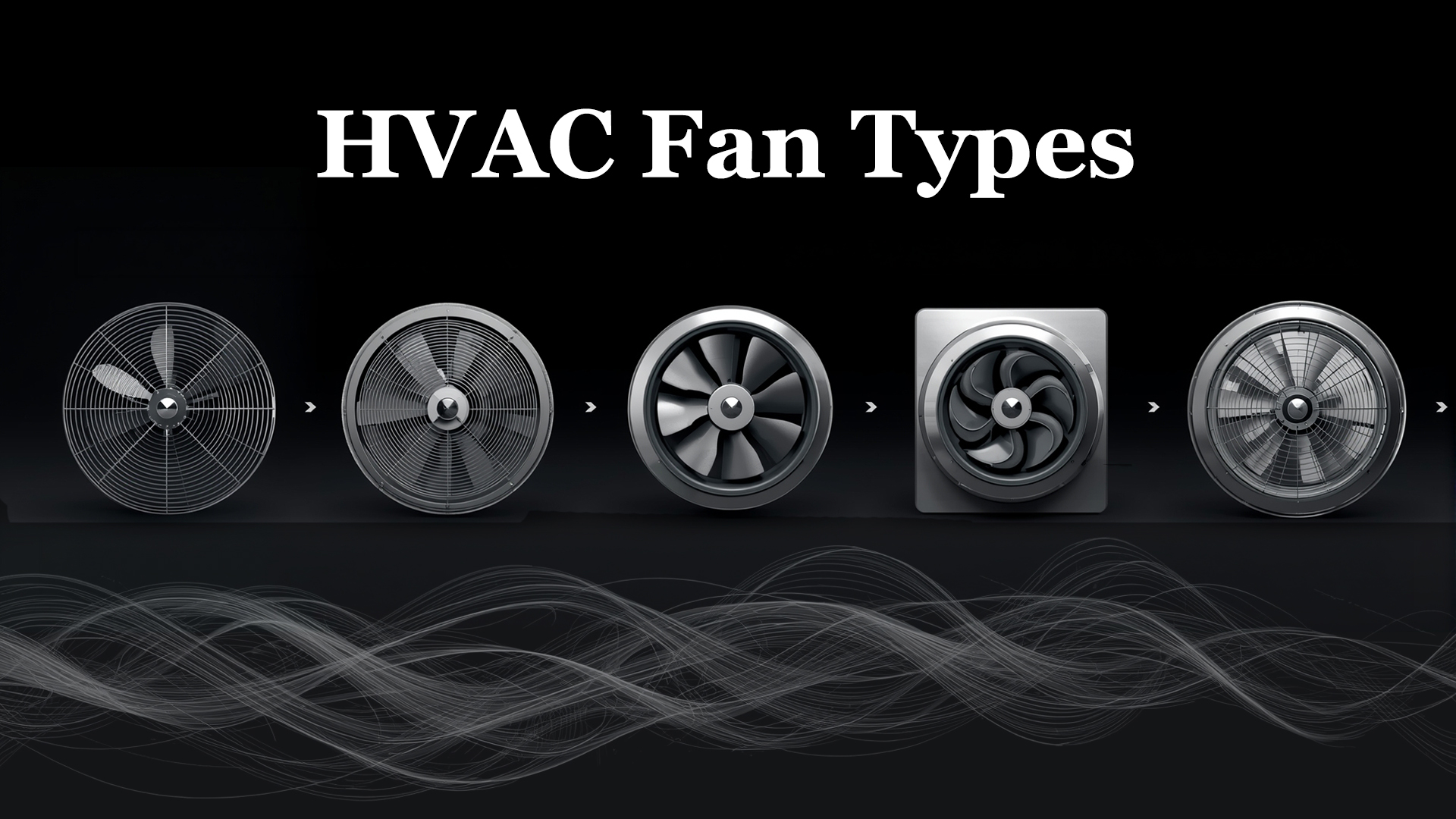
Introduction: Why HVAC Fans Matter More Than You Think
If you don’t understand HVAC fans, you don’t understand airflow.
And airflow is the foundation of every HVAC system—whether it’s a rooftop unit serving an office building, an air handler in a hospital, a warehouse exhaust system, or a mission-critical data center.
Fans are what actually move the air. They determine how much air flows, how far it travels, how efficiently the system operates, and whether the system performs as designed.
Yet, many people in the HVAC industry only recognize fans by how they look—not how they perform.
This article will give you a clear, structured understanding of the most common HVAC fan types, how they work, and where they are used—without overwhelming you with unnecessary detail. Each fan type will be expanded further in dedicated articles within this series.
What Is an HVAC Fan?
An HVAC fan is a mechanical device used to move air through a system. It converts mechanical energy from a motor into airflow.
In practical terms, fans are responsible for:
- Supplying conditioned air to spaces
- Returning air back to equipment
- Exhausting air from buildings
- Moving air across coils for heating or cooling
- Ventilating industrial and commercial environments
Every HVAC system—no matter how simple or complex—relies on fans to function.
The Two Main Categories of HVAC Fans
All HVAC fans fall into two primary categories:
1. Axial Fans
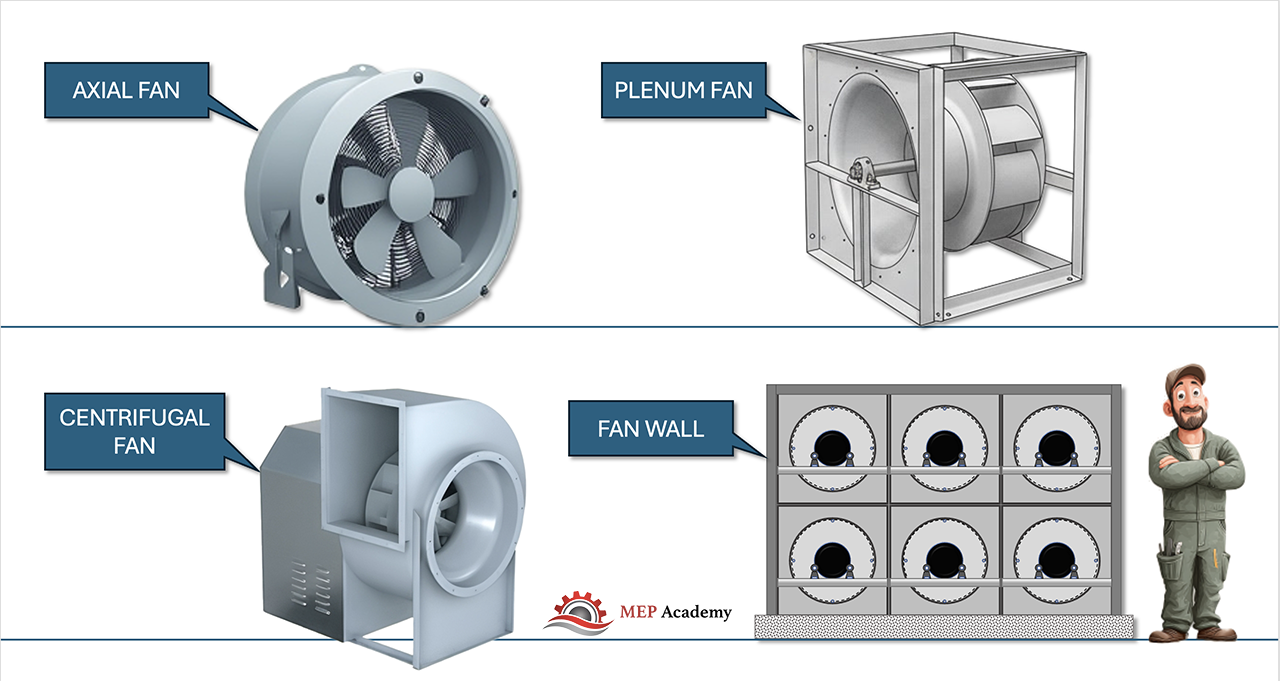
Axial fans move air in a straight line, parallel to the shaft of the fan.
Think of a propeller pushing air forward.
These fans are typically used when:
- High airflow is required
- Static pressure is low to moderate
- Air moves over short distances or through minimal resistance
However, not all axial fans perform the same. There are several subtypes:
- Propeller fans (very low pressure applications)
- Tube axial fans (moderate pressure, ducted systems)
- Vane axial fans (higher pressure, with guide vanes to straighten airflow)
This distinction is critical, especially when evaluating system performance or reading plans.
2. Centrifugal Fans
Centrifugal fans move air differently.
Air enters the fan at the center and is discharged at a 90-degree angle through a scroll housing.
This design allows centrifugal fans to generate higher static pressure, making them ideal for:
- Ducted HVAC systems
- Air handling units (AHUs)
- Variable air volume (VAV) systems
- Commercial and industrial applications
There are several types of centrifugal fans, including:
- Forward-curved fans (high airflow, lower pressure)
- Backward-inclined fans (higher efficiency, higher pressure capability)
- Airfoil fans (most efficient, used in high-performance systems)
Centrifugal fans are the backbone of most commercial HVAC systems.
Plenum Fans and Fan Arrays
Plenum fans are a specialized type of centrifugal fan.
Unlike traditional centrifugal fans, plenum fans:
- Do not use a scroll housing
- Discharge air directly into a plenum space
- Are typically direct-drive
This design provides:
- Greater flexibility in air distribution
- Reduced duct transitions
- Improved system efficiency in certain applications
Fan Arrays (Fan Walls)
“In larger systems, especially in data centers, engineers often arrange plenum fans in groups called fan arrays or fan walls.”
Instead of one large fan, multiple smaller fans operate together.
This offers several advantages:
- Redundancy (system continues operating if one fan fails)
- Improved energy efficiency
- Easier maintenance and replacement
Fan arrays are increasingly common in high-performance and mission-critical environments.
Propeller Fans (Wall and Exhaust Applications)
Propeller fans are the simplest form of axial fan.
They are commonly used in:
- Wall exhaust fans
- Warehouse ventilation
- Agricultural buildings
- Garage ventilation systems
These fans are:
- Cost-effective
- Easy to install
- Designed for low-pressure applications
However, their performance drops quickly when ductwork or resistance is introduced.
Inline and Duct Fans
Inline fans are installed directly within duct systems.
They can be:
- Axial (tube axial style)
- Centrifugal (more common for duct applications)
Contractors typically use these fans when:
- Space is limited
- Air needs to move through long duct runs
- A system requires additional airflow in specific sections
Inline fans are common in both commercial and residential applications.
How to Identify Fan Types in the Field or on Plans
One of the most valuable skills in HVAC is quickly identifying fan types.
Here are simple rules you can use:
- Air moves straight through → Axial fan
- Air turns 90 degrees → Centrifugal fan
- No housing, open discharge → Plenum fan
- Multiple small fans in a grid → Fan array / fan wall
- Wall-mounted propeller → Exhaust fan
These visual cues can help you interpret plans, understand systems, and communicate more effectively with your team.
Why Fan Selection Matters
Fan selection is not just a design detail—it impacts the entire system.
Choosing the wrong fan can affect:
- Airflow delivery
- Energy consumption
- Noise levels
- System reliability
- Installation complexity
- Project cost
For example:
- An axial fan used where high pressure is required may fail to deliver airflow
- An oversized centrifugal fan may increase energy usage unnecessarily
- Improper fan selection can lead to balancing issues and poor system performance
For estimators, this impacts pricing.
And for project managers, this impacts execution.
For designers, this impacts system performance.
Where HVAC Fans Are Used
Fans are used across nearly every type of HVAC system, including:
- Rooftop units (RTUs)
- Air handling units (AHUs)
- Exhaust systems (restrooms, kitchens, garages)
- Industrial ventilation systems
- Data center cooling systems
- Agricultural and warehouse ventilation
Understanding where each fan type is used helps you connect equipment to real-world applications.
What’s Next in This Series
This article is part of a complete HVAC Fan Training Series designed to take you from basic understanding to real-world application.
Upcoming articles and videos will cover:
- Axial Fans Explained (Propeller, Tube Axial, Vane Axial)
- Centrifugal Fans Explained (Forward Curved vs Backward Inclined vs Airfoil)
- Plenum Fans vs Housed Fans
- Fan Performance (CFM, Static Pressure, Fan Curves)
- How to Read a Fan Curve
- Fan Selection Basics
- Real-World Applications and Case Studies
Each topic will build on this foundation.
Final Thoughts
HVAC fans are one of the most fundamental — but often misunderstood — components in mechanical systems.
When you understand how different fan types work, where they are used, and how they perform, you gain a significant advantage in:
- Reading plans
- Estimating projects
- Managing installations
- Troubleshooting systems
This knowledge is not just theoretical—it directly impacts real-world outcomes.
Learn More
If you want to go deeper into HVAC systems, estimating, and real-world applications, explore our full training resources:
- 👉 HVAC Training & Courses: https://courses.mepacademy.com
- 👉 Estimating Spreadsheets & Tools: https://mepacademy.gumroad.com
Related Articles
- Axial Fans Explained (Coming Soon)
- Centrifugal Fans Explained (Coming Soon)
- Fan Performance and Fan Curves (Coming Soon)