


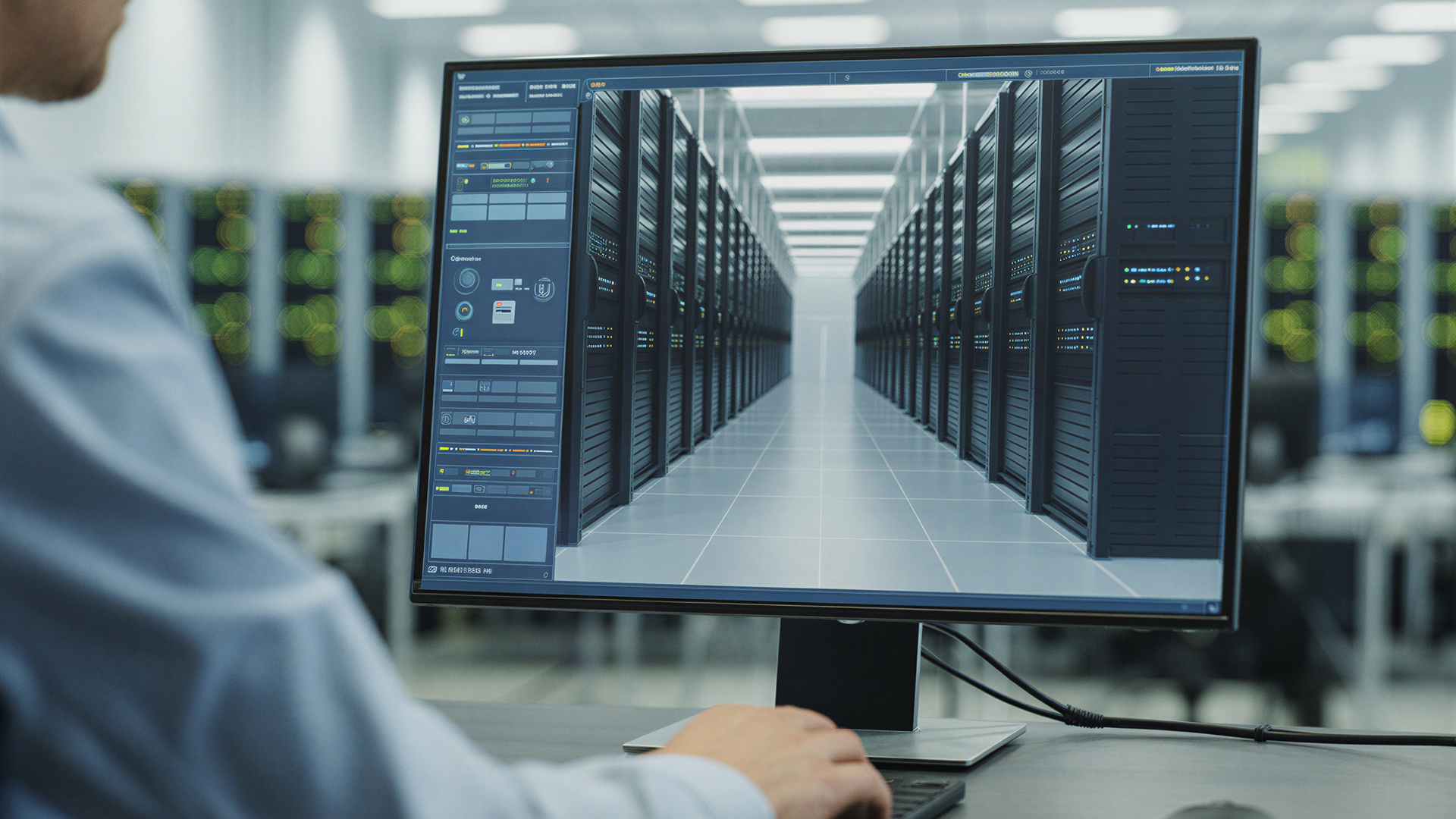
Data centers don’t fail because of power first—they fail because of heat. Behind every high-performing data center is a cooling system working continuously to remove enormous amounts of heat generated by servers. While airflow strategies like hot aisle and cold aisle containment help manage that heat, the real work of removing it from the building is handled by the chilled water system.
In this guide, we’ll break down how chilled water systems work in data centers, how they integrate with other infrastructure systems, and why they are the preferred solution for large-scale, high-density facilities.
Watch the Full Video Explanation
Why Cooling is Critical in Data Centers
Every server, switch, and piece of IT equipment generates heat during operation. In modern facilities—especially those supporting cloud computing and AI workloads—heat loads can reach tens of megawatts.
Unlike commercial buildings, data centers have:
- No tolerance for downtime
- Strict temperature and humidity requirements
- Continuous 24/7 operation
If heat is not removed effectively, the consequences can include:
- Thermal throttling of equipment
- Reduced hardware lifespan
- System shutdowns
- Complete operational failure
This is why cooling systems are designed with the same level of redundancy and reliability as electrical systems.
What is a Chilled Water System?
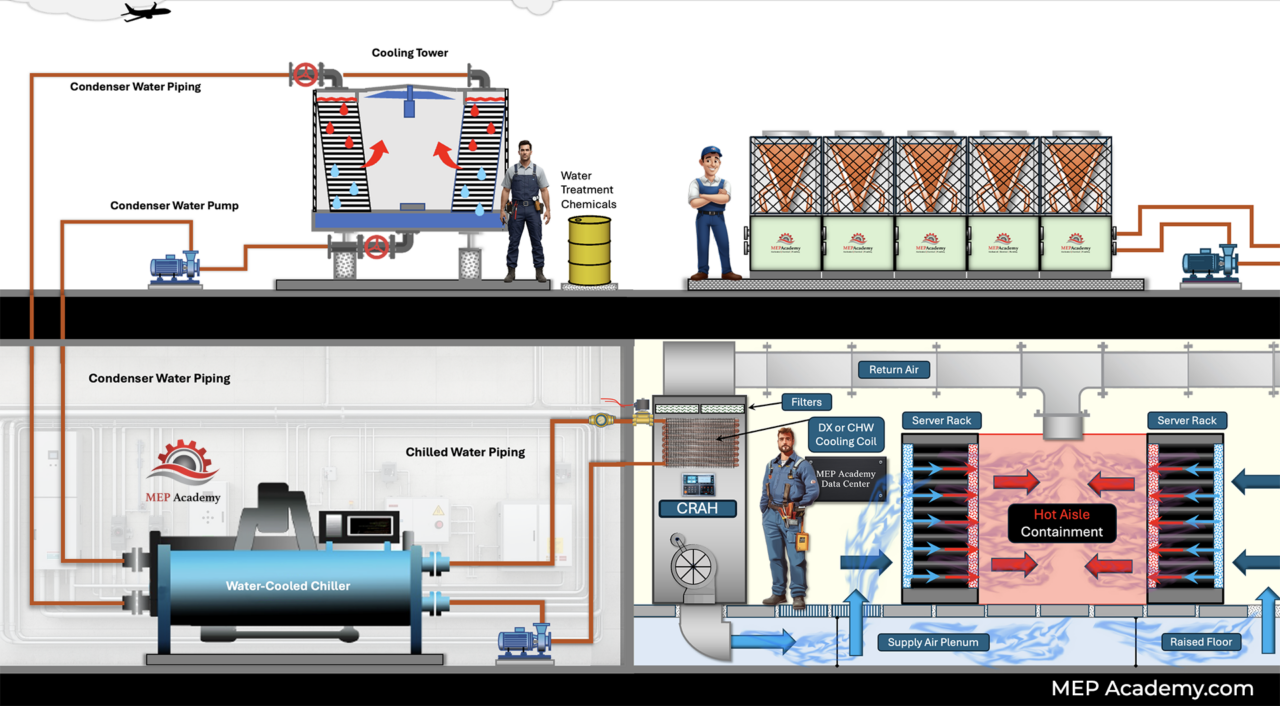
A chilled water system is a centralized cooling system that removes heat from a building by circulating cold water through equipment and rejecting that heat outdoors.
At a high level, the system works as a continuous loop:
- Chillers cool water to a low temperature
- Pumps circulate that chilled water through the facility
- Cooling coils absorb heat from the air
- Warm water returns to the chiller
- Heat is rejected to the outside environment
This cycle repeats continuously to maintain stable operating conditions.
Key Components of a Data Center Chilled Water System
1. Chillers
Chillers are the core of the system. They use a refrigeration cycle to remove heat from water.
There are two primary types:
- Air-Cooled Chillers
- Reject heat directly to outdoor air
- Simpler installation
- Lower water usage
- Typically less efficient at large scale
- Water-Cooled Chillers
- Use cooling towers for heat rejection
- Higher efficiency for large data centers
- More complex infrastructure
2. Pumps
Pumps move water throughout the system and are typically arranged in:
- Primary Loop — circulates water through the chiller
- Secondary Loop — distributes water to the building
Modern systems often use:
- Variable Frequency Drives (VFDs) for efficiency
- Redundant pump configurations (N+1 or 2N)
3. CRAH Units (Computer Room Air Handlers)
CRAH units are located inside the data hall and contain chilled water coils.
They:
- Pull in hot return air from servers
- Pass air over chilled water coils
- Deliver cooled air back into the cold aisle
This directly supports the airflow strategies discussed in earlier videos.
4. Cooling Towers (Water-Cooled Systems Only)
Cooling towers reject heat from the system using evaporation.
They are:
- Highly efficient for large heat loads
- Typically installed on rooftops or outdoors
- A key component of high-capacity data center cooling systems
5. Piping Network
The piping system distributes chilled water throughout the facility.
Typical features include:
- Supply and return piping loops
- Insulated piping to prevent energy loss
- Redundant routing for reliability
How the System Works (Step-by-Step)
Let’s walk through the full cycle:
- Chillers produce cold water (typically 42°F–48°F)
- Pumps circulate chilled water to CRAH units
- Hot air from servers passes over cooling coils
- Heat transfers into the water
- Cooled air is delivered back to the servers
- Warm water returns to the chiller
- Heat is rejected outside via air or cooling towers
This continuous loop ensures stable environmental conditions at all times.
Supply & Return Temperature Delta (ΔT)
One of the most important performance metrics is the temperature difference between supply and return water.
- Typical ΔT range: 10°F to 16°F
- Higher ΔT = more efficient system
Low ΔT can indicate:
- Poor coil performance
- Improper flow rates
- System inefficiencies
Economization (Free Cooling)
Many modern data centers use economizers to reduce energy consumption.
Types include:
- Air-side economizers
- Water-side economizers
These systems take advantage of cooler outdoor conditions to reduce or eliminate chiller operation.
Load Variability
Data centers experience fluctuating loads depending on:
- Server utilization
- Time of day
- Seasonal conditions
Chilled water systems must dynamically adjust using:
- Variable speed pumps
- Staging of chillers
- Advanced control systems
Redundancy and Reliability
Cooling systems are designed with redundancy similar to power systems.
Common configurations:
- N — minimum required capacity
- N+1 — one backup component
- 2N — fully redundant systems
Redundancy may include:
- Multiple chillers
- Backup pumps
- Dual piping loops
- Independent cooling paths
This ensures the system remains operational even during component failures.
Why Data Centers Use Chilled Water Systems
Compared to traditional DX (Direct Expansion) systems, chilled water offers:
- Better efficiency at scale
- Greater flexibility for large facilities
- Easier integration with redundancy strategies
- Improved long-term operating costs
This makes chilled water the preferred solution for most enterprise and hyperscale data centers.
How Cooling Integrates with the Full Data Center System
To fully understand data centers, you have to look at how systems work together:
- Electrical systems provide power to servers
- Airflow systems distribute conditioned air
- Chilled water systems remove heat from the building
If any one of these systems fails, the entire operation is at risk.
This is what makes data center design unique—every system is interdependent.
Common Design Considerations
When designing or evaluating a chilled water system, engineers consider:
- Total cooling load (kW or tons)
- Redundancy requirements
- Energy efficiency (kW/ton)
- Space constraints
- Water availability
- Maintenance accessibility
What’s Next in the Series
In the next article, we’ll take a closer look at the equipment inside the data hall:
👉 CRAC vs CRAH Units Explained
Understanding how these units operate will complete your understanding of how cooling is delivered directly to the servers.
Explore the Full Data Center Series
To understand how all systems work together, visit:
👉 How Data Centers Work: Power, Cooling, and Infrastructure
Data Center Engineering Series
This article is the hub of our Data Center Educational Series, where we break down each major system in detail.
Currently Published
- How Data Centers Actually Work
An overview of how modern data centers operate, explaining the critical electrical, mechanical, and IT infrastructure required to keep servers running 24/7. - Data Center Power Flow: From Utility Grid to Server Rack
Learn how electrical power travels from the utility grid through switchgear, UPS systems, generators, and distribution equipment before reaching server racks. - Data Center Cooling Methods Explained
Learn how CRAC units, chilled water systems, and airflow management remove heat from server environments. - Data Center Redundancy Explained (N, N+1, and 2N Systems)
Understand how redundancy strategies like N, N+1, and 2N designs protect data centers from outages and ensure continuous operation. - How Data Center Electrical Systems Work
Understand how data center electrical systems deliver continuous power using switchgear, UPS systems, generators, and redundancy design. - Data Center Refrigerant Economizer
Discover how refrigerant economizer systems improve cooling efficiency by using outdoor conditions to reduce compressor operation and lower energy consumption. - Data Center HVAC Systems
- How Data Center UPS Systems Work
Understand how UPS systems provide instant backup power and protect data centers from outages and power disruptions. - Hot Aisle vs Cold Aisle Containment
Hot aisle vs cold aisle containment explained. Learn how airflow control improves data center cooling efficiency and reduces energy costs. - CRAC vs CRAH Units Explained
Learn the difference between Computer Room Air Conditioners and Computer Room Air Handlers, including how DX refrigerant cooling compares with chilled water cooling in data center environments. - Air-Cooled vs Water-Cooled Data Centers
Learn the difference between Computer Room Air Conditioners and Computer Room Air Handlers, including how DX refrigerant cooling compares with chilled water cooling in data center environments. - Immersion Cooling Explained
Discover how immersion cooling is transforming AI data centers by submerging servers in a non-conductive dielectric fluid for highly efficient heat removal. Learn how single-phase and two-phase immersion cooling work, why AI is driving their adoption, and how these systems compare to traditional air cooling. - AI Data Centers Explained
Learn how high-density GPU data centers deliver massive amounts of electrical power and remove the resulting heat using liquid cooling, CDUs, and advanced cooling infrastructure.
Learn More
If you want to learn how these systems are designed and applied in real-world MEP projects, explore our training programs:
Final Thoughts
Chilled water systems are the backbone of data center cooling.
They quietly and continuously remove heat from some of the most critical infrastructure in the world—ensuring uptime, reliability, and performance.
As computing demands continue to grow, especially with AI and high-density workloads, these systems will only become more important.