



Noise in HVAC systems and ductwork is one of the most common complaints in offices, hospitals, schools, and homes. The good news? Once you understand the sources of HVAC noise and how sound travels, you can find the right fix. This guide explains the main causes of HVAC noise, defines breakout noise and sound paths, and shows you proven noise control solutions used by engineers and contractors. We’ll break it down step by step, starting with common symptoms to help you pinpoint the problem, followed by detailed explanations and mitigation strategies.
Step 1: Identifying the Noise You’re Hearing
Before diving into technical details, let’s help you diagnose what you might be experiencing. HVAC noises vary in character, and recognizing them can lead you directly to the source and solution:
Low-frequency humming or rumbling: This often comes from mechanical equipment like fans, pumps, or compressors vibrating or operating inefficiently. If it’s constant and felt as much as heard, check central units or air handlers.
High-pitched whistling or hissing: Typically caused by high air velocity through ducts, grilles, or vents. It might worsen when the system ramps up, indicating restricted airflow or undersized components.
Rattling or banging: Could stem from loose parts in ductwork, such as dampers or fittings, or from air turbulence in bends and transitions.

Muffled thumping or booming: Often “breakout noise” where sound escapes through duct walls into rooms, especially in areas with thin or uninsulated ducts.
Echoing or amplified sounds: These suggest noise traveling along sound paths within the duct network, like from a rooftop unit down to occupied spaces.
By noting when the noise occurs (e.g., during startup, peak operation, or constantly), its location (near vents, in walls, or from the mechanical room), and its quality (steady vs. intermittent), you can narrow down the culprit. For instance, if the noise is louder near return air vents, it might involve air handlers or duct velocity issues. Once identified, the sections below provide targeted fixes.
Sources of Noise in HVAC Systems
Noise in HVAC systems primarily arises from two categories: mechanical equipment and airflow dynamics. Understanding these helps in troubleshooting.
Mechanical Equipment
HVAC systems rely on various components that generate noise through vibration, rotation, or fluid movement:
Fans and Air Handlers: Centrifugal or axial fans in air handlers create aerodynamic noise from blade turbulence and motor vibrations. A worn bearing might produce a grinding hum from imbalanced components or poor isolation from the building structure.
Pumps: Circulating water or refrigerants, pumps can cause cavitation noise (like bubbling) if air enters the system or if they’re improperly sized, they often cause humming or vibration through connected piping.
Compressors: In chillers or heat pumps, these produce pulsating sounds from gas compression cycles. Scroll compressors are quieter than reciprocating ones but can still vibrate.
Other equipment like boilers or condensers can contribute if mounted without vibration dampers. Vibrations transmit through floors or walls, amplifying the issue in multi-story buildings.
Air Velocity and Flow-Related Noise
High-speed air moving through ducts generates turbulence, especially at bends, restrictions, or outlets and inlets:
Turbulent Flow: Air speeds above 1,500 feet per minute (fpm) in ducts can create whooshing or roaring sounds, or it can be created by sharp duct elbows, undersized dampers, or poor transitions. Grilles and diffusers exacerbate this if undersized.
Regenerated Noise: Dampers, valves, or fittings disrupt airflow, regenerating noise downstream.
In residential settings, you might hear this as a persistent rush near vents; in commercial spaces, it could manifest as uneven noise distribution across floors.
Vibrations from fans, pumps, or compressors can travel along ducts and building structure, radiating as noise in occupied spaces.
Defining Breakout Noise and Sound Paths
To effectively address noise, it’s crucial to understand how it propagates.
Breakout Noise: This refers to sound that “breaks out” from the duct walls into surrounding spaces. Thin sheet metal can act like a speaker, amplifying fan or turbulence noise. It’s common in unlined ducts where vibrations radiate outward, often heard as a dull roar in adjacent rooms. Factors like duct material (e.g., flexible vs. rigid) and insulation thickness influence its severity.
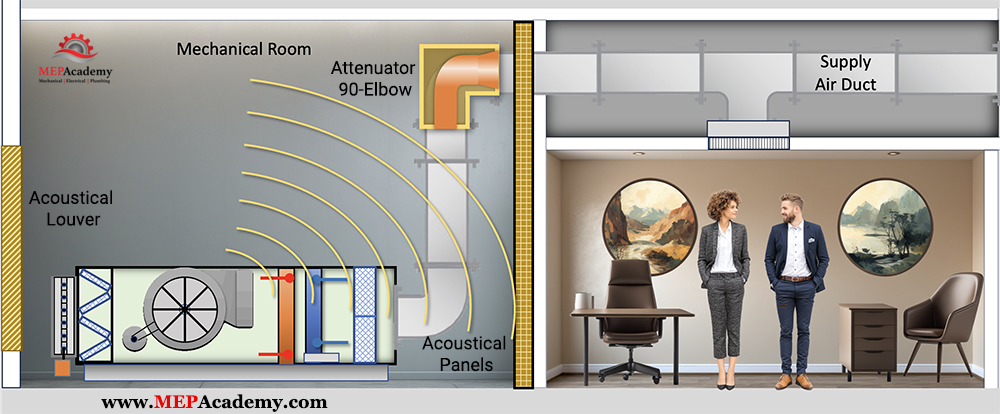
Sound Paths: These are the routes noise takes through the system, including airborne paths (directly through air in ducts) and structure-borne paths (vibrations via mounts or connections). Flanking paths occur when noise bypasses barriers, such as through ceiling plenums or wall penetrations. In ductwork, primary paths include supply and return ducts, where noise travels from the source to outlets. Equipment rooms can leak noise through penetrations and walls.
Understanding paths helps in placing barriers strategically—for example, noise from a rooftop unit might follow vertical risers into offices below.
Solutions: How to Control HVAC Noise
Once you’ve identified the noise type and source, apply these proven techniques. Start with low-cost assessments like checking for loose parts, then escalate to engineering solutions.
Duct Sound Attenuators (Silencers): Installed in ducts, silencers absorb fan and airflow noise without drastically reducing air pressure. These are inline devices with absorptive baffles that reduce noise by 10 to 30 decibels. Install them near noisy equipment or branches to target breakout and airborne paths. Ideal for high-velocity systems; choose based on frequency (e.g., low-frequency for fans).
Return Air Duct Boots & Elbows: These fittings connect ducts to grilles and can be lined or shaped to minimize turbulence. Upgrading to acoustically treated boots reduces hissing at returns, especially in residential HVAC. Return air boots block direct “line-of-sight” transmission of sound from equipment rooms into occupied spaces or from one space to another as in side-by-side offices that use an unducted return air plenum.
Duct Liner and Duct Liner with Perforated Metal: Internal liners (fiberglass or foam) absorb sound waves, cutting breakout noise by up to 20 decibels. Perforated metal facings protect the liner while allowing sound penetration for absorption. Avoid using in high-moisture areas to prevent mold.
Oversizing Ductwork and Grilles to Reduce Velocity: Lowering air velocity reduces whistling and rushing air noise. Larger ducts and diffusers provide quieter airflow. Design ducts and outlets larger than minimum to keep air speeds below 1,000 fpm, slashing airflow noise. For example, increasing grille size by 20% can halve velocity-related sounds. This is a preventive measure during installation or retrofits.
Sound Enclosures: Encasing noisy equipment like compressors or air handler’s cuts radiated sound significantly. These are box-like structures that surround equipment (e.g., compressors) with absorptive materials and vibration isolators. They contain noise at the source, effective for outdoor units or mechanical rooms, reducing transmission by 15 to 40 decibels. Look for Compressor Blankets.
Other tips: Flexible duct connectors, neoprene pads, and spring isolators keep vibration from traveling into the structure, ensure proper balancing of fans, and incorporate turning vanes in duct elbows to smooth airflow. Regular maintenance, like cleaning filters and lubricating parts, prevents noise escalation.
Other Important Information
Standards and Regulations: Adhere to guidelines like ASHRAE (American Society of Heating, Refrigerating and Air-Conditioning Engineers) standards for acceptable noise levels (e.g., NC-35 for offices). Local building codes may require noise assessments in sensitive areas like hospitals.
Professional Assessment: For complex issues, consult an acoustical engineer. Tools like sound level meters can quantify noise (aim for under 45 dBA in living spaces).
Energy Trade-offs: Some mitigations, like oversizing ducts, may increase energy use slightly, but benefits in comfort often outweigh this. Eco-friendly options include low-noise variable-speed fans.
Common Pitfalls: Ignoring return air paths can undermine efforts, as they often carry more noise. In retrofits, ensure mitigations don’t restrict airflow, which could strain the system.
Key Takeaways
1. Find the Source First: Match the noise characteristics (e.g., hum vs. whoosh) to sources like equipment, airflow velocity or vibration to target solutions effectively.
2. Prevent Propagation: Address breakout noise and sound paths with duct liners and sound attenuators to stop sound from spreading.
3. Air Velocity Matters: Oversizing ducts, grilles and other components reduces airflow noise without major overhauls.
4. Vibration must be isolated—use mounts, pads, and flexible connectors.
5. Maintain Regularly: Routine checks on vibrations and parts can prevent minor issues from becoming noisy problems.
Final Thoughts
Noise in HVAC systems isn’t just an annoyance—it impacts productivity, patient recovery, student concentration, and overall comfort. By identifying the type of noise and its path, you can select the right solution, from duct liners and silencers to enclosures and oversized ductwork.
A quiet HVAC system not only delivers comfort but also adds value to the building environment. If your system is too noisy, start with diagnosis—because the solution is often simpler than you think.