


Hot Gas Reheat Explained: HVAC Humidity Control for Gyms, Indoor Pools, and Commercial Buildings
Humidity control is one of the most misunderstood aspects of commercial HVAC design. Many people assume that if an air conditioning system lowers the room temperature, it must also be controlling humidity properly. In reality, temperature and humidity are two very different challenges, and in many commercial buildings, humidity becomes the dominant concern.
This is especially true in facilities such as indoor swimming pools, gymnasiums, aerobic studios, schools, healthcare facilities, supermarkets, and other high-occupancy buildings where large amounts of moisture are constantly introduced into the air. In these environments, the HVAC system often needs to continue removing moisture even after the space no longer requires additional sensible cooling.
That is where Hot Gas Reheat becomes one of the most valuable humidity-control strategies used in modern HVAC systems.
What Is Hot Gas Reheat?
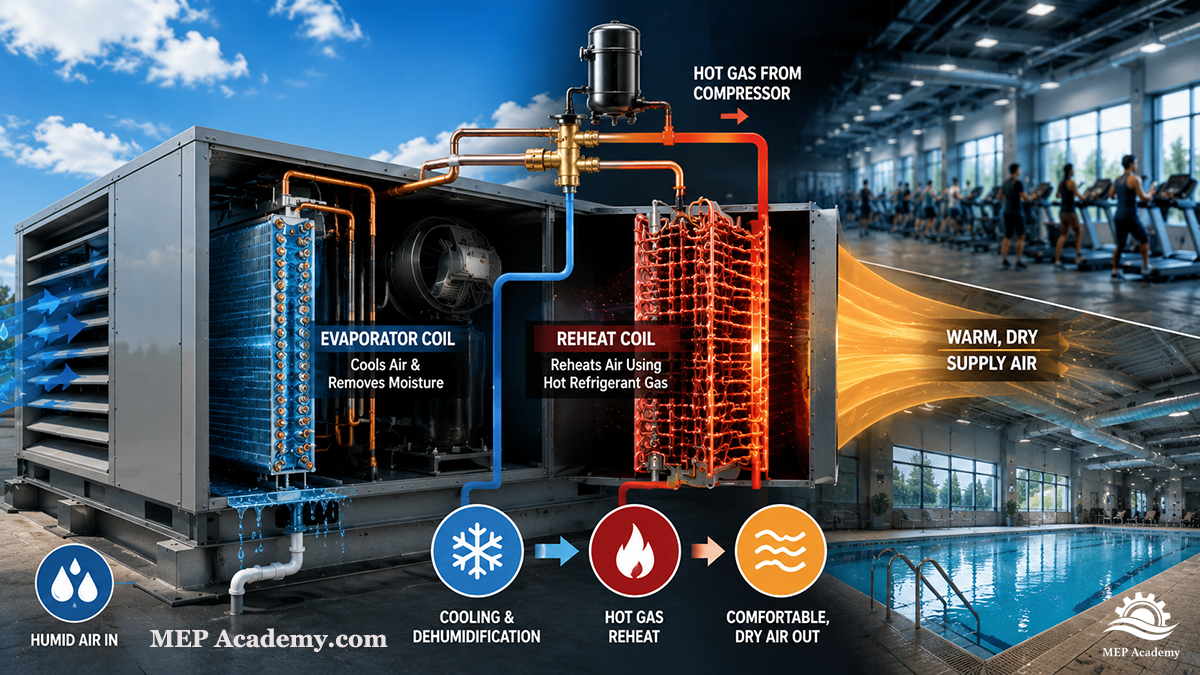
Hot Gas Reheat is a dehumidification method used in direct expansion (DX) cooling systems and packaged rooftop units. The system intentionally overcools the air to remove additional moisture, then reheats the air using hot refrigerant gas from the compressor before supplying the air back into the occupied space.
This allows the HVAC system to continue removing humidity without overcooling the building.
In simple terms, the system performs three steps:
- Cool the air aggressively
- Remove moisture from the air
- Reheat the air to a comfortable supply temperature
The result is dry air without creating an excessively cold indoor environment.
Understanding Sensible Heat vs Latent Heat
To understand why Hot Gas Reheat is necessary, it is important to understand the difference between sensible heat and latent heat.
Sensible heat refers to heat that changes air temperature. When the thermostat lowers the room temperature from seventy-five degrees to seventy degrees, the HVAC system is removing sensible heat.
Latent heat refers to moisture contained within the air. When the system condenses water vapor out of the air at the evaporator coil, it is removing latent heat.
In many commercial buildings, the latent load can become extremely high due to occupancy levels, outdoor ventilation air, evaporation, and moisture generation within the space.
Buildings with high latent loads include:
- Indoor swimming pools
- Fitness centers
- Aerobic studios
- Locker rooms
- Schools
- Auditoriums
- Restaurants
- Healthcare facilities
- Supermarkets
- Humid climate office buildings
These spaces generate enormous amounts of moisture from perspiration, breathing, wet surfaces, outdoor air, and occupant activity.
Why Humidity Control Matters
Humidity affects much more than comfort.
Without proper humidity control, buildings can experience:
- Mold growth
- Condensation
- Corrosion
- Odors
- Poor indoor air quality
- Fogged windows
- Damage to finishes and building materials
Occupants may also feel cold and clammy even when the thermostat indicates a normal room temperature.
This occurs because standard thermostats primarily monitor temperature and do not directly control humidity levels.
A space can feel uncomfortable even at a perfectly acceptable temperature if the humidity remains too high.
In fact, many buildings that appear to have cooling problems are actually suffering from poor humidity control.
How Hot Gas Reheat Works
The process begins when warm humid return air enters the HVAC unit.
The air first passes across the evaporator coil, which becomes cold enough to condense moisture out of the air. As water vapor contacts the cold coil surface, condensation forms and drains away through the condensate system.
The colder the coil surface temperature becomes, the greater the moisture removal capability.
However, this creates a challenge.
The leaving air temperature may now be too cold for the occupied space. For example, the system may need fifty-degree supply air to remove sufficient moisture, but the room itself may only require sixty-five-degree supply air for occupant comfort.
Without reheating, the space would become excessively cold.
Hot Gas Reheat solves this problem by redirecting a portion of the hot compressor discharge gas through a reheat coil located downstream of the evaporator coil.
Instead of rejecting all compressor heat at the condenser, part of that heat is recycled and used to warm the cold supply air after dehumidification has already occurred.
The supply air leaves the unit:
- Dry
- Neutral in temperature
- Comfortable for occupants
This allows the HVAC system to continue removing humidity while maintaining proper space temperature.
The Refrigeration Cycle in a Hot Gas Reheat System
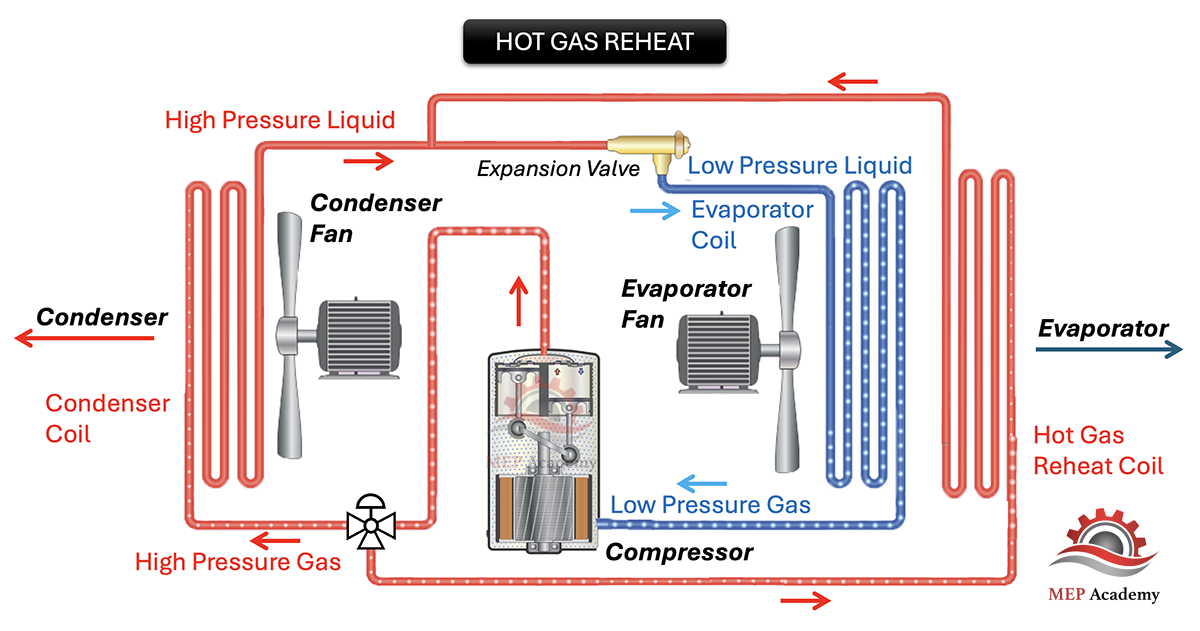
In a standard DX refrigeration system, the compressor raises the temperature and pressure of the refrigerant gas before sending it to the condenser where heat is rejected outdoors.
In a Hot Gas Reheat system, a portion of this hot refrigerant gas is diverted before reaching the condenser and routed through a dedicated reheat coil.
The sequence generally works like this:
- Warm humid air enters the evaporator coil
- The evaporator coil cools the air and removes moisture
- Compressor discharge gas is diverted through the reheat coil
- The reheat coil warms the cold dry air
- Neutral dry supply air is delivered to the occupied space
This allows continuous latent heat removal without excessive sensible cooling.
Common Applications for Hot Gas Reheat
Indoor Pools and Natatoriums
Indoor pools create extremely large latent loads because of continuous water evaporation. Without proper dehumidification, windows fog up, metal corrodes, and building materials begin to deteriorate.
Natatorium HVAC systems often rely heavily on Hot Gas Reheat to maintain proper humidity levels while keeping the space comfortable for occupants.
Gymnasiums and Aerobic Studios
Fitness facilities generate substantial moisture due to heavy occupant activity and perspiration.
Large groups of active occupants can rapidly increase indoor humidity levels, especially when combined with outdoor ventilation requirements.
Hot Gas Reheat allows these spaces to remain dry and comfortable without overcooling occupants.
Schools and Auditoriums
High occupancy combined with outdoor ventilation air can create significant humidity swings throughout the day.
Hot Gas Reheat helps stabilize indoor conditions and improve comfort during peak occupancy periods.
Healthcare Facilities
Many healthcare and therapy spaces require strict indoor humidity control to maintain comfort, reduce contamination risks, and protect equipment and finishes.
Supermarkets
Supermarkets often use dehumidification strategies to reduce condensation around refrigerated display cases and improve indoor comfort.
Why Not Simply Shut Off the Cooling System?
One of the biggest misconceptions in HVAC is the assumption that once the thermostat setpoint is reached, the cooling system should stop operating.
The problem is that humidity may still remain too high.
To remove moisture effectively, the evaporator coil must stay cold enough for condensation to continue forming.
If the cooling system cycles off too early, humidity levels can rise rapidly even though the room temperature appears acceptable.
Hot Gas Reheat allows the system to continue operating for dehumidification purposes without making the occupants uncomfortable.
Hot Gas Reheat vs Electric Reheat
Some HVAC systems use electric resistance heaters to reheat the air after cooling.
In these systems, the evaporator coil cools the air and removes moisture, then electric heating elements warm the air back up before it enters the space.
While effective, electric reheat consumes a significant amount of electrical energy because the system is essentially cooling and heating at the same time.
Hot Gas Reheat is often considered more energy efficient because it reuses compressor heat already available within the refrigeration cycle.
Instead of wasting all condenser heat outdoors, part of that heat is recycled and used for reheating.
Although Hot Gas Reheat still increases compressor runtime and is not considered “free cooling,” it is generally more efficient than electric resistance reheat.
Hot Gas Reheat vs Hot Gas Bypass
Both Hot Gas Reheat and Hot Gas Bypass are frequently confused because both involve compressor discharge gas, but they serve completely different purposes.
Hot Gas Reheat is designed for humidity control. The system intentionally removes additional moisture from the air and then reheats the supply air to maintain occupant comfort.
Hot Gas Bypass, on the other hand, is primarily used for compressor capacity control and evaporator coil protection during low-load conditions. In a Hot Gas Bypass system, hot refrigerant gas is injected back into the suction side or evaporator circuit to artificially maintain refrigeration load and prevent coil freezing.
In simple terms:
- Hot Gas Reheat controls humidity and supply air temperature
- Hot Gas Bypass protects refrigeration operation during low-load conditions
The two systems may appear similar within the refrigeration circuit, but their purposes are entirely different.
Modern HVAC Control Strategies
Modern packaged rooftop units and dedicated dehumidification systems often incorporate advanced controls for managing humidity.
These may include:
- Space humidity sensors
- Dew point sensors
- Supply air temperature sensors
- Variable speed fans
- Modulating compressors
- Dedicated outdoor air systems (DOAS)
- Energy recovery systems
- Building automation system integration
When humidity rises above the desired setpoint, the system can continue operating in dehumidification mode while Hot Gas Reheat maintains comfortable supply air temperatures.
These advanced strategies improve both occupant comfort and energy performance.
The Importance of Proper HVAC Design
Humidity control is not simply about comfort. It is also about protecting the building itself.
Improper humidity management can lead to:
- Mold remediation costs
- Corrosion damage
- Premature equipment deterioration
- Indoor air quality complaints
- Occupant discomfort
- Condensation issues
- Damage to ceilings, finishes, and insulation
This is why proper latent load calculations and dehumidification strategies are critical in HVAC design.
In many commercial buildings, the HVAC system does not necessarily need colder air.
What the building truly needs is drier air.
Final Thoughts
Hot Gas Reheat is one of the most important dehumidification strategies used in commercial HVAC systems. By separating moisture removal from temperature control, the system can aggressively remove humidity while still maintaining comfortable indoor conditions.
Whether serving an indoor pool, fitness center, school, healthcare facility, or other high-occupancy building, Hot Gas Reheat helps improve:
- Occupant comfort
- Indoor air quality
- Moisture control
- Building protection
- Long-term HVAC performance
Understanding how Hot Gas Reheat works is essential for HVAC technicians, engineers, estimators, facility managers, and anyone involved in commercial mechanical systems.
Because in many buildings, comfort is not just about temperature.
It is about controlling moisture.