



Heat Recovery Chillers Explained: How They Work and Why They Matter
Most HVAC systems are designed to move heat.
A cooling system removes heat from a building and rejects it somewhere else. A heating system adds heat to a building when spaces need to be warmed.
But in many commercial buildings, something interesting happens.
One part of the building may need cooling at the exact same time another part of the building needs heating.
An interior office area may need cooling because of people, lights, computers, and equipment, while perimeter zones near windows may need heating because of cold outdoor conditions.
In a hospital, laboratories and imaging rooms may need cooling year-round while the ventilation system still needs heating and reheat.
In a hotel, the building may need chilled water for guest rooms and kitchens while also needing domestic hot water for showers and laundry.
A Heat Recovery Chiller takes advantage of this situation.
Instead of wasting heat through the cooling tower, the system captures that heat and reuses it somewhere else in the building.
That is the basic idea behind heat recovery.
What Is a Heat Recovery Chiller?
A Heat Recovery Chiller is a special type of chiller that produces chilled water and useful hot water at the same time.
A normal water-cooled chiller removes heat from the building and rejects that heat through the condenser water system to a cooling tower.
A Heat Recovery Chiller still removes heat from the building, but instead of throwing all of the heat away, it transfers useful heat into a hot water loop.
That recovered heat can then be used for:
- Heating hot water systems
- Reheat coils
- Domestic hot water preheat
- Makeup air heating
- Perimeter heating
- Process heating
- Pool heating
- Snow melting systems
The chiller is doing two useful jobs at once.
It is cooling one load while heating another.
Why Heat Recovery Chillers Make Sense
In many conventional HVAC systems, chillers and boilers may operate at the same time.
The chiller removes heat from the building and rejects it outdoors.
Meanwhile, the boiler burns fuel to create heat somewhere else in the building.
That means the building is paying to reject heat and paying again to create heat.
A Heat Recovery Chiller changes that process.
Instead of wasting heat through the cooling tower, the building reuses that heat for another purpose.
This can:
- Reduce boiler runtime
- Reduce cooling tower load
- Lower energy use
- Improve overall plant efficiency
- Reduce condenser water heat rejection
- Lower cooling tower water makeup
The best applications are buildings with simultaneous heating and cooling loads.
How a Heat Recovery Chiller Works
The refrigeration cycle is very similar to a standard water-cooled chiller.
First, warm return chilled water comes back from the building.
Inside the evaporator, refrigerant absorbs heat from the chilled water.
The chilled water is cooled and sent back out to the building.
The compressor then raises the pressure and temperature of the refrigerant.
In a standard chiller, the condenser would reject this heat to condenser water and eventually to a cooling tower.
But in a Heat Recovery Chiller, the condenser transfers that heat into a useful hot water loop.
The hot water can then be used for heating elsewhere in the building.
So instead of treating condenser heat as waste, the system uses it as a valuable energy source.
Application #1 — Cooling Condenser Water Before It Reaches the Main Chillers
One interesting application for Heat Recovery Chillers is in large central plants.
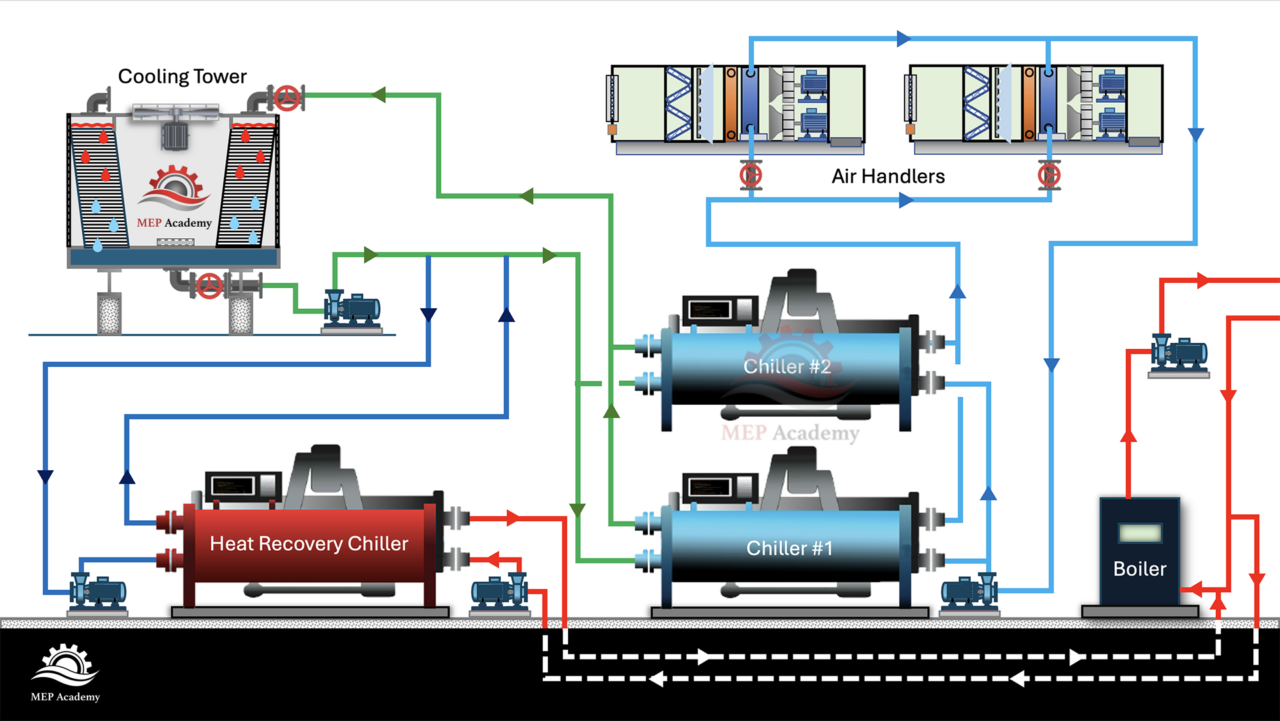
In this arrangement, the Heat Recovery Chiller is used to cool down the condenser water before it enters the main water-cooled chillers.
How It Works
In a normal central plant:
- Cooling towers send condenser water to the chillers
- The chillers reject heat into the condenser water
- The condenser water returns to the cooling towers
- The cooling towers reject the heat outdoors
The temperature of the condenser water is very important.
Generally, lower condenser water temperatures help the chillers operate more efficiently because the compressors do not have to work as hard to reject heat.
Now imagine placing a Heat Recovery Chiller in that condenser water loop.
The warmer condenser water first passes through the Heat Recovery Chiller.
The Heat Recovery Chiller removes heat from that condenser water and transfers the recovered heat into a hot water loop.
The condenser water then continues to the main chillers at a lower temperature.
This helps the main chillers operate more efficiently.
At the same time, the recovered heat is used somewhere useful in the building.
Typical Applications
This type of system is commonly used in:
- Hospitals
- University campuses
- Large office towers
- District cooling systems
- Laboratory buildings
- Central utility plants
For example, a hospital may need cooling for medical equipment and interior spaces year-round while also needing heating hot water for reheat coils and domestic water heating.
The Heat Recovery Chiller helps both systems at the same time.
Application #2 — Producing Chilled Water and Hot Water Simultaneously
This is probably the easiest Heat Recovery Chiller application to understand.
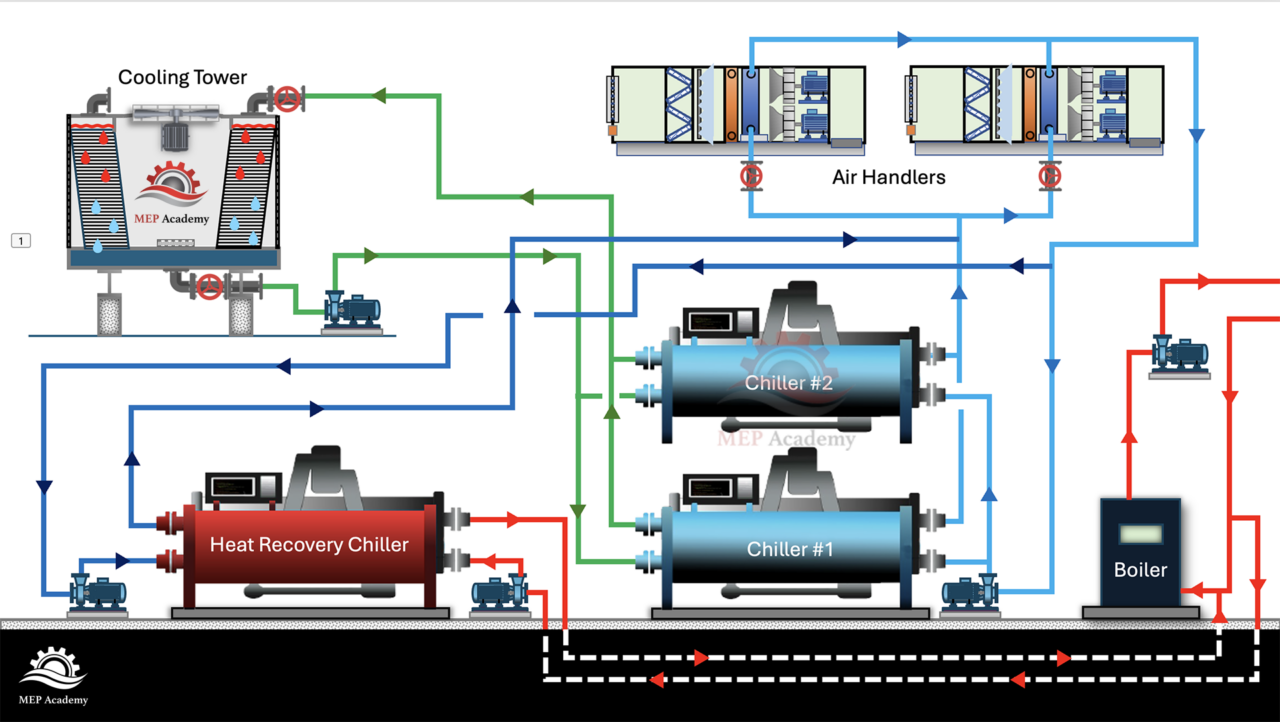
In this arrangement, the Heat Recovery Chiller directly produces chilled water for cooling and hot water for heating at the same time.
How It Works
The chilled water side serves cooling loads such as:
- Air handling units
- Data rooms
- Electrical rooms
- Interior office zones
- Laboratories
- Process cooling systems
The hot water side serves heating loads such as:
- Reheat coils
- Heating coils
- Domestic hot water preheat
- Perimeter heating
- Makeup air systems
The Heat Recovery Chiller removes heat from the cooling side and transfers it to the heating side.
The system is literally moving heat from where it is not wanted to where it is needed.
Example: Office Building
An office building may have interior spaces that require cooling year-round because of lighting, people, and computers.
At the same time, the perimeter offices near the exterior walls may need heating during cold weather.
The Heat Recovery Chiller removes heat from the interior spaces and transfers that heat to the perimeter heating system.
Instead of wasting the heat outdoors, the building reuses it.
Domestic Hot Water Preheat Applications
Hotels, hospitals, dormitories, and multifamily buildings are excellent candidates for Heat Recovery Chillers because they often have large domestic hot water loads.
The Heat Recovery Chiller can preheat domestic water before it reaches the final water heater.
Cold domestic water enters a preheat tank or heat exchanger.
Recovered heat from the chiller raises the water temperature before it reaches the boiler or water heater.
The final heater then has less work to do.
This can significantly reduce energy consumption.
Heat Recovery Chillers and Condensing Boilers
Heat Recovery Chillers often work very well with condensing boiler systems.
Lower hot water temperatures generally improve Heat Recovery Chiller efficiency because the compressor does not need to work as hard.
Many modern heating systems now use lower-temperature hot water systems, especially with:
- Condensing boilers
- Radiant systems
- Reheat systems
- Low-temperature heating coils
In many plants, the Heat Recovery Chiller becomes the first stage of heating.
The boilers only add heat when the recovered heat is not enough.
This allows the building to use recovered heat first before burning additional fuel.
Simultaneous Heating and Cooling Is the Key
Heat Recovery Chillers work best when the building has simultaneous heating and cooling demands.
That is the key concept.
If the building has cooling loads but no useful heating load, then excess heat still needs to be rejected through a cooling tower or dry cooler.
If the building needs heating but has no cooling load available, then the Heat Recovery Chiller has little heat to recover.
This is why building load profiles are important.
The designer must look at how the building operates throughout the year, not just during peak summer or peak winter conditions.
Common Buildings That Use Heat Recovery Chillers
Heat Recovery Chillers are commonly found in:
- Hospitals
- Hotels
- Laboratories
- University campuses
- Central utility plants
- High-rise office buildings
- District cooling systems
- Data centers
- Multifamily residential towers
- Industrial process facilities
These buildings often have overlapping cooling and heating loads that make heat recovery practical.
Heating Priority vs Cooling Priority
Some systems operate in cooling priority.
In this mode, the chiller runs mainly because the building needs chilled water. If there is a useful heating load available, the system recovers heat.
Other systems operate in heating priority.
In this arrangement, the Heat Recovery Chiller operates mainly because the building needs hot water. The chilled water becomes the useful byproduct.
Large campus systems may operate in either mode depending on the season and plant demand.
Heat Recovery Chillers Are About Managing Heat
A Heat Recovery Chiller is not simply another type of chiller.
It is really a heat management strategy.
The system takes heat from where it is not wanted and moves it to where it is useful.
Instead of wasting condenser heat outdoors, the building uses that energy somewhere else in the system.
That is why Heat Recovery Chillers are becoming increasingly popular in modern HVAC central plants.
They help reduce waste, improve efficiency, lower boiler operation, and make better use of energy the building already has available.
Final Thoughts
The next time you look at a central plant, do not just ask how the building is making chilled water.
Ask where the rejected heat is going.
Is it being wasted through the cooling tower?
Or is it being recovered and used somewhere useful?
That question is the foundation of Heat Recovery Chiller design.
Because in the right application, the system is not just cooling the building.
It is intelligently managing energy throughout the entire plant.
Continue Learning About Data Center Systems
Continue exploring our complete series on HVAC systems, central plants, chilled water systems, cooling towers, CRAH units, CRAC units, data center cooling, and commercial mechanical systems at: