



Artificial Intelligence is transforming the data center industry faster than almost any technological advancement in recent history.
For decades, most data centers relied on air cooling to remove heat from servers. Cold air entered the front of the rack, hot air exited the rear, and cooling systems continuously removed the heat generated by IT equipment.
That approach worked well when racks consumed 5 to 15 kilowatts of power.
Today’s AI workloads are changing everything.
Modern AI servers packed with high-performance GPUs can consume tens of kilowatts per server, pushing rack densities beyond 100 kW and, in some cases, approaching 200 kW per rack. At these power levels, traditional air cooling begins to reach its practical limits.
This is why liquid cooling has become one of the most important technologies in modern AI data centers.
In this article, we’ll explain how liquid cooling works, why AI is driving its adoption, the different types of liquid cooling systems, and how these systems integrate with the facility’s mechanical infrastructure.
Why AI Is Creating a Cooling Challenge
Artificial Intelligence requires enormous computing power.
Unlike traditional enterprise applications, AI workloads depend heavily on Graphics Processing Units (GPUs). These processors perform thousands of calculations simultaneously, making them ideal for machine learning, large language models, and advanced analytics.
The downside is power consumption.
A traditional server might consume several hundred watts to a few kilowatts of power.
A modern AI server equipped with multiple GPUs can consume 10, 20, or even more than 100 kilowatts depending on the configuration.
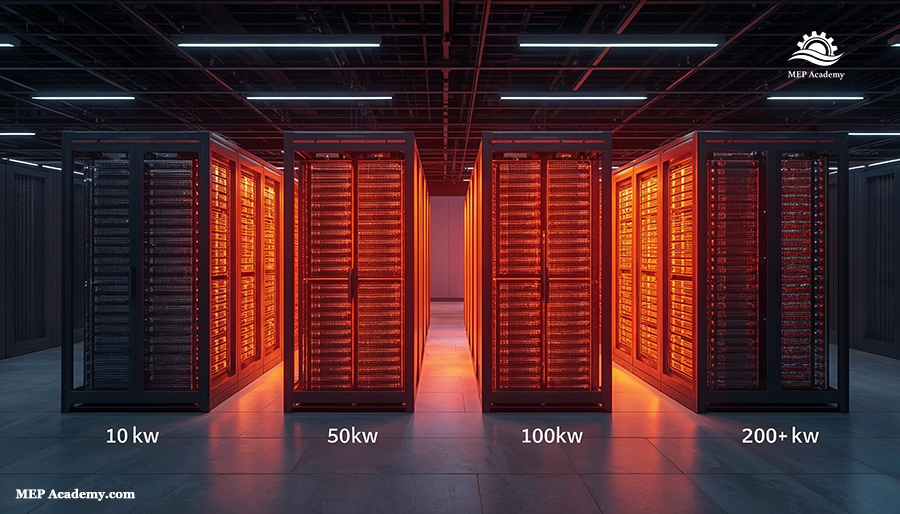
Because nearly all electrical power consumed by a server eventually becomes heat, increasing computing power directly increases cooling requirements.
As rack densities continue to climb, data center operators face a growing challenge:
How do you remove that heat efficiently?
Why Air Cooling Has Limits
Air cooling remains the most common cooling method in many data centers today.
Air enters the cold aisle, passes through server equipment, absorbs heat, and exits into the hot aisle where cooling equipment removes the heat.
While effective for lower-density applications, air has limitations.
Air is relatively poor at transporting heat compared to liquids.
To remove larger amounts of heat, cooling systems must move increasing volumes of air through server racks.
This creates several challenges:
- Larger server fans
- Higher fan speeds
- Increased energy consumption
- Greater noise levels
- Reduced cooling efficiency at higher densities
At some point, simply moving more air is no longer practical.
This is why the industry is increasingly adopting liquid cooling technologies for high-density AI environments.
What Is Liquid Cooling?
Liquid cooling uses a fluid to absorb and transport heat away from electronic components.
Instead of relying solely on air to remove heat from processors, liquid is brought much closer to the heat source.
The liquid absorbs heat directly from CPUs, GPUs, and other high-power components.
The warmed liquid then transports that heat to a cooling system where it can be removed and rejected from the building.
Because liquids can carry far more heat than air, they can support significantly higher power densities while reducing airflow requirements.
Direct-to-Chip Cooling
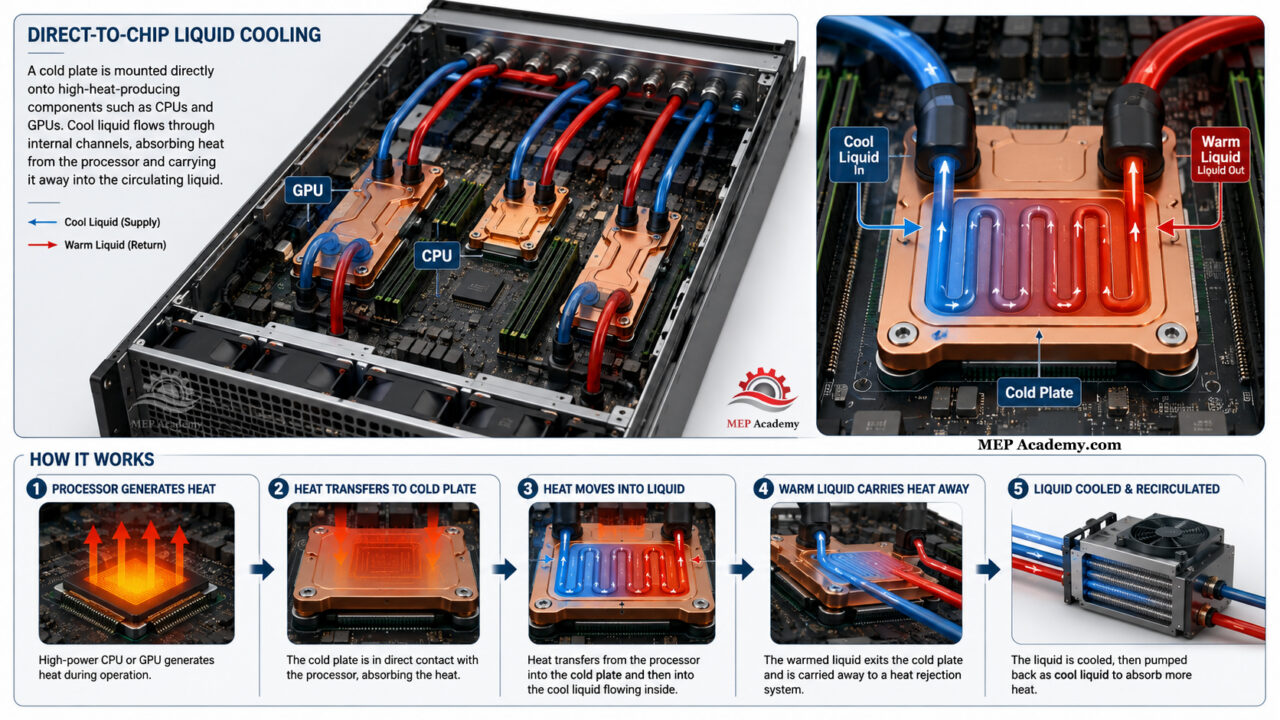
Direct-to-chip cooling is currently the most widely deployed liquid cooling technology in AI data centers.
In this approach, a device called a cold plate is mounted directly onto high-heat-producing components such as CPUs and GPUs.
Inside the cold plate are small internal channels.
Cool liquid flows through these channels continuously.
As the processor generates heat:
- Heat transfers into the cold plate.
- The liquid absorbs the heat.
- Warmed liquid leaves the server.
- Cool liquid returns to continue the process.
Because heat is removed directly at the source, direct-to-chip cooling is significantly more effective than relying on air alone.
Advantages of Direct-to-Chip Cooling
- Supports higher rack densities
- Improves cooling efficiency
- Reduces server fan requirements
- Enables AI and HPC workloads
- Reduces data center airflow demands
Most direct-to-chip systems still utilize some airflow for cooling secondary components that are not connected to cold plates.
As a result, many AI facilities use a hybrid approach combining liquid cooling and air cooling.
What Is a Cooling Distribution Unit (CDU)?
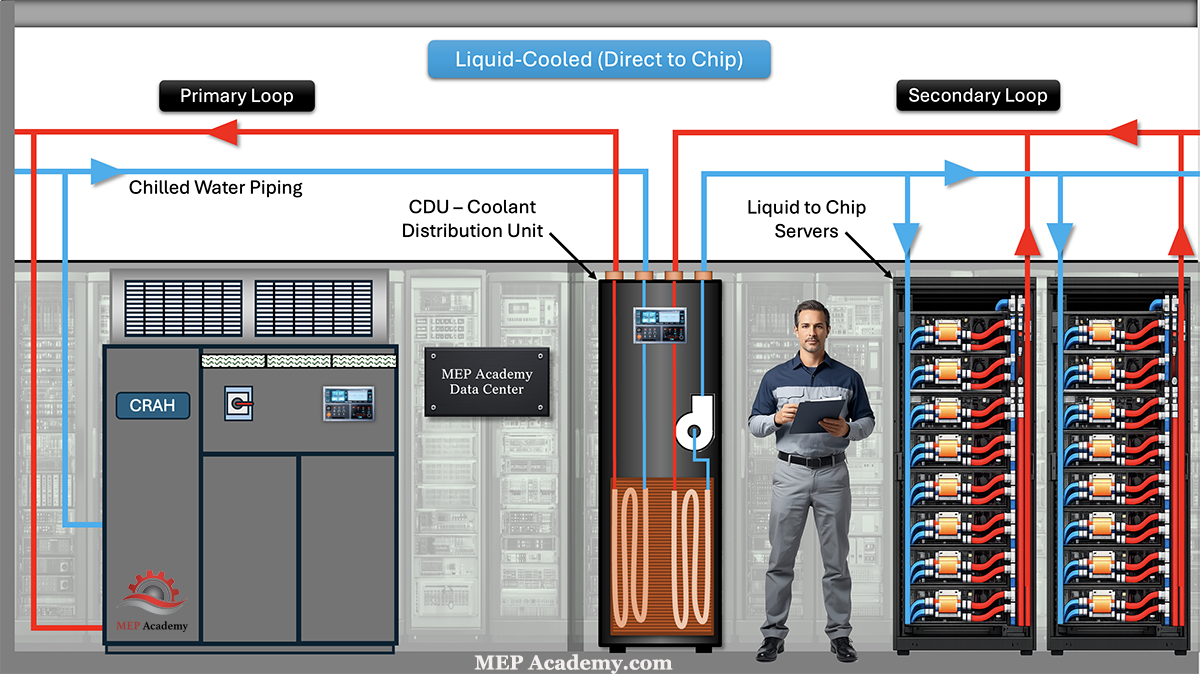
One of the most important pieces of liquid cooling infrastructure is the Cooling Distribution Unit, commonly called a CDU.
The CDU serves as the interface between the data center’s facility cooling system and the IT equipment.
Its functions typically include:
- Circulating coolant through server racks
- Controlling coolant temperature
- Maintaining proper pressure
- Monitoring flow rates
- Transferring heat to the facility cooling loop
Think of the CDU as the mechanical bridge between the servers and the building’s cooling system.
Without the CDU, the liquid cooling network inside the racks cannot operate effectively.
Immersion Cooling
While direct-to-chip cooling brings liquid directly to the processor, immersion cooling takes a different approach.
In an immersion cooling system, the servers themselves are submerged in a specially engineered dielectric fluid.
Because the fluid does not conduct electricity, the electronic equipment can operate safely while fully immersed.
Heat transfers directly into the surrounding liquid.
Immersion cooling can support extremely high rack densities while significantly reducing airflow requirements.
There are two primary immersion cooling methods.
Single-Phase Immersion Cooling
In a single-phase immersion cooling system, the dielectric fluid remains liquid throughout the entire process.
The fluid absorbs heat from the servers and circulates through a cooling loop where the heat is removed.
The fluid never changes state.
How Single-Phase Cooling Works
- Servers are submerged in dielectric liquid.
- Heat transfers into the fluid.
- The fluid circulates through a heat exchanger.
- Heat is removed.
- Cooled liquid returns to the tank.
Because no boiling occurs, single-phase systems are relatively straightforward to operate compared to two-phase systems.
Two-Phase Immersion Cooling
Two-phase immersion cooling uses a dielectric fluid that boils when it contacts hot components.
This boiling process absorbs large amounts of heat.
As the fluid changes into vapor:
- Vapor rises through the tank.
- Vapor contacts a cooled condenser surface.
- Vapor condenses back into liquid.
- Liquid returns to the immersion bath.
The process repeats continuously.
Because phase change cooling absorbs significant amounts of heat, two-phase systems can support some of the highest power densities in the industry.
However, they are generally more complex than single-phase systems.
How Heat Ultimately Leaves the Building
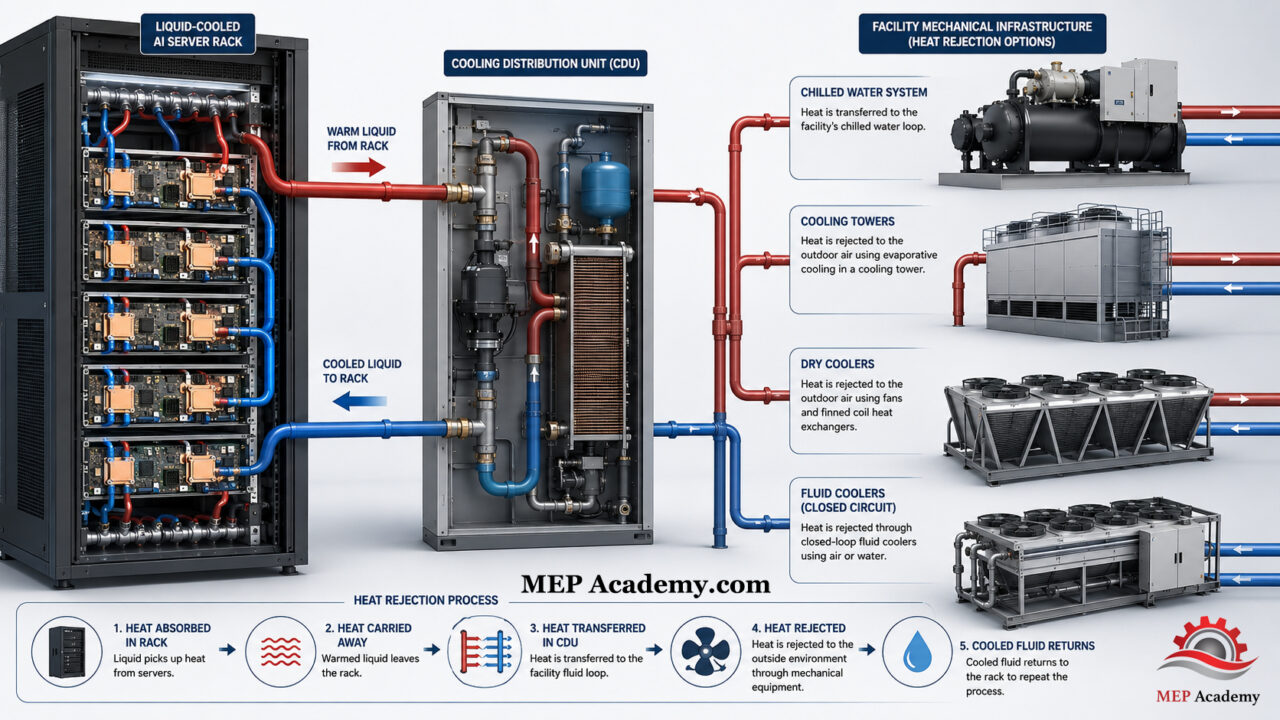
Removing heat from the server is only part of the cooling process.
Eventually, the heat must leave the facility entirely.
After heat is transferred into the liquid cooling system, it is rejected through the facility’s mechanical infrastructure.
This may include:
Chilled Water Systems
Many data centers utilize central chilled water plants to absorb heat from liquid cooling systems.
Cooling Towers
Cooling towers reject heat to the atmosphere through evaporative cooling.
Dry Coolers
Dry coolers transfer heat directly to outdoor air using finned coils and fans.
Fluid Coolers
Fluid coolers combine elements of dry cooling and evaporative cooling to improve efficiency.
The exact configuration depends on the data center design, climate, reliability requirements, and operating strategy.
Regardless of the equipment used, the goal remains the same:
Move heat from the processors to the outdoors.
Why Liquid Cooling Is Becoming the New Standard
Artificial Intelligence continues to drive higher rack densities.
As computing power increases, cooling systems must evolve.
Liquid cooling offers several important advantages:
- Higher rack densities
- Improved cooling efficiency
- Reduced airflow requirements
- Lower fan energy consumption
- Better use of data center floor space
- Support for next-generation AI hardware
Many industry experts believe future AI facilities will be designed around liquid cooling from the beginning rather than treating it as an optional enhancement.
For high-density AI computing, liquid cooling is rapidly becoming a necessity rather than a luxury.
Air Cooling vs Liquid Cooling
| Feature | Air Cooling | Liquid Cooling |
|---|---|---|
| Heat Transfer Efficiency | Lower | Higher |
| Rack Density Support | Lower | Higher |
| Fan Energy Consumption | Higher | Lower |
| Infrastructure Complexity | Lower | Higher |
| AI Workload Capability | Limited at High Density | Excellent |
| Future Scalability | Moderate | High |
Conclusion
For decades, air cooling served as the foundation of data center thermal management.
Today, AI is changing the rules.
As rack power densities continue to rise, liquid cooling technologies such as direct-to-chip cooling and immersion cooling are becoming critical components of modern data center design.
Whether using cold plates mounted directly on GPUs or entire immersion tanks filled with dielectric fluid, the objective remains the same:
Remove heat more efficiently so computing systems can operate at higher performance levels.
As artificial intelligence continues to expand, liquid cooling will play a central role in supporting the next generation of data center infrastructure.
Currently Published
- How Data Centers Actually Work
An overview of how modern data centers operate, explaining the critical electrical, mechanical, and IT infrastructure required to keep servers running 24/7. - Data Center Power Flow: From Utility Grid to Server Rack
Learn how electrical power travels from the utility grid through switchgear, UPS systems, generators, and distribution equipment before reaching server racks. - Data Center Cooling Methods Explained
Learn how CRAC units, chilled water systems, and airflow management remove heat from server environments. - Data Center Redundancy Explained (N, N+1, and 2N Systems)
Understand how redundancy strategies like N, N+1, and 2N designs protect data centers from outages and ensure continuous operation. - How Data Center Electrical Systems Work
Understand how data center electrical systems deliver continuous power using switchgear, UPS systems, generators, and redundancy design. - Data Center Refrigerant Economizer
Discover how refrigerant economizer systems improve cooling efficiency by using outdoor conditions to reduce compressor operation and lower energy consumption. - Data Center HVAC Systems
- How Data Center UPS Systems Work
Understand how UPS systems provide instant backup power and protect data centers from outages and power disruptions. - Hot Aisle vs Cold Aisle Containment
Hot aisle vs cold aisle containment explained. Learn how airflow control improves data center cooling efficiency and reduces energy costs. - Data Center Chilled Water Systems Explained
Learn how chilled water systems cool data centers, including chillers, CRAH units, pumps, and how the entire system removes heat efficiently. - CRAC vs CRAH Units Explained
Learn the difference between Computer Room Air Conditioners and Computer Room Air Handlers, including how DX refrigerant cooling compares with chilled water cooling in data center environments. - Air-Cooled vs Water-Cooled Data Centers
Learn the difference between Computer Room Air Conditioners and Computer Room Air Handlers, including how DX refrigerant cooling compares with chilled water cooling in data center environments. - Immersion Cooling Explained
Discover how immersion cooling is transforming AI data centers by submerging servers in a non-conductive dielectric fluid for highly efficient heat removal. Learn how single-phase and two-phase immersion cooling work, why AI is driving their adoption, and how these systems compare to traditional air cooling. - AI Data Centers Explained
Learn how high-density GPU data centers deliver massive amounts of electrical power and remove the resulting heat using liquid cooling, CDUs, and advanced cooling infrastructure.