



Artificial intelligence is changing data centers faster than any technological shift in decades. As AI processors become more powerful, they consume more electricity and generate unprecedented amounts of heat. That heat must be removed efficiently, or the servers will overheat, throttle performance, or even fail.
For years, data centers have relied on sophisticated air-cooling systems to keep servers operating within safe temperature limits. Cold air is delivered to the front of server racks, server fans pull that air across processors and memory, and the heated air is exhausted into a hot aisle where mechanical cooling systems remove the heat from the building.
This approach has served the industry remarkably well.
However, today’s AI servers are creating a new engineering challenge.
Modern AI racks can consume well over 100 kilowatts of power, and some next-generation deployments are approaching or exceeding 200 kilowatts per rack. At these power densities, simply moving more air through the data hall becomes increasingly difficult, inefficient, and expensive.
The industry is reaching a point where traditional air cooling is no longer the most practical solution for every application.
That’s why many of the world’s largest technology companies are investing heavily in immersion cooling.
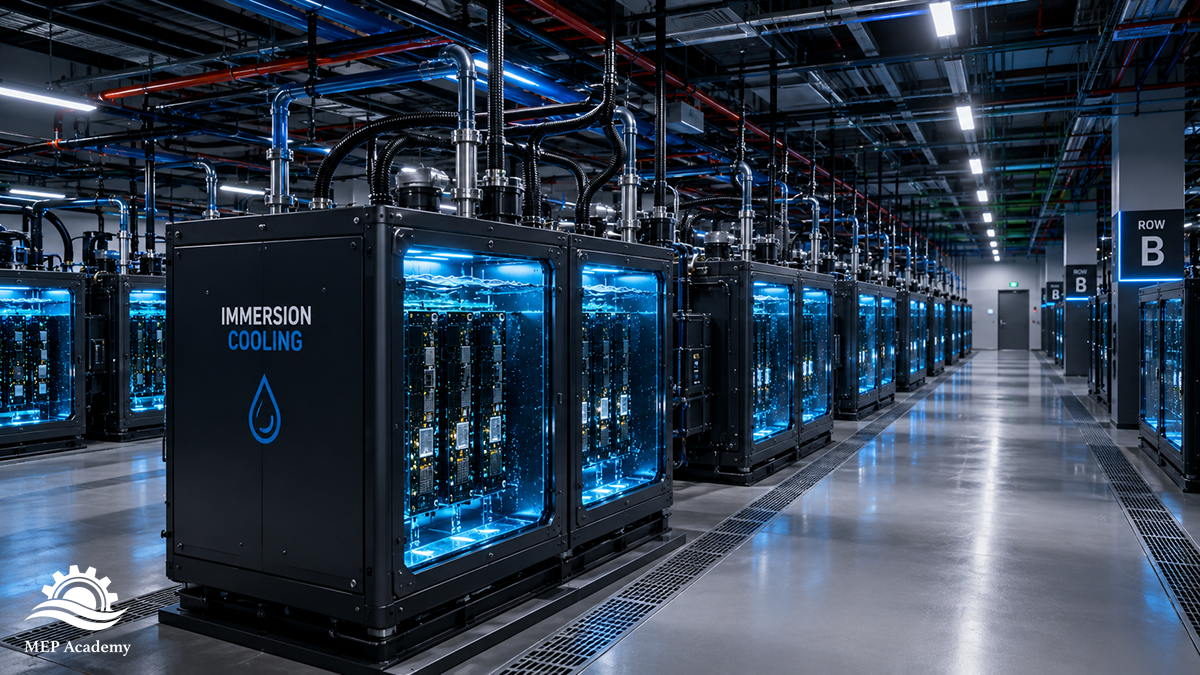
Unlike conventional cooling systems that cool the surrounding room, immersion cooling places the servers directly into a specially engineered dielectric liquid that safely absorbs heat from the electronic components. Because the fluid does not conduct electricity, the servers continue operating normally while completely submerged.
At first glance, the concept seems almost unbelievable.
After all, we’ve all been taught that electronics and liquids don’t mix.
Yet immersion cooling is rapidly becoming one of the most promising technologies for supporting artificial intelligence, machine learning, high-performance computing (HPC), scientific research, and other extremely demanding computing applications.
In this article, we’ll explain:
- What immersion cooling is
- Why AI is driving its rapid adoption
- How immersion cooling actually works
- The difference between single-phase and two-phase immersion cooling
- How heat ultimately leaves the building
- The advantages and disadvantages of immersion cooling
- Why future AI data centers may look completely different from today’s facilities
Whether you’re a mechanical engineer, contractor, estimator, project manager, facility engineer, data center professional, or simply curious about the technology powering artificial intelligence, understanding immersion cooling provides valuable insight into where the industry is heading.
Why Traditional Air Cooling Is Reaching Its Limits
To understand why immersion cooling is gaining attention, it’s important to first understand the limitations of conventional air cooling.
In a traditional data center, cooling follows a relatively straightforward process:
- Computer Room Air Handlers (CRAHs), Computer Room Air Conditioners (CRACs), or other cooling equipment supply cold air to the data hall.
- Cold air enters the front of each server rack through the cold aisle.
- Thousands of small server fans pull that air across CPUs, GPUs, memory modules, power supplies, and other electronic components.
- The air absorbs heat generated by the equipment.
- Hot air exits the rear of the racks into the hot aisle.
- Mechanical cooling equipment removes that heat from the building before the cycle repeats.
For decades, this approach worked exceptionally well because server power densities remained relatively low.
Increased Computing Demand
As computing requirements increased, however, rack power consumption climbed steadily:
- 5–10 kW per rack
- 15–20 kW per rack
- 30–50 kW per rack
- 60–100 kW per rack
Now, AI is pushing rack densities to levels that were once considered impossible.
Moving enough air to cool these systems presents several challenges:
- Larger server fans consume more electrical power.
- Higher airflow increases pressure losses.
- Cooling equipment becomes larger and more complex.
- Airflow management becomes increasingly difficult.
- Hot spots become harder to eliminate.
- Mechanical infrastructure occupies more building space.
In simple terms, air is no longer the ideal medium for transporting extremely large amounts of heat.
Liquid, on the other hand, is far more effective.
Because liquids have much greater density and heat capacity than air, they can absorb and transport significantly more thermal energy using far less volume.
Instead of moving enormous quantities of air through an entire room, immersion cooling removes heat directly where it is generated—inside the server itself.
This fundamental shift is changing how engineers think about cooling AI infrastructure.
How Immersion Cooling Works
The concept behind immersion cooling is surprisingly straightforward.
Instead of cooling the room…
The cooling system cools the servers directly.
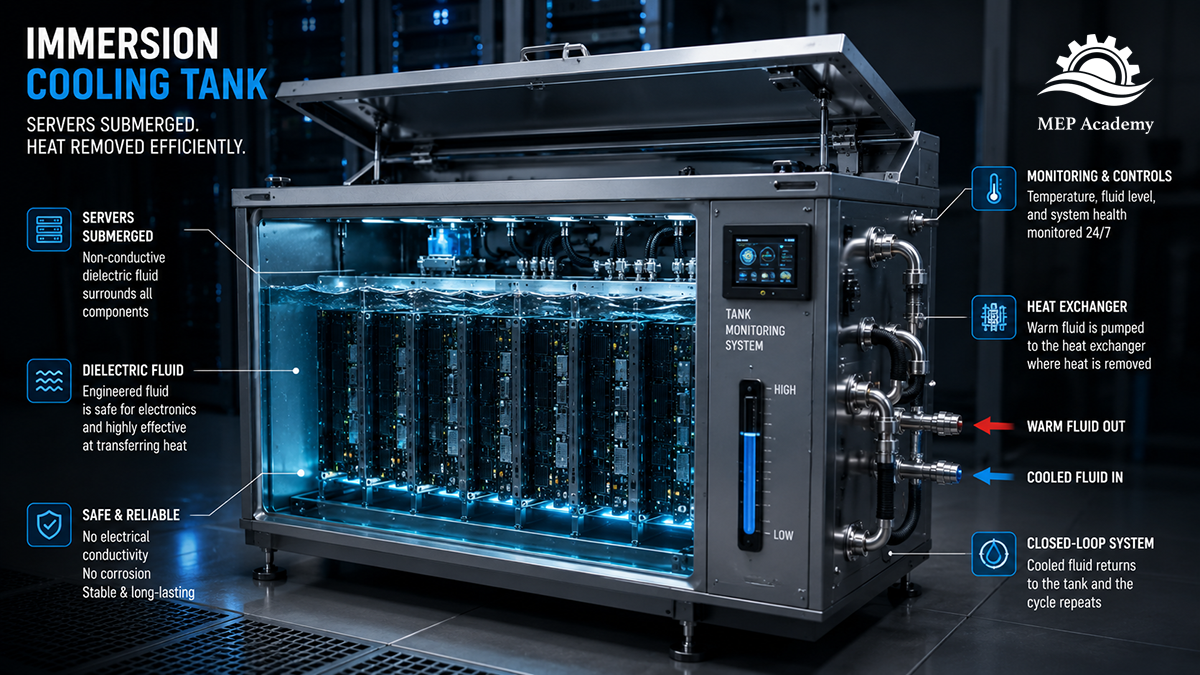
Servers are installed inside specially designed tanks filled with a dielectric fluid. Unlike water, dielectric fluids do not conduct electricity, allowing electronic components to operate safely while completely submerged.
As processors, graphics processing units (GPUs), memory modules, and other electronic components generate heat, that heat transfers directly into the surrounding liquid.
The warmed dielectric fluid then circulates through a heat exchanger, where its heat is transferred into a separate facility water loop. After the fluid is cooled, it returns to the immersion tank, where the cycle repeats continuously.
The building’s mechanical cooling system still plays an important role. The heat absorbed by the dielectric fluid is ultimately rejected outdoors through cooling towers, dry coolers, fluid coolers, or chilled water systems, depending on the facility design.
The key difference is that the servers are no longer cooled by moving massive amounts of air through the data hall. Instead, heat is captured immediately at its source and transported efficiently by liquid.
How It Works Diagram
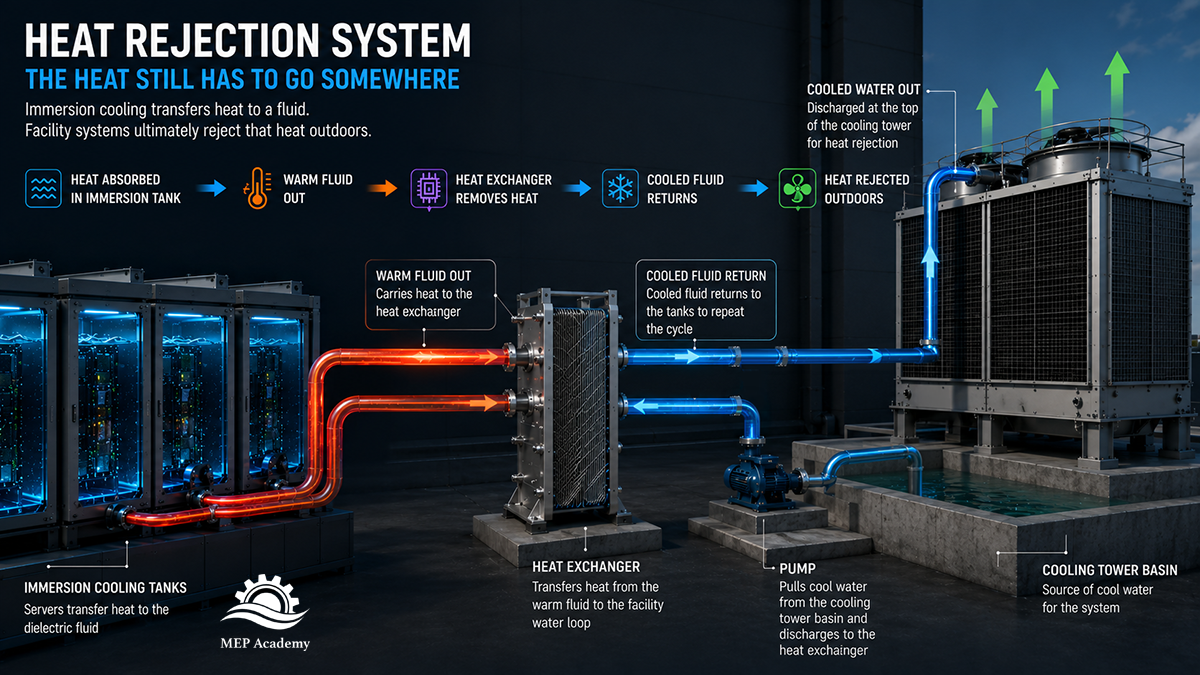
The simplified diagram illustrates the basic heat flow through an immersion cooling system.
- Servers generate heat while operating inside a dielectric fluid.
- The dielectric fluid absorbs heat from the electronic components.
- Warm dielectric fluid flows through a heat exchanger.
- Heat transfers into the facility water loop.
- Cooling water is pumped from the cooling tower basin through the heat exchanger.
- Warm condenser water returns to the top of the cooling tower.
- The cooling tower rejects the heat to the atmosphere.
- The cooled water collects in the basin, and the cycle repeats.
Unlike conventional air-cooled facilities, the majority of heat transport occurs through liquid piping rather than airflow within the data hall.
Although the cooling method has changed dramatically, the basic laws of thermodynamics have not. Every watt of electrical energy consumed by the servers ultimately becomes heat that must be rejected outside the building.
Understanding this complete heat-transfer path is essential for anyone involved in designing, constructing, operating, or maintaining modern AI data centers.
Single-Phase vs. Two-Phase Immersion Cooling
Although the basic principle of immersion cooling remains the same—submerging electronic equipment in a non-conductive dielectric fluid—there are two distinct methods used to remove heat from the servers.
These are known as single-phase immersion cooling and two-phase immersion cooling.
Both technologies eliminate the need to cool servers with room air, but they transfer heat in different ways.
Single-Phase Immersion Cooling
Single-phase immersion cooling is currently the most widely deployed immersion cooling technology.
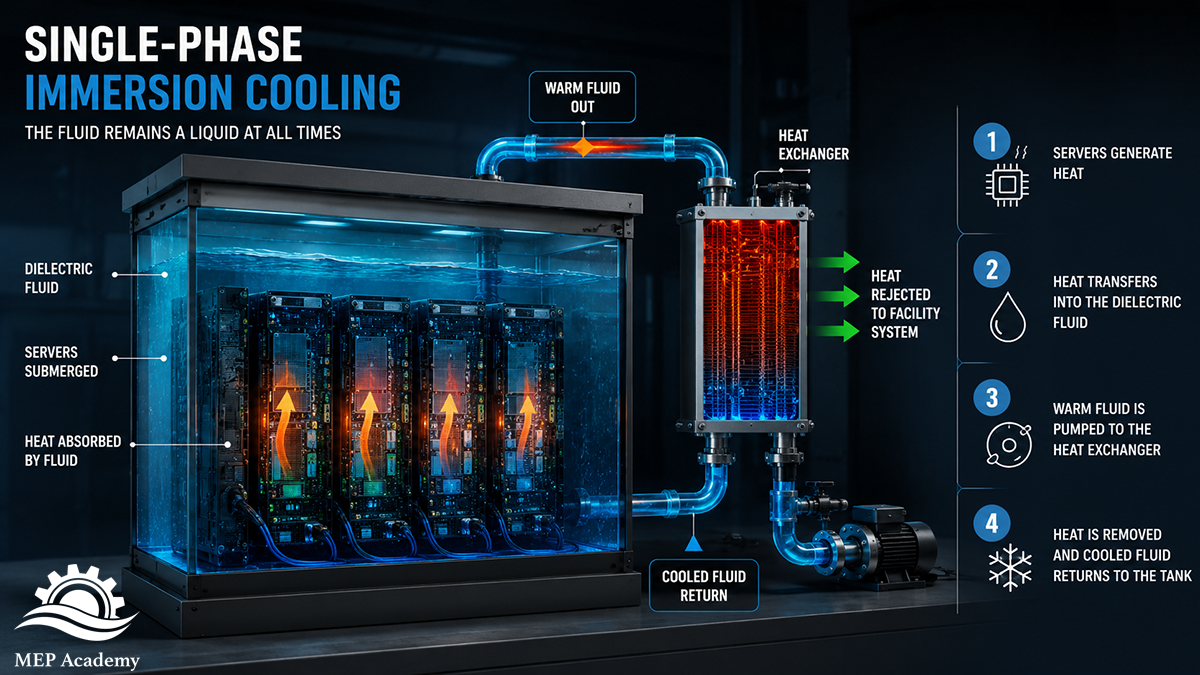
In a single-phase system, the dielectric fluid remains a liquid throughout the entire cooling process. It never boils or changes state.
Servers are mounted vertically inside a sealed immersion tank filled with dielectric fluid. As CPUs, GPUs, memory, and power electronics generate heat, that heat transfers directly into the surrounding liquid.
A circulation pump moves the warmed dielectric fluid through a heat exchanger, where heat is transferred into a separate facility water loop. The cooled dielectric fluid then returns to the immersion tank, creating a continuous closed-loop cooling cycle.
Because the fluid never changes phase, these systems are relatively straightforward to design, operate, and maintain.
Many manufacturers prefer this approach because it uses familiar pumping and heat exchanger technologies while still providing dramatically better cooling performance than conventional air cooling.
Insert Image Here
Two-Phase Immersion Cooling
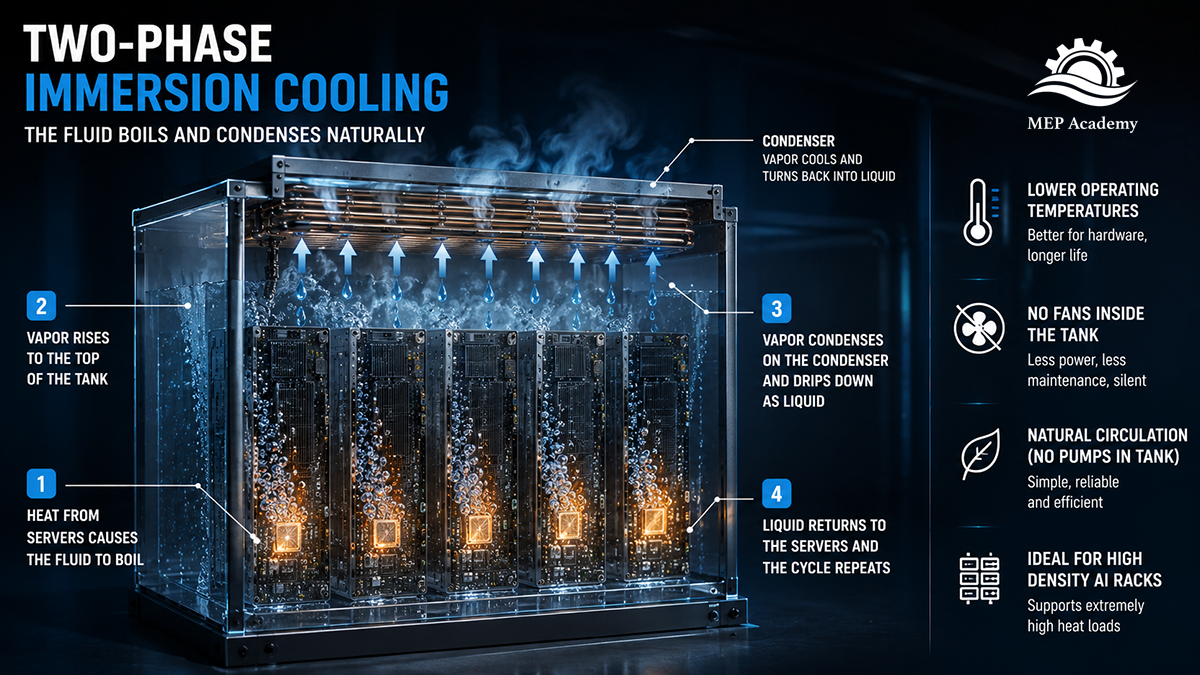
Two-phase immersion cooling operates on an entirely different principle.
Instead of remaining a liquid, the dielectric fluid is intentionally selected to boil at relatively low temperatures.
As processors become hot, the surrounding dielectric fluid begins boiling directly on the electronic components.
This boiling process absorbs enormous amounts of heat.
The resulting vapor naturally rises toward the top of the immersion tank, where it contacts a condenser supplied with cooler facility water.
The vapor condenses back into liquid droplets that fall back into the tank, repeating the cycle continuously.
One interesting characteristic of two-phase immersion cooling is that no circulation pumps are required inside the immersion tank itself.
Gravity and phase change perform much of the work.
The process resembles a miniature water cycle:
- Liquid absorbs heat.
- Liquid boils.
- Vapor rises.
- Vapor condenses.
- Liquid falls back into the tank.
The cycle repeats continuously.
Although two-phase systems offer exceptional heat transfer capabilities, they generally require more specialized fluids and carefully engineered containment systems, making them more complex than single-phase designs.
Insert Image Here
Single-Phase vs. Two-Phase Comparison
| Feature | Single-Phase | Two-Phase |
|---|---|---|
| Dielectric fluid remains liquid | ✔ Yes | ✘ No |
| Fluid boils during operation | ✘ No | ✔ Yes |
| Internal circulation pump required | ✔ Yes | Usually No |
| Uses condenser inside tank | ✘ No | ✔ Yes |
| System complexity | Lower | Higher |
| Maintenance complexity | Lower | Higher |
| Typical applications | AI, HPC, enterprise data centers | Extremely high-density AI and research computing |
| Technology maturity | More common today | Growing rapidly |
Both technologies dramatically outperform traditional air cooling at high rack densities.
Which solution is selected depends on numerous factors including equipment compatibility, rack density, facility design, maintenance philosophy, operating costs, and owner preferences.
Why Artificial Intelligence Is Driving Immersion Cooling
Artificial intelligence is fundamentally changing the way data centers are designed.
For decades, most enterprise servers handled workloads such as databases, web hosting, email, virtualization, and business applications. These servers generated manageable amounts of heat, allowing traditional air-cooling systems to perform effectively.
AI workloads are different.
Training large language models, performing machine learning, rendering complex simulations, and executing scientific calculations require enormous numbers of Graphics Processing Units (GPUs) operating simultaneously.
Unlike traditional CPUs, modern GPUs can consume several hundred watts each, with the latest generations approaching or exceeding 1,000 watts per processor.
A single AI server may contain:
- Multiple high-performance GPUs
- High-speed memory
- Multiple CPUs
- High-capacity networking hardware
- Large power supplies
When dozens of these servers are installed into one rack, power densities increase dramatically.
Instead of cooling a 10-kilowatt rack, engineers may now be cooling a rack exceeding 100 kilowatts—and in some next-generation AI deployments, over 200 kilowatts.
This creates several engineering challenges.
Traditional air cooling requires:
- Larger CRAH or CRAC units
- Higher airflow volumes
- More fan power
- Increased ductwork or air distribution
- More careful airflow management
- Greater building mechanical capacity
Eventually, simply moving more air becomes impractical.
Liquid cooling solves this problem by transporting heat much more efficiently.
Because liquids have significantly higher heat capacity than air, much smaller volumes can carry the same amount of thermal energy.
This allows AI processors to operate at much higher performance levels while maintaining acceptable operating temperatures.
For this reason, many of the world’s largest technology companies—including hyperscale cloud providers and AI developers—are investing billions of dollars in liquid cooling technologies, including immersion cooling and direct-to-chip cooling.
As AI continues to evolve, cooling technology must evolve with it.
Advantages of Immersion Cooling
Immersion cooling offers numerous advantages over conventional air cooling, particularly for high-density computing applications.
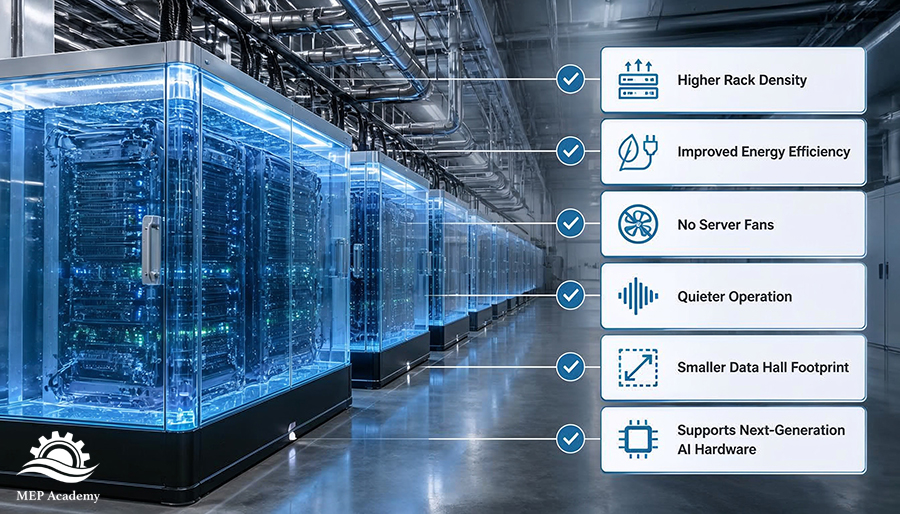
Higher Rack Densities
Perhaps the greatest benefit is the ability to support significantly higher rack power densities.
Instead of being limited by airflow, immersion cooling removes heat directly from the electronic components, allowing much greater computing capacity within the same floor area.
Improved Energy Efficiency
Traditional servers require thousands of high-speed fans that consume electricity around the clock.
Immersion-cooled servers often eliminate most or all internal server fans, reducing electrical consumption while simplifying airflow management.
This reduction in fan energy can improve overall facility efficiency.
Better Temperature Uniformity
Air-cooled servers can develop localized hot spots where airflow is restricted.
Immersion cooling surrounds every component with dielectric fluid, creating much more uniform cooling throughout the server.
This consistent thermal environment can improve reliability and performance.
Reduced Noise
One of the first things visitors notice inside an immersion-cooled data center is how quiet it is.
Traditional server rooms can exceed 80 decibels due to thousands of rapidly spinning fans.
Because immersion-cooled servers eliminate most internal fans, noise levels are dramatically reduced.
Smaller Air Infrastructure
Many conventional cooling components become less important when server heat is removed directly by liquid.
Facilities may require fewer:
- Raised floor systems
- Perforated floor tiles
- Hot aisle containment systems
- Cold aisle containment systems
- Large air distribution pathways
Instead, the cooling infrastructure shifts toward liquid piping and heat exchangers.
Supports Future AI Hardware
Perhaps the greatest long-term advantage is scalability.
As AI processors continue increasing in power consumption, immersion cooling provides a practical path toward cooling the next generation of ultra-high-density computing hardware.
Disadvantages of Immersion Cooling
Although immersion cooling offers impressive benefits, it is not the ideal solution for every data center.
Like every engineering system, it involves tradeoffs.
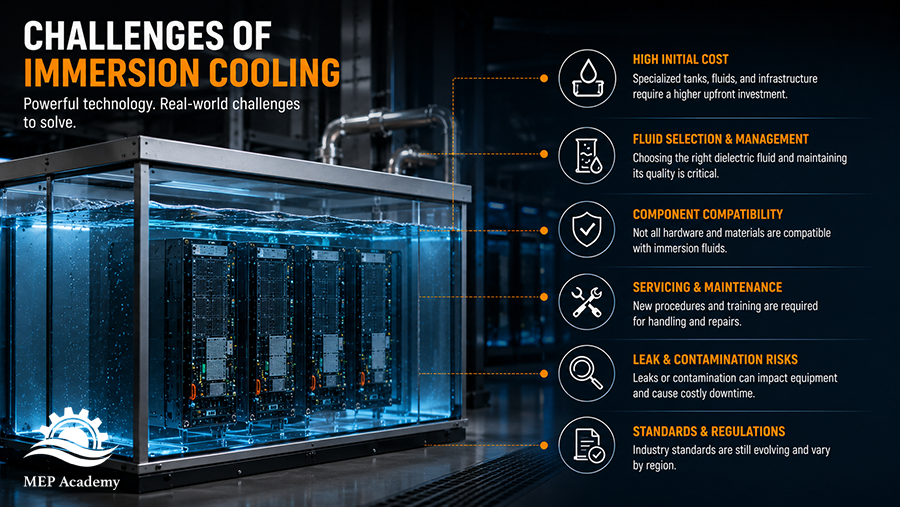
Higher Initial Cost
Immersion tanks, dielectric fluids, specialized infrastructure, and compatible hardware often require greater initial investment than conventional air-cooled systems.
However, many owners evaluate these costs over the facility’s entire operating life rather than considering only first cost.
Specialized Maintenance
Maintaining immersion-cooled servers differs from maintaining conventional servers.
Technicians must remove equipment from dielectric fluid, allow excess liquid to drain, and follow specialized maintenance procedures.
Personnel require additional training to safely service immersion systems.
Equipment Compatibility
Not every server is designed for immersion cooling.
Manufacturers may specify approved hardware configurations, compatible materials, and recommended dielectric fluids.
Compatibility should always be verified before deployment.
Fluid Management
Although dielectric fluids are engineered specifically for electronic cooling, they still require proper handling, storage, filtration, monitoring, and occasional replacement depending on the fluid chemistry and operating conditions.
Evolving Industry Standards
Immersion cooling remains a rapidly developing technology.
Industry standards, equipment designs, fluid chemistries, and maintenance practices continue to evolve as more AI facilities are built.
Organizations considering immersion cooling should carefully evaluate equipment vendors, long-term support, service availability, and future expansion plans.
Despite these challenges, industry experts generally expect liquid cooling technologies to play an increasingly important role as AI computing continues to grow.
Rather than replacing every air-cooled data center, immersion cooling is likely to become one of several specialized cooling strategies used where extremely high rack densities make conventional air cooling impractical.
Design Considerations for Engineers and Contractors
As immersion cooling becomes more common, the responsibilities of mechanical engineers, electrical engineers, contractors, commissioning agents, and facility owners are beginning to change. While the servers themselves may look dramatically different, the supporting infrastructure becomes even more important.
One of the biggest misconceptions is that immersion cooling eliminates the need for mechanical systems.
It does not.
It simply changes where heat is captured.
Instead of removing heat from room air, the mechanical system removes heat from a liquid loop. The same amount of heat must still leave the building because every watt of electrical energy consumed by the servers eventually becomes heat.
For engineers and contractors, this means designing and constructing a reliable heat rejection system becomes even more critical.
Mechanical System Design
Although immersion cooling reduces the need for large air-handling systems inside the data hall, the facility still requires robust mechanical infrastructure to reject heat outdoors.
Depending on the owner’s design criteria, this may include:
- Chilled water systems
- Cooling towers
- Dry coolers
- Fluid coolers
- Plate-and-frame heat exchangers
- Pumps and piping systems
- Expansion tanks
- Water treatment systems
- Filtration equipment
Rather than designing airflow through a room, engineers are increasingly designing liquid distribution systems that move heat efficiently throughout the facility.
Piping Infrastructure
Liquid-cooled data centers contain considerably more piping than traditional air-cooled facilities.
Design considerations include:
- Supply and return piping
- Pump redundancy
- Isolation valves
- Balancing valves
- Air elimination
- Expansion control
- Leak detection
- Equipment isolation for maintenance
- Future expansion capacity
Many AI facilities also incorporate redundant cooling loops so maintenance can occur without shutting down critical computing equipment.
Electrical Infrastructure
Although immersion cooling reduces fan energy within the servers, AI equipment still requires enormous amounts of electrical power.
Electrical engineers must consider:
- Larger electrical services
- Higher-capacity switchgear
- UPS systems
- Standby generators
- Busways
- Rack power distribution
- Grounding systems
- Monitoring equipment
The cooling method changes.
The electrical demand continues to grow.
Structural Considerations
Immersion cooling tanks are considerably heavier than conventional server racks.
Remember that each tank contains:
- Servers
- Steel framework
- Heat exchangers
- Hundreds or even thousands of pounds of dielectric fluid
Structural engineers must verify:
- Floor loading
- Equipment anchorage
- Seismic restraints
- Access pathways
- Equipment replacement clearances
These loads can be substantially greater than traditional raised-floor server installations.
Maintenance Access
One design aspect that is sometimes overlooked is serviceability.
Engineers should provide adequate space for:
- Opening tank lids
- Removing server modules
- Servicing pumps
- Cleaning heat exchangers
- Fluid filtration
- Fluid replacement
- Crane or lifting equipment where required
Just because the equipment is compact does not mean it requires less maintenance space.
Proper access remains essential throughout the life of the facility.
Commissioning Considerations
Commissioning becomes even more important with immersion cooling systems.
Testing may include:
- Fluid circulation verification
- Pump operation
- Temperature monitoring
- Flow verification
- Leak testing
- Heat exchanger performance
- Control sequence verification
- Alarm testing
- Emergency shutdown procedures
Like any mission-critical infrastructure, successful startup depends on careful planning and comprehensive testing.
Common Misconceptions About Immersion Cooling
Because immersion cooling is relatively new to many people, several misconceptions continue to circulate.
Let’s clear up some of the most common ones.
Misconception #1: The Servers Are Underwater
This is probably the biggest misconception.
Servers are not submerged in water.
They operate inside specially engineered dielectric fluids that do not conduct electricity.
These fluids are specifically developed for cooling electronic equipment while providing electrical insulation.
Misconception #2: Immersion Cooling Eliminates HVAC Systems
Not even close.
The heat still has to leave the building.
Immersion cooling changes how heat is collected—not whether heat must be rejected.
Most immersion-cooled facilities still rely on cooling towers, dry coolers, fluid coolers, chilled water systems, pumps, heat exchangers, and sophisticated control systems.
Mechanical engineers remain an essential part of every immersion-cooled data center.
Misconception #3: The Entire Data Center Is Filled With Liquid
Only the servers are immersed.
The remainder of the facility still contains electrical rooms, UPS equipment, batteries, generators, switchgear, transformers, networking equipment, offices, maintenance areas, and numerous other support spaces.
Many of these areas continue using conventional HVAC systems.
Misconception #4: Immersion Cooling Is Replacing Every Data Center
Not necessarily.
Air cooling remains an excellent solution for many facilities.
Direct-to-chip cooling is also growing rapidly.
Future data centers will likely use multiple cooling strategies depending on rack density, application, owner preference, and total cost of ownership.
Immersion cooling is one important tool—not the only tool.
Misconception #5: There Are No Fans Anywhere
Although immersion-cooled servers often eliminate internal server fans, many facilities still use fans elsewhere.
Cooling towers, dry coolers, electrical equipment, generators, transformers, and HVAC systems frequently include fans.
The overall facility is quieter, but fans have certainly not disappeared entirely.
The Future of Immersion Cooling
Only a few years ago, immersion cooling was considered a niche technology used primarily in research laboratories and specialized high-performance computing facilities.
Today, the conversation has changed dramatically.
Artificial intelligence has accelerated demand for computing infrastructure at an unprecedented pace.
Every new generation of AI hardware produces more computing power.
More computing power consumes more electricity.
electricity generates more heat.
More heat requires better cooling technologies.
This cycle continues with every new generation of processors.
Industry analysts expect liquid cooling—including both immersion cooling and direct-to-chip cooling—to become increasingly common in hyperscale AI facilities over the next decade.
That does not necessarily mean traditional air-cooled data centers will disappear.
Instead, future facilities may use several different cooling technologies within the same campus.
For example:
- Traditional enterprise servers may remain air cooled.
- Medium-density AI clusters may use direct-to-chip cooling.
- Ultra-high-density AI training clusters may use immersion cooling.
Each technology has strengths, and owners will select the approach that best fits their operational requirements.
One trend, however, appears increasingly clear.
Mechanical infrastructure will become more important—not less.
The future AI data center will likely contain:
- Larger liquid distribution systems
- More heat exchangers
- More sophisticated controls
- Increased monitoring
- Greater redundancy
- Higher-capacity heat rejection equipment
As computing evolves, so must the buildings that support it.
Key Takeaways
Immersion cooling represents one of the most significant changes in data center cooling technology in decades.
Rather than relying on air to remove heat from electronic equipment, immersion cooling places servers directly into a dielectric liquid capable of absorbing enormous amounts of thermal energy.
As artificial intelligence continues increasing rack power densities, this technology provides a practical method for cooling hardware that would be difficult—or even impossible—to cool efficiently with air alone.
The most important concepts to remember are:
- Immersion cooling submerges servers in a non-conductive dielectric fluid—not water.
- The dielectric fluid absorbs heat directly from the electronic components.
- Heat is transferred through heat exchangers into the facility water system.
- Mechanical systems still reject that heat outdoors using cooling towers, dry coolers, fluid coolers, or chilled water systems.
- Single-phase systems circulate liquid dielectric fluid, while two-phase systems use boiling and condensation to transfer heat.
- Immersion cooling supports much higher rack power densities than conventional air cooling.
- Engineers, contractors, and facility owners must still design robust mechanical, electrical, structural, and control systems to support these installations.
- As AI infrastructure continues expanding, immersion cooling is expected to become an increasingly important solution for high-density computing environments.
While immersion cooling may not replace every traditional data center, it is already reshaping how engineers think about cooling the next generation of artificial intelligence infrastructure. Understanding this technology today provides valuable insight into where the industry is headed tomorrow.
Frequently Asked Questions
Immersion cooling is a liquid cooling technology in which servers are completely submerged in a specially engineered dielectric fluid that does not conduct electricity. The fluid absorbs heat directly from electronic components and transfers that heat to the building’s mechanical cooling system through a heat exchanger.
Unlike conventional air cooling, immersion cooling removes heat directly at the source rather than cooling the surrounding room air.
Dielectric fluid is a specially formulated liquid designed for cooling electronic equipment.
Unlike water, dielectric fluids do not conduct electricity, allowing powered electronic components to operate safely while submerged.
These fluids also provide excellent thermal transfer characteristics, making them highly effective for removing heat from processors, GPUs, memory modules, and other electronic components.
Neither cooling method is universally better.
Traditional air cooling remains an excellent solution for many enterprise data centers with moderate rack densities.
Immersion cooling becomes increasingly attractive as rack power densities rise because liquid transfers heat much more efficiently than air.
For very high-density AI computing, immersion cooling can often support higher performance while reducing airflow requirements and improving energy efficiency.
The biggest difference is how the heat is removed.
With immersion cooling, the entire server is submerged in dielectric fluid.
With direct-to-chip cooling, cold plates are attached directly to high-heat components such as CPUs and GPUs, while much of the remaining server continues to be cooled by air.
Both technologies are forms of liquid cooling, but they use different approaches to remove heat.
No.
This is one of the most common misconceptions.
Immersion cooling changes how heat is collected—not how it ultimately leaves the building.
The heat must still be rejected outdoors using mechanical systems such as:
Cooling towers
Dry coolers
Fluid coolers
Chilled water systems
Pumps
Heat exchangers
Mechanical infrastructure remains an essential part of every immersion-cooled facility.
Because immersion cooling uses dielectric fluids rather than water.
Dielectric fluids are electrically non-conductive, meaning they do not create short circuits when they contact electronic components.
The fluids are specifically engineered for electronic cooling applications.
Not always.
Although some standard server hardware can be adapted for immersion cooling, many manufacturers now offer equipment specifically designed or certified for immersion applications.
Compatibility with materials, connectors, thermal interfaces, and fluid chemistry should always be confirmed before deployment.
In many cases, yes.
Because the dielectric fluid removes heat directly from the electronic components, immersion-cooled servers often do not require the high-speed internal fans found in traditional air-cooled servers.
Removing these fans can reduce electrical consumption, decrease noise levels, and simplify server design.
However, fans may still be used elsewhere in the facility, such as on cooling towers, dry coolers, generators, or other mechanical equipment.
No.
Although AI is currently driving much of the industry’s growth, immersion cooling has been used for years in:
High-performance computing (HPC)
Scientific research
Cryptocurrency mining
Government computing
Defense applications
Supercomputers
Artificial intelligence has simply accelerated adoption because of its exceptionally high computing and cooling requirements.
Yes—when properly designed, installed, and maintained.
Modern immersion cooling systems include engineered tanks, compatible dielectric fluids, monitoring systems, leak detection, filtration systems, temperature controls, and established maintenance procedures.
Like any engineered mechanical system, safety depends on proper design, installation, commissioning, and operation.
It can be.
By eliminating many server fans and reducing the amount of air that must be moved through the data hall, immersion cooling can lower cooling energy requirements.
The actual efficiency improvements depend on the overall facility design, climate, operating conditions, and heat rejection system.
Probably not.
The future will likely include multiple cooling technologies working side by side.
Many enterprise facilities will continue using traditional air cooling.
Direct-to-chip cooling is expected to grow rapidly for AI workloads.
Immersion cooling will likely be used where extremely high rack densities justify its advantages.
The cooling technology selected will depend on the application’s performance requirements, cost, maintainability, and overall design objectives.
The primary reason is artificial intelligence.
Modern AI processors generate far more heat than traditional enterprise servers.
As rack power densities continue increasing, conventional air cooling becomes more difficult and expensive to scale.
Immersion cooling provides an efficient method for removing large amounts of heat directly from the computing hardware, making it an increasingly attractive solution for next-generation AI data centers.
Mechanical engineers, electrical engineers, contractors, and commissioning teams should understand that immersion cooling changes the cooling strategy but does not eliminate the need for robust infrastructure.
Successful immersion-cooled data centers still require carefully designed:
Mechanical cooling systems
Heat rejection equipment
Pumping systems
Heat exchangers
Electrical distribution
Structural support
Controls and monitoring
Commissioning procedures
Preventive maintenance programs
As AI infrastructure expands, understanding liquid cooling technologies will become increasingly valuable for professionals involved in designing, constructing, and operating modern data centers.
Currently Published
- How Data Centers Actually Work
An overview of how modern data centers operate, explaining the critical electrical, mechanical, and IT infrastructure required to keep servers running 24/7. - Data Center Power Flow: From Utility Grid to Server Rack
Learn how electrical power travels from the utility grid through switchgear, UPS systems, generators, and distribution equipment before reaching server racks. - Data Center Cooling Methods Explained
Learn how CRAC units, chilled water systems, and airflow management remove heat from server environments. - Data Center Redundancy Explained (N, N+1, and 2N Systems)
Understand how redundancy strategies like N, N+1, and 2N designs protect data centers from outages and ensure continuous operation. - How Data Center Electrical Systems Work
Understand how data center electrical systems deliver continuous power using switchgear, UPS systems, generators, and redundancy design. - Data Center Refrigerant Economizer
Discover how refrigerant economizer systems improve cooling efficiency by using outdoor conditions to reduce compressor operation and lower energy consumption. - Data Center HVAC Systems
- How Data Center UPS Systems Work
Understand how UPS systems provide instant backup power and protect data centers from outages and power disruptions. - Hot Aisle vs Cold Aisle Containment
Hot aisle vs cold aisle containment explained. Learn how airflow control improves data center cooling efficiency and reduces energy costs. - Data Center Chilled Water Systems Explained
Learn how chilled water systems cool data centers, including chillers, CRAH units, pumps, and how the entire system removes heat efficiently. - CRAC vs CRAH Units Explained
Learn the difference between Computer Room Air Conditioners and Computer Room Air Handlers, including how DX refrigerant cooling compares with chilled water cooling in data center environments. - Air-Cooled vs Water-Cooled Data Centers
Learn the difference between Computer Room Air Conditioners and Computer Room Air Handlers, including how DX refrigerant cooling compares with chilled water cooling in data center environments. - Immersion Cooling Explained
Discover how immersion cooling is transforming AI data centers by submerging servers in a non-conductive dielectric fluid for highly efficient heat removal. Learn how single-phase and two-phase immersion cooling work, why AI is driving their adoption, and how these systems compare to traditional air cooling.