


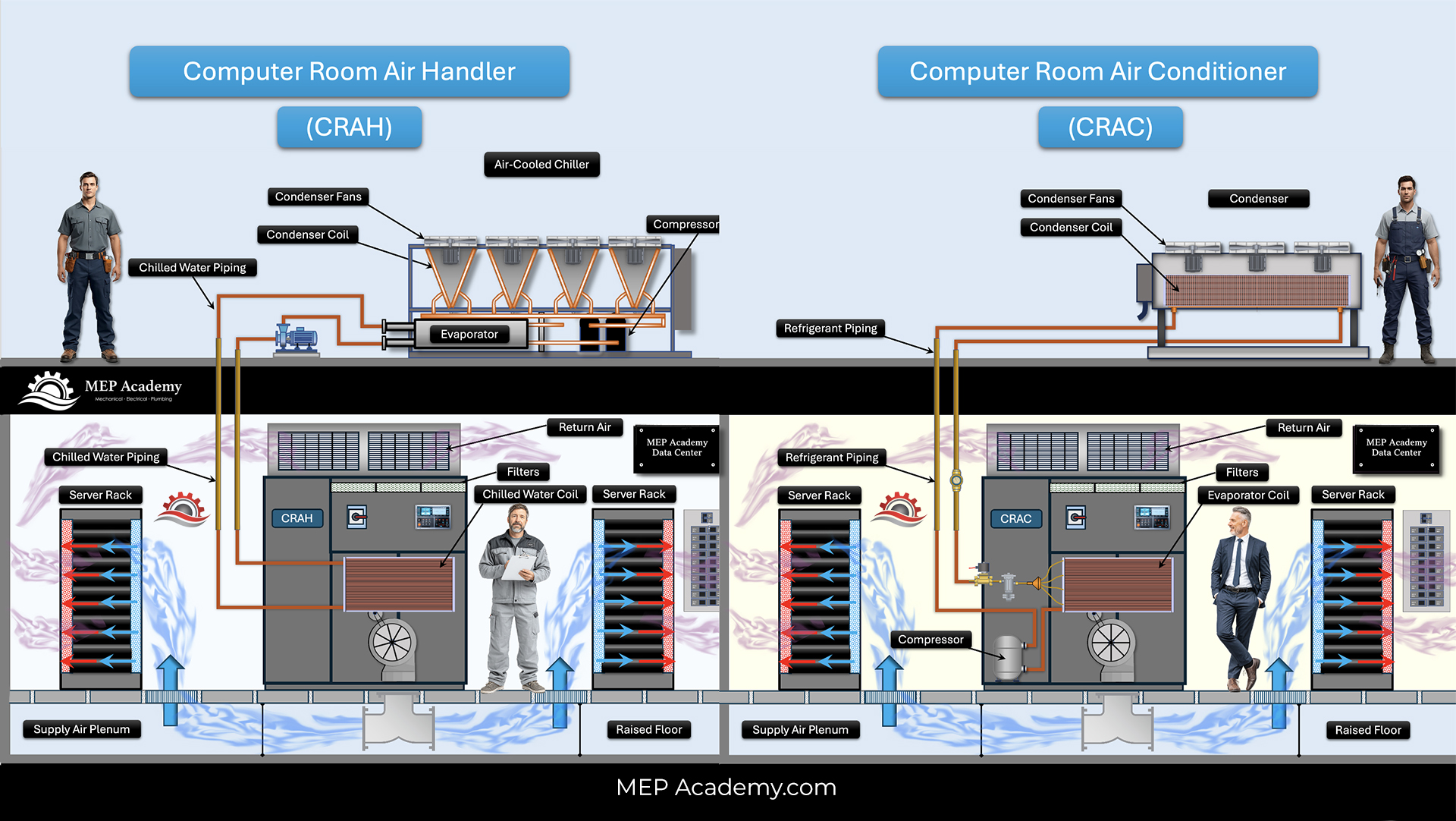
Data centers generate heat every second of every day. Servers, storage equipment, network switches, UPS systems, power distribution equipment, and high-density computing racks all produce heat that must be removed continuously.
If that heat is not removed, the result can be thermal throttling, equipment alarms, reduced server life, emergency shutdowns, or complete data center failure.
That is why data centers use precision cooling systems instead of ordinary comfort cooling systems.
Two of the most common room-based precision cooling systems used in data centers are CRAC units and CRAH units.
At first glance, they can look very similar. Both are large cooling cabinets. Both move air through the data center. And both help maintain temperature, humidity, and airflow. And both may be installed around the perimeter of the data hall, in mechanical galleries, or connected to raised floor or overhead air distribution systems.
But internally, they are very different.
A CRAC unit uses direct refrigeration.
A CRAH unit uses chilled water.
That one difference changes how the system is designed, how it is maintained, how much energy it uses, and where it is most commonly applied.
In this article, we’ll explain the difference between CRAC and CRAH units, how each system works, where they are used, and why this topic is becoming even more important as data centers move toward AI, high-density racks, and liquid cooling.
Watch the Video: CRAC vs CRAH Units Explained
In the video above, we explain the basic difference between CRAC and CRAH units and how they are used in data center cooling systems.
This article expands on that explanation with additional details for contractors, engineers, estimators, technicians, facility operators, and anyone learning how data center mechanical systems work.
Quick Answer: What Is the Difference Between CRAC and CRAH?
The simplest way to understand the difference is this:
A CRAC unit is a Computer Room Air Conditioner.
It typically uses a refrigerant-based direct expansion cooling system with compressors.
A CRAH unit is a Computer Room Air Handler.
It uses chilled water from a central chiller plant and does not normally contain compressors inside the room unit.
In other words:
CRAC = Refrigerant-based cooling
CRAH = Chilled-water-based cooling
Both systems cool the data center, but they do it using different cooling sources.
CRAC vs CRAH Comparison Table
| Feature | CRAC Unit | CRAH Unit |
|---|---|---|
| Full Name | Computer Room Air Conditioner | Computer Room Air Handler |
| Primary Cooling Method | Direct expansion refrigeration | Chilled water |
| Cooling Medium | Refrigerant | Water |
| Compressor | Usually inside or directly associated with the CRAC system | Normally not inside the CRAH unit |
| Cooling Source | Built-in refrigeration circuit | Central chilled water plant |
| Common Applications | Smaller data centers, server rooms, telecom rooms, edge sites, older facilities | Large data centers, colocation facilities, hyperscale campuses, chilled water plants |
| Infrastructure Required | Condenser or heat rejection system | Chillers, pumps, piping, valves, cooling towers or dry coolers |
| Scalability | Good for smaller or modular applications | Better for large-scale cooling loads |
| Energy Efficiency | Can be efficient in smaller applications but less efficient at large scale | Often more efficient at large scale |
| Maintenance Focus | Compressors, refrigerant circuit, coils, fans, controls | Chilled water valves, coils, fans, pumps, chiller plant coordination |
| Typical System Type | DX cooling system | Chilled water air handling system |
This table gives the basic comparison, but the real value comes from understanding how each system actually works.
What Is a CRAC Unit?
CRAC stands for Computer Room Air Conditioner.
A CRAC unit is a precision cooling unit that works similarly to a traditional direct expansion air conditioning system. It uses a refrigerant circuit to remove heat from the data center air.
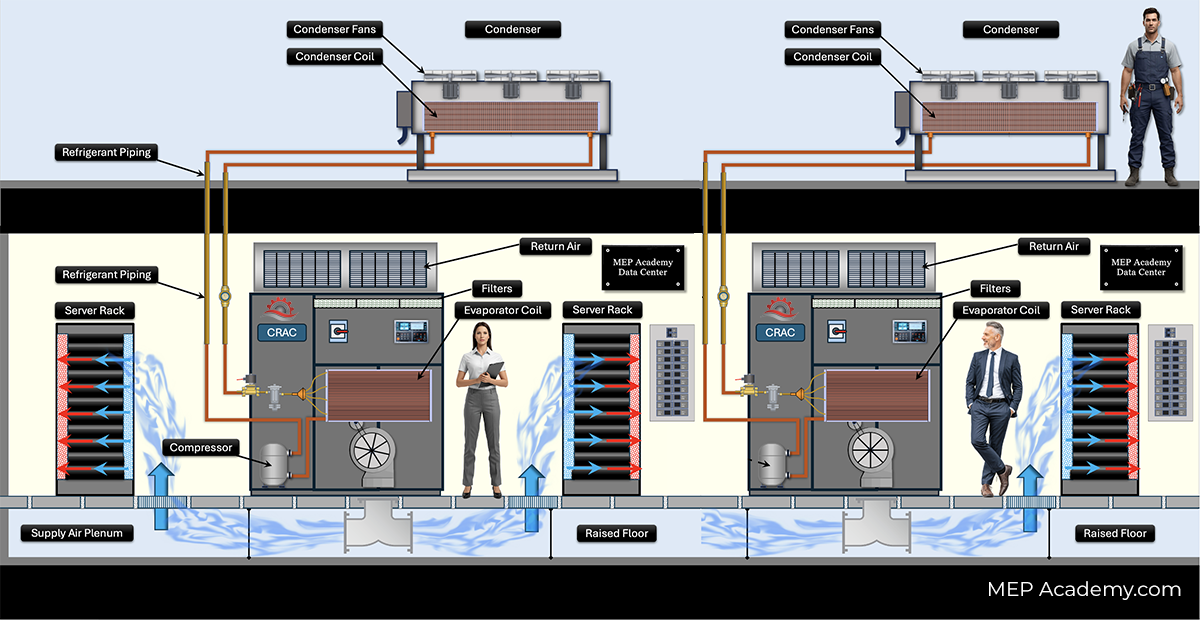
Inside or associated with the CRAC system, you may find components such as:
- Compressors
- Refrigerant piping
- Evaporator coils
- Expansion valves
- Supply fans
- Filters
- Humidification or dehumidification components
- Controls and sensors
- Condensers or remote heat rejection equipment
The CRAC unit pulls warm return air from the data center. That air passes across a cold evaporator coil. Refrigerant inside the coil absorbs heat from the air. The cooled air is then supplied back into the data center.
The absorbed heat is then rejected outside the space through a condenser, dry cooler, or other heat rejection system.
In simple terms:
A CRAC unit creates cooling using a refrigerant-based mechanical cooling cycle.
That is why it is called an air conditioner.
How a CRAC Unit Works
A basic CRAC cooling cycle works like this:
- Hot return air from the data center enters the CRAC unit.
- The air passes over the evaporator coil.
- Refrigerant inside the coil absorbs heat from the air.
- The cooled air is supplied back into the data center.
- The compressor moves refrigerant through the refrigeration cycle.
- Heat is rejected outside through a condenser or other heat rejection equipment.
- The cycle repeats continuously.
This is similar in principle to many commercial air conditioning systems, but CRAC units are designed for mission-critical environments where temperature, humidity, airflow, and reliability are more tightly controlled.
Important Clarification: Some CRAC Units Can Have Dual Cooling Coils
A CRAC unit is usually thought of as a DX or refrigerant-based cooling unit. However, some CRAC units can be configured with more than one cooling method.
For example, a CRAC unit may include:
- A DX refrigeration coil as the primary cooling source
- A chilled water coil as a secondary or backup cooling source
This gives the facility more flexibility.
In some designs, the CRAC unit may operate on DX cooling during normal operation and use chilled water under certain conditions. In other designs, chilled water may be used as the primary source when available, with DX cooling available as backup.
The exact sequence depends on the manufacturer, controls, and project design.
However, this does not make the unit the same as a CRAH unit.
The defining feature of a CRAC unit is that it can provide refrigerant-based mechanical cooling. A CRAH unit is primarily an air handler that relies on chilled water from a central plant.
So when comparing CRAC and CRAH units, the basic distinction is still:
CRAC units are generally refrigerant-based air conditioners.
CRAH units are generally chilled-water air handlers.
What Is a CRAH Unit?
CRAH stands for Computer Room Air Handler.
A CRAH unit looks similar to a CRAC unit from the outside, but internally it operates differently.
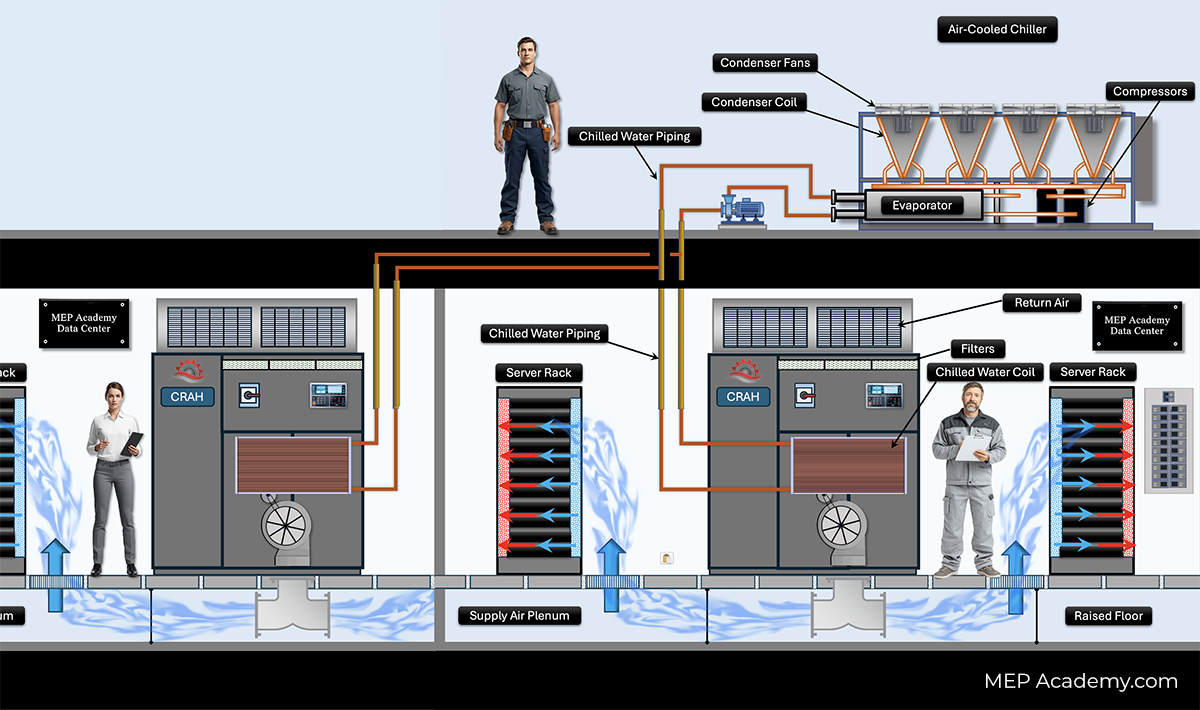
A CRAH unit does not normally create cooling with its own compressor and refrigerant circuit. Instead, it uses chilled water supplied from a central chiller plant.
Inside a CRAH unit, you typically find:
- Chilled water cooling coil
- Supply fans
- Filters
- Control valves
- Temperature sensors
- Humidity controls
- Airflow controls
- Building automation or data center control integration
The CRAH unit pulls warm return air from the data center. That air passes across a chilled water coil. The chilled water absorbs heat from the air. The cooled air is then supplied back into the data center.
The warmed chilled water returns to the chiller plant, where the heat is removed and the water is cooled again.
In simple terms:
A CRAH unit does not create cooling inside the unit. It transfers cooling from the chilled water system into the data center air.
That is why it is called an air handler.
How a CRAH Unit Works
A basic CRAH cooling cycle works like this:
- The central chiller plant produces chilled water.
- Pumps circulate chilled water to the CRAH units.
- Hot return air from the data center enters the CRAH unit.
- The air passes over the chilled water coil.
- Heat transfers from the air into the chilled water.
- The cooled air is supplied back into the data center.
- The warmed water returns to the chiller plant.
- The chiller plant removes the heat and sends cooled water back to the CRAH unit.
This system separates the air handling function from the cooling production function.
The CRAH unit handles airflow.
The chiller plant produces the cooling.
This separation is one reason CRAH systems are common in large data centers.
Why the Difference Matters
The difference between CRAC and CRAH is not just terminology.
It affects almost every part of the data center cooling strategy.
It affects:
- Electrical power consumption
- Mechanical infrastructure
- Maintenance responsibilities
- Redundancy planning
- First cost
- Operating cost
- Scalability
- Energy efficiency
- Controls integration
- Space planning
- Future expansion
A CRAC unit may be simpler to install for a smaller room or standalone facility.
A CRAH system may be more efficient and scalable for a large data center with a central chilled water plant.
This is why the right answer is not always “CRAH is better” or “CRAC is better.”
The right answer depends on the facility.
CRAC Units: Advantages and Disadvantages
Advantages of CRAC Units
CRAC units are often used because they are relatively self-contained and familiar to HVAC technicians.
Some advantages include:
- Good for smaller data centers and server rooms
- Can be easier to install where chilled water is not available
- Familiar DX refrigeration technology
- Useful for retrofit applications
- Can be deployed in modular or standalone environments
- Less dependent on central plant infrastructure
- Can provide dedicated cooling to a specific room or zone
For small data centers, telecom rooms, network rooms, or edge facilities, a CRAC unit may be a practical solution because it does not require a large chilled water plant.
Disadvantages of CRAC Units
CRAC units also have limitations.
Some disadvantages include:
- Compressors consume significant electrical power
- Refrigerant systems require specialized maintenance
- More moving parts inside or associated with the cooling system
- Less efficient at very large scale compared with optimized chilled water systems
- Heat rejection equipment must be coordinated outside the data hall
- Refrigerant piping length and design limitations may apply
- Scaling many DX systems can become complex
For large data centers, installing many individual refrigerant-based units can become less efficient and harder to manage than a centralized chilled water system.
CRAH Units: Advantages and Disadvantages
Advantages of CRAH Units
CRAH units are often used in larger data centers because they work well with central chilled water infrastructure.
Some advantages include:
- Excellent scalability for large cooling loads
- No compressor inside the CRAH unit
- Can be highly energy efficient at scale
- Works well with central chiller plants
- Can integrate with water-side economizers
- Can use variable speed fans and control valves
- Can support large data halls and high cooling capacities
- Maintenance can be centralized around the chiller plant and water systems
Because CRAH units rely on chilled water, they can be part of a larger, optimized cooling strategy that includes chillers, pumps, cooling towers, dry coolers, economizers, and advanced controls.
Disadvantages of CRAH Units
CRAH systems also have challenges.
Some disadvantages include:
- Requires chilled water infrastructure
- Higher first cost for large central plant systems
- More piping, valves, pumps, and controls
- More coordination between the data hall and mechanical plant
- Potential water leak concerns inside or near critical spaces
- More complex redundancy planning
- Requires skilled operation of the central plant
A CRAH unit may be simpler than a CRAC unit internally, but the overall chilled water system can be much more complex.
That complexity must be designed, installed, commissioned, and maintained correctly.
Airflow: Raised Floor, Slab Floor, and Containment
Both CRAC and CRAH units are used to move air through the data center. But how that air is delivered depends on the facility design.
Traditional data centers often used raised floors.
In a raised floor design, the cooling unit supplies cold air into the underfloor plenum. The air travels under the raised floor and rises through perforated floor tiles in front of server racks.
The servers pull the cold air through the equipment, and hot air exits into the hot aisle.
This is where hot aisle and cold aisle layout becomes important.
In modern data centers, many facilities use slab floors instead of raised floors. In these designs, air may be supplied through:
- Overhead ductwork
- Supply air galleries
- Fan walls
- Perimeter cooling units
- In-row cooling units
- Containment systems
- Rear-door heat exchangers
- Direct liquid cooling systems
This is important because CRAC and CRAH units are not the only cooling methods used in data centers.
They are two of the most common room-based precision cooling systems, but many high-density facilities now use hybrid systems that combine air cooling and liquid cooling.
CRAC and CRAH Units Are Not the Only Data Center Cooling Systems
A common mistake is to think that data center cooling is only about CRAC and CRAH units.
That may have been a reasonable assumption in many traditional data centers, but modern facilities use a wider range of cooling technologies.
Other data center cooling methods include:
- In-row cooling units
- Rear-door heat exchangers
- Fan wall systems
- Air-cooled chillers
- Water-cooled chillers
- Indirect evaporative cooling
- Direct-to-chip liquid cooling
- Immersion cooling
- Liquid cooling distribution units
- Hybrid air and liquid cooling systems
As rack densities increase, especially with AI and GPU-based computing, air cooling alone may not always be enough.
This does not mean CRAC and CRAH units are obsolete.
It means they are part of a larger cooling strategy.
Many data centers still use room-based air cooling for general heat removal, while liquid cooling handles the highest-density racks.
Temperature and Humidity Control
Data center cooling is not only about temperature.
It is also about maintaining the proper environmental conditions for IT equipment.
ASHRAE thermal guidelines are commonly used as a reference for data center environmental conditions. ASHRAE’s recommended temperature range for many classes of IT equipment is commonly cited as 18°C to 27°C, or approximately 64.4°F to 80.6°F. Humidity is also controlled using dew point and relative humidity limits to reduce risks such as electrostatic discharge, condensation, and corrosion. (xp20.ashrae.org)
This is one reason data centers use precision cooling systems instead of standard comfort cooling systems.
A comfort cooling system is designed primarily for people.
A precision cooling system is designed for equipment, airflow, reliability, and continuous operation.
Why CRAH Units Are Common in Large Data Centers
Large data centers often use CRAH units because chilled water systems can be very effective at scale.
A central chilled water plant can serve many CRAH units across multiple data halls. This allows the facility to centralize cooling production and optimize plant efficiency.
A chilled water plant may include:
- Chillers
- Primary pumps
- Secondary pumps
- Condenser water pumps
- Cooling towers
- Dry coolers
- Heat exchangers
- Water treatment systems
- Expansion tanks
- Controls and automation systems
With the right design, chilled water systems can use variable speed equipment, economizers, and plant optimization strategies to reduce energy use.
This is especially important because cooling can represent a major portion of the data center’s total energy consumption.
In a large data center, even a small improvement in cooling efficiency can create significant long-term savings.
Why CRAC Units Are Still Used
Even though CRAH systems are common in large data centers, CRAC units are still widely used.
CRAC units can be a good fit for:
- Small server rooms
- Edge data centers
- Telecom rooms
- Network closets
- Legacy data centers
- Retrofit projects
- Facilities without chilled water
- Dedicated cooling zones
- Smaller enterprise data centers
In these applications, installing a central chilled water plant may not make sense.
A CRAC unit can provide dedicated cooling without requiring a large chilled water system.
That makes CRAC units practical in many smaller or existing facilities.
Maintenance Differences Between CRAC and CRAH Units
Maintenance is another major difference between CRAC and CRAH systems.
CRAC Maintenance
CRAC maintenance may include:
- Checking refrigerant charge
- Inspecting compressors
- Cleaning evaporator coils
- Inspecting condenser coils or remote condensers
- Checking expansion valves
- Testing controls and sensors
- Replacing filters
- Inspecting fans and belts where applicable
- Checking condensate drains
- Verifying humidity control operation
Because CRAC units use refrigeration, technicians must understand refrigerant circuits, compressors, superheat, subcooling, leak detection, and heat rejection.
CRAH Maintenance
CRAH maintenance may include:
- Cleaning chilled water coils
- Inspecting control valves
- Checking chilled water supply and return temperatures
- Verifying water flow
- Replacing filters
- Inspecting fans and motors
- Testing controls and sensors
- Checking humidification systems
- Coordinating with chiller plant operation
- Inspecting strainers and piping components
The CRAH unit itself may have fewer refrigeration components, but the overall system depends heavily on the chilled water plant.
That means maintenance must consider both the air handler and the central plant.
Redundancy: What Happens if a Unit Fails?
Data centers are designed around reliability.
Cooling redundancy is often described using terms like:
- N
- N+1
- 2N
- Distributed redundancy
With CRAC systems, redundancy may involve installing extra units so that if one CRAC unit fails, another unit can carry the load.
With CRAH systems, redundancy must account for both the CRAH units and the chilled water infrastructure.
That means the design must consider redundancy for:
- CRAH units
- Chillers
- Pumps
- Cooling towers
- Electrical feeds
- Controls
- Piping loops
- Valves
- Water treatment systems
A chilled water data center can be extremely reliable, but only if the entire cooling chain is properly designed.
A CRAH unit cannot cool the data hall if chilled water is not available.
That is why redundancy planning must look upstream, not just at the room cooling unit.
Controls and Monitoring
Modern CRAC and CRAH units rely heavily on controls.
The cooling unit must respond to changing loads, changing rack densities, and changing environmental conditions.
Controls may monitor:
- Return air temperature
- Supply air temperature
- Rack inlet temperature
- Humidity
- Dew point
- Fan speed
- Chilled water valve position
- Refrigerant pressures
- Compressor operation
- Alarm conditions
- Differential pressure
- Airflow
- Leak detection
- Power consumption
In many data centers, the goal is not just to keep the room cold.
The goal is to deliver the right temperature air to the server inlets while minimizing wasted energy.
This is why rack inlet temperature is often more important than general room temperature.
If cold air bypasses the racks and returns directly to the cooling unit, energy is wasted.
If hot exhaust air recirculates into the server inlets, equipment temperatures can rise even if the room average temperature looks acceptable.
Good airflow management is just as important as cooling capacity.
The Role of Hot Aisle and Cold Aisle Containment
CRAC and CRAH units work best when the data center has good airflow management.
In a traditional hot aisle/cold aisle layout, server racks are arranged so that cold air enters the front of the racks and hot air exits the rear.
Cold aisles face cold aisles.
Hot aisles face hot aisles.
This helps separate supply air from return air.
Containment systems improve this further by physically separating hot and cold air streams.
There are two common approaches:
Cold aisle containment encloses the cold aisle so that cold supply air is delivered directly to the server inlets.
Hot aisle containment encloses the hot aisle so that hot exhaust air is captured and returned directly to the cooling units.
Containment can improve cooling performance for both CRAC and CRAH systems because it reduces air mixing and improves return air temperature.
Higher return air temperatures can also improve cooling coil performance and system efficiency.
Energy Efficiency and PUE
Data centers often measure energy efficiency using PUE, or Power Usage Effectiveness.
PUE compares the total facility power to the power used by the IT equipment.
A lower PUE means more of the facility’s energy is going directly to IT equipment instead of support systems such as cooling, lighting, and power distribution losses.
Cooling system selection can have a major impact on PUE.
CRAC systems may be appropriate for smaller facilities, but large numbers of compressor-based units can increase energy use.
CRAH systems can often support better energy performance at scale because the chilled water plant can be optimized using:
- Variable speed chillers
- Variable speed pumps
- Cooling towers
- Waterside economizers
- Airside economizers where applicable
- Higher chilled water temperatures
- Improved containment
- Advanced controls
However, a CRAH system is not automatically efficient.
Poor controls, poor airflow management, low chilled water temperature, excessive fan energy, or inefficient plant operation can reduce performance.
The system must be designed and operated correctly.
CRAC vs CRAH for AI Data Centers
AI data centers are changing the cooling conversation.
Traditional server racks may have been cooled effectively with room-based air cooling. But AI and GPU clusters can create much higher rack densities.
As rack power increases, each rack generates dramatically more heat.
This creates several challenges:
- More airflow is required
- Higher fan energy may be needed
- Hot spots become more likely
- Air distribution becomes more difficult
- Cooling redundancy becomes more critical
- Liquid cooling may become necessary
CRAH systems and chilled water infrastructure can support large cooling loads, but even they may not be enough for the highest-density AI racks.
That is why many modern data centers are adding:
- Direct-to-chip liquid cooling
- Rear-door heat exchangers
- Coolant distribution units
- Liquid-cooled racks
- Hybrid air and liquid systems
In many cases, the future is not CRAC versus CRAH.
The future is air cooling plus liquid cooling working together.
Common Misconceptions About CRAC and CRAH Units
Misconception 1: CRAC and CRAH Mean the Same Thing
They do not.
A CRAC unit is generally a refrigerant-based computer room air conditioner.
A CRAH unit is generally a chilled-water computer room air handler.
They may look similar, but the cooling source is different.
Misconception 2: CRAH Units Are Always Better
Not always.
CRAH units can be excellent for large data centers with chilled water infrastructure. But for a small server room, a CRAH unit may be impractical if there is no chilled water plant.
Misconception 3: CRAC Units Are Obsolete
Many applications still use CRAC units, especially smaller rooms, edge sites, telecom spaces, and retrofit projects.
Misconception 4: Cooling Capacity Solves Everything
Cooling capacity alone is not enough.
Airflow management, containment, redundancy, controls, humidity, maintenance, and commissioning all matter.
A poorly managed cooling system with enough capacity can still have hot spots.
Misconception 5: Room Temperature Is the Only Important Measurement
The most important temperature is often the temperature at the server inlet.
A room average temperature can look acceptable while certain racks are still overheating due to poor airflow or recirculation.
Which System Should Be Used?
There is no single answer.
A CRAC unit may be the better choice when:
- The facility is small
- Chilled water is not available
- The project is a retrofit
- A specific room needs dedicated cooling
- Simpler infrastructure is preferred
- The cooling load is moderate
A CRAH unit may be the better choice when:
- The facility is large
- A central chilled water plant is available
- Energy efficiency at scale is important
- The facility needs large cooling capacity
- The project requires long-term scalability
- The data center uses centralized mechanical infrastructure
The correct selection depends on the total data center design.
That includes the IT load, rack density, redundancy requirements, available utilities, building infrastructure, budget, energy goals, and future expansion plan.
What Contractors and Estimators Should Pay Attention To
For contractors and estimators, CRAC and CRAH systems create different scope requirements.
CRAC Scope Considerations
For CRAC systems, review:
- Unit capacity and configuration
- Refrigerant piping requirements
- Condenser location
- Electrical power requirements
- Controls integration
- Condensate drain requirements
- Humidifier water requirements
- Service clearances
- Rigging access
- Startup and commissioning
- Leak detection requirements
- Refrigerant code requirements
CRAH Scope Considerations
For CRAH systems, review:
- Chilled water supply and return piping
- Pipe sizing and insulation
- Control valves
- Balancing valves
- Strainers
- Flow meters
- Pumps
- Chiller plant capacity
- Condensate drains
- Leak detection
- Controls integration
- Water treatment
- Testing and balancing
- Commissioning requirements
This is where many estimating mistakes happen.
A CRAC unit may require refrigerant piping and heat rejection equipment.
A CRAH unit may require chilled water piping, valves, insulation, pumps, controls, and central plant coordination.
The equipment name alone does not define the full scope.
Always read the mechanical schedules, specifications, piping diagrams, controls drawings, and commissioning requirements.
Commissioning Considerations
In data centers, technicians must commission the cooling systems carefully.
Commissioning may include:
- Factory startup
- Functional performance testing
- Airflow verification
- Water flow verification
- Controls testing
- Alarm testing
- Redundancy testing
- Failure mode testing
- Power loss simulation
- Chiller plant response testing
- Temperature and humidity trend review
- Integrated systems testing
For CRAC systems, commissioning should verify the refrigeration circuit, compressor operation, condenser operation, airflow, humidity control, and alarms.
For CRAH systems, commissioning should verify chilled water flow, valve operation, coil performance, fan operation, chiller plant response, and controls sequencing.
In mission-critical environments, it is not enough to know that the unit turns on.
The system must perform under normal operation, partial failure, maintenance conditions, and emergency scenarios.
Final Summary: CRAC vs CRAH
CRAC and CRAH units are both important data center cooling systems, but they are not the same.
A CRAC unit is a Computer Room Air Conditioner. It typically uses direct expansion refrigeration, compressors, refrigerant, evaporator coils, and heat rejection equipment.
A CRAH unit is a Computer Room Air Handler. It uses chilled water from a central chiller plant and transfers that cooling into the data center air through a chilled water coil.
The easiest way to remember the difference is:
CRAC creates cooling with refrigerant.
CRAH transfers cooling from chilled water.
CRAC units are common in smaller data centers, server rooms, telecom rooms, edge facilities, and retrofit projects.
CRAH units are common in larger data centers, colocation facilities, hyperscale campuses, and facilities with central chilled water plants.
As data centers continue to grow, especially with AI and high-density computing, cooling systems are becoming more complex. CRAC and CRAH units remain important, but they are now part of a broader cooling strategy that may also include containment, chilled water optimization, rear-door heat exchangers, direct liquid cooling, and immersion cooling.
Understanding the difference between CRAC and CRAH units is one of the foundational steps in understanding how data center mechanical systems work.
Continue Learning about Data Center Systems
This article is the hub of our Data Center Educational Series, where we break down each major system in detail.
Currently Published
- How Data Centers Actually Work
An overview of how modern data centers operate, explaining the critical electrical, mechanical, and IT infrastructure required to keep servers running 24/7. - Data Center Power Flow: From Utility Grid to Server Rack
Learn how electrical power travels from the utility grid through switchgear, UPS systems, generators, and distribution equipment before reaching server racks. - Data Center Cooling Methods Explained
Learn how CRAC units, chilled water systems, and airflow management remove heat from server environments. - Data Center Redundancy Explained (N, N+1, and 2N Systems)
Understand how redundancy strategies like N, N+1, and 2N designs protect data centers from outages and ensure continuous operation. - How Data Center Electrical Systems Work
Understand how data center electrical systems deliver continuous power using switchgear, UPS systems, generators, and redundancy design. - Data Center Refrigerant Economizer
Discover how refrigerant economizer systems improve cooling efficiency by using outdoor conditions to reduce compressor operation and lower energy consumption. - Data Center HVAC Systems
- How Data Center UPS Systems Work
Understand how UPS systems provide instant backup power and protect data centers from outages and power disruptions. - Hot Aisle vs Cold Aisle Containment
Hot aisle vs cold aisle containment explained. Learn how airflow control improves data center cooling efficiency and reduces energy costs. - Data Center Chilled Water Systems Explained
Learn how chilled water systems cool data centers, including chillers, CRAH units, pumps, and how the entire system removes heat efficiently. - CRAC vs CRAH Units Explained
Learn the difference between Computer Room Air Conditioners and Computer Room Air Handlers, including how DX refrigerant cooling compares with chilled water cooling in data center environments. - Air-Cooled vs Water-Cooled Data Centers
Learn the difference between Computer Room Air Conditioners and Computer Room Air Handlers, including how DX refrigerant cooling compares with chilled water cooling in data center environments. - Immersion Cooling Explained
Discover how immersion cooling is transforming AI data centers by submerging servers in a non-conductive dielectric fluid for highly efficient heat removal. Learn how single-phase and two-phase immersion cooling work, why AI is driving their adoption, and how these systems compare to traditional air cooling.