


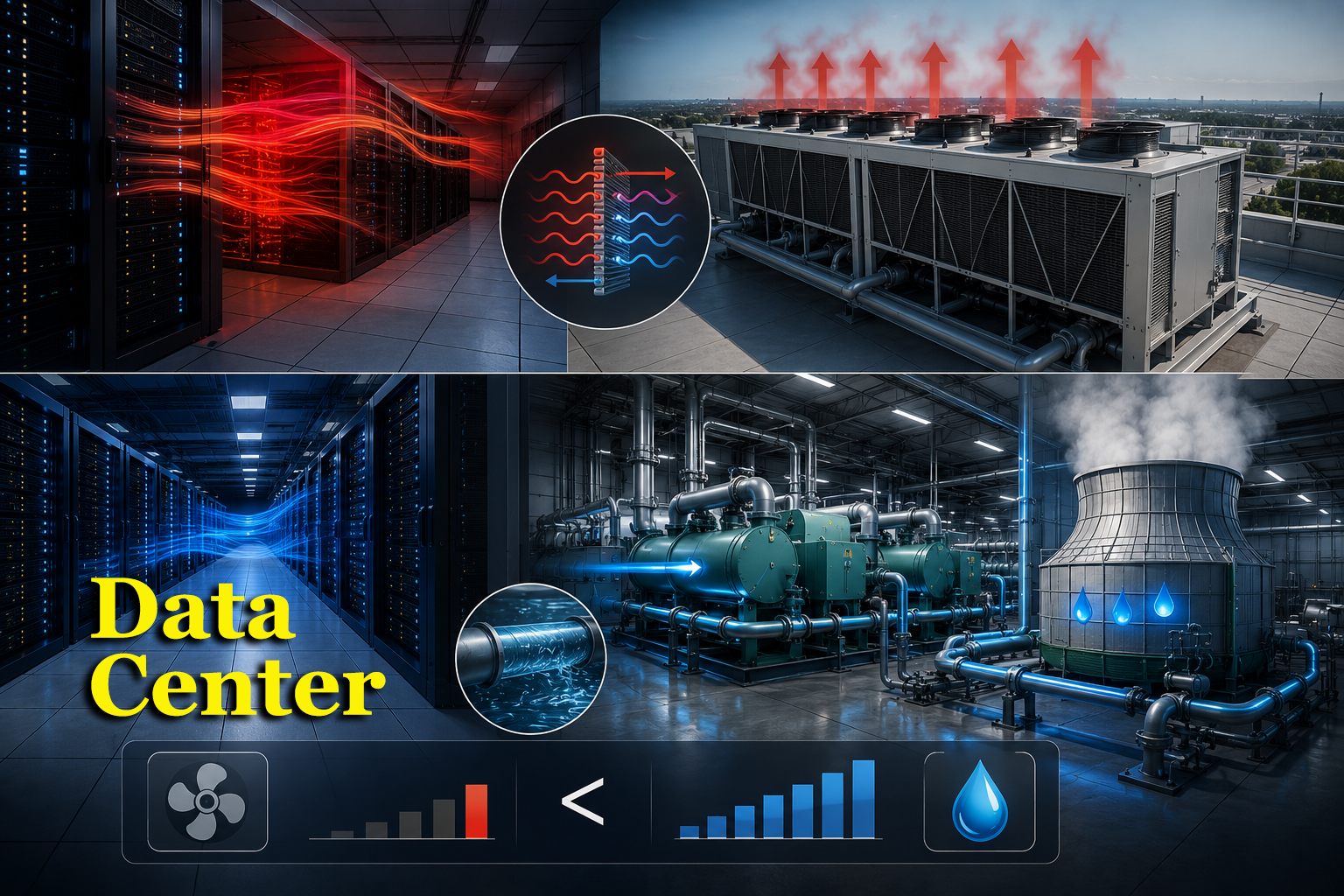
Modern data centers consume enormous amounts of power, and nearly all of that power eventually becomes heat. Whether the facility supports cloud computing, enterprise applications, artificial intelligence, or high-performance computing, one challenge remains constant: removing heat from the IT equipment.
Without effective cooling, servers can overheat, performance can be reduced, equipment life can be shortened, and critical operations can be interrupted.
Watch the Video
One of the most important decisions in data center design is how that heat will be rejected from the facility. In most cases, the choice comes down to two primary approaches: air-cooled systems and water-cooled systems.
Both methods are widely used throughout the industry. Both can provide reliable cooling. However, they differ significantly in efficiency, water consumption, complexity, and operating costs.
In this article, we’ll explain how air-cooled and water-cooled data centers work, the advantages and disadvantages of each approach, and why many modern facilities are carefully evaluating both energy and water usage when selecting a cooling strategy.
The Real Challenge: Removing Heat
Every server, processor, storage device, and network switch generates heat while operating.
The cooling system’s job is simple in theory:
- Capture heat from the IT equipment
- Move the heat away from the servers
- Reject the heat outdoors
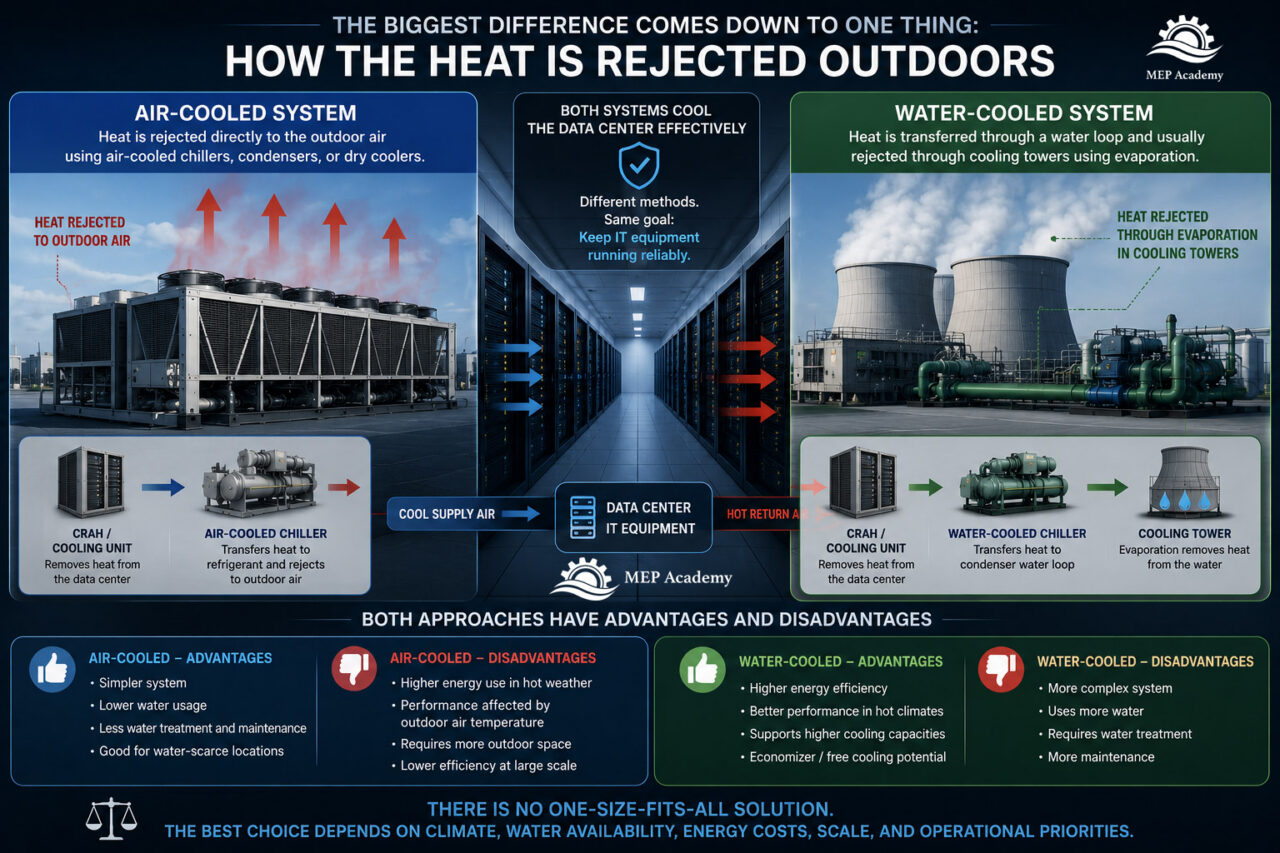
The primary difference between air-cooled and water-cooled systems is how that final step occurs.
What Is an Air-Cooled Data Center?
An air-cooled data center rejects heat directly to the outdoor air using equipment such as:
- Air-cooled chillers
- Dry coolers
- Refrigerant condensers
- DX cooling systems
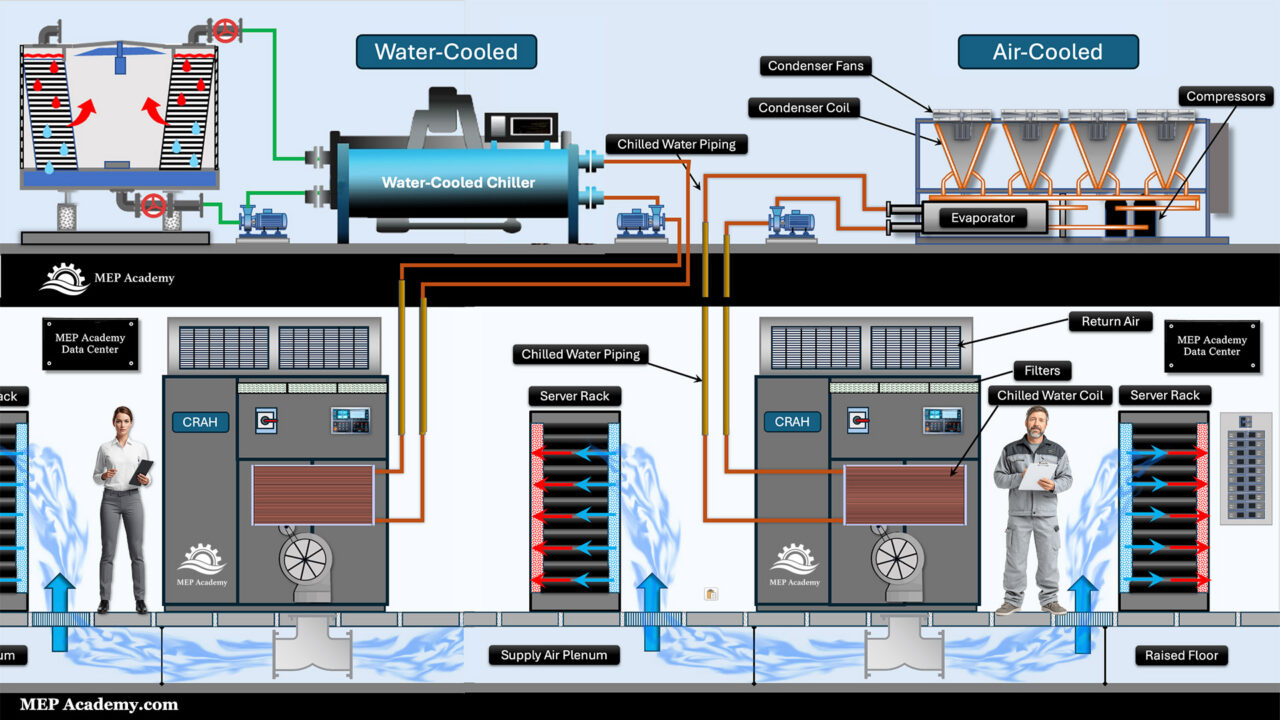
In an air-cooled chilled water system, indoor cooling units remove heat from the server room and transfer that heat to chilled water. The chilled water then returns to an air-cooled chiller, where condenser fans reject the heat directly to the outdoor air.
The final heat rejection medium is air.
Advantages of Air-Cooled Systems
Air-cooled systems offer several benefits:
- Lower water consumption
- No cooling towers required
- Reduced water treatment requirements
- Simpler mechanical systems
- Easier installation in some locations
- Suitable for smaller and modular facilities
Many edge data centers and smaller facilities use air-cooled systems because of their relative simplicity.
Disadvantages of Air-Cooled Systems
Air-cooled systems also have limitations.
Because air is not as effective at transferring heat as water, these systems generally require more energy to reject the same amount of heat.
Performance can also decline during periods of extreme outdoor temperatures.
As outdoor air becomes hotter, the cooling equipment must work harder to reject heat.
This often leads to:
- Higher electrical consumption
- Reduced efficiency
- Increased operating costs during hot weather
What Is a Water-Cooled Data Center?
A water-cooled data center uses water to transport and reject heat.
The most common configuration includes:
- Chilled water system
- Water-cooled chillers
- Condenser water pumps
- Cooling towers
The process typically works like this:
- Indoor cooling units remove heat from the server room.
- Chilled water carries that heat back to the chiller.
- The chiller transfers the heat to a condenser water loop.
- The condenser water flows to a cooling tower.
- The cooling tower rejects the heat through evaporation.
The final heat rejection process uses water and evaporation rather than outdoor air alone.
Why Water Is More Efficient Than Air
One reason water-cooled systems are popular in large data centers is because water transfers heat much more effectively than air.
Water can carry significantly more heat per unit volume than air.
This allows water-cooled systems to:
- Move large amounts of heat efficiently
- Support larger cooling capacities
- Reduce energy consumption
- Improve overall cooling performance
This advantage becomes increasingly important as rack densities continue to increase.
Why Hyperscale Data Centers Often Use Water Cooling
Many hyperscale data centers operate at massive scales and may contain thousands of server racks.
As cooling loads increase, energy efficiency becomes a major operational concern.
Water-cooled systems are often selected because they can:
- Support very large cooling loads
- Improve chiller efficiency
- Reduce long-term energy costs
- Enable advanced economizer strategies
Although these systems are more complex, the potential energy savings can be substantial over the life of the facility.
Water-Side Economizers and Free Cooling
One major advantage of many water-cooled systems is the ability to use economizers.
A water-side economizer can reduce or partially eliminate mechanical refrigeration during favorable outdoor conditions.
Instead of relying entirely on compressors, cooling towers or fluid coolers can help cool the water directly.
This can significantly reduce:
- Chiller energy consumption
- Utility costs
- Overall facility PUE
Many large data centers take advantage of these opportunities whenever climate conditions allow.
The Biggest Drawback: Water Consumption
While water-cooled systems are often more energy efficient, they consume water.
Cooling towers reject heat through evaporation.
That evaporation requires continuous makeup water to replace water lost from the system.
Additional water is also required for:
- Blowdown
- Water treatment
- Maintenance activities
This has become an important consideration as many new data centers are being built in regions facing water supply challenges.
As a result, some operators are shifting toward air-cooled or hybrid cooling systems to reduce water usage.
PUE vs WUE: The Modern Cooling Trade-Of
Today’s data center operators often evaluate cooling systems using two important metrics.
PUE – Power Usage Effectiveness
PUE measures energy efficiency.
It compares the total facility energy consumption to the energy consumed by the IT equipment.
Lower PUE values generally indicate a more energy-efficient facility.
WUE – Water Usage Effectiveness
WUE measures water consumption.
It evaluates how much water is used relative to the IT workload.
A facility may have an excellent PUE while consuming large amounts of water.
Likewise, a facility may conserve water but require more electrical energy.
Modern data center owners must balance both metrics when selecting cooling technologies.
A Common Misunderstanding
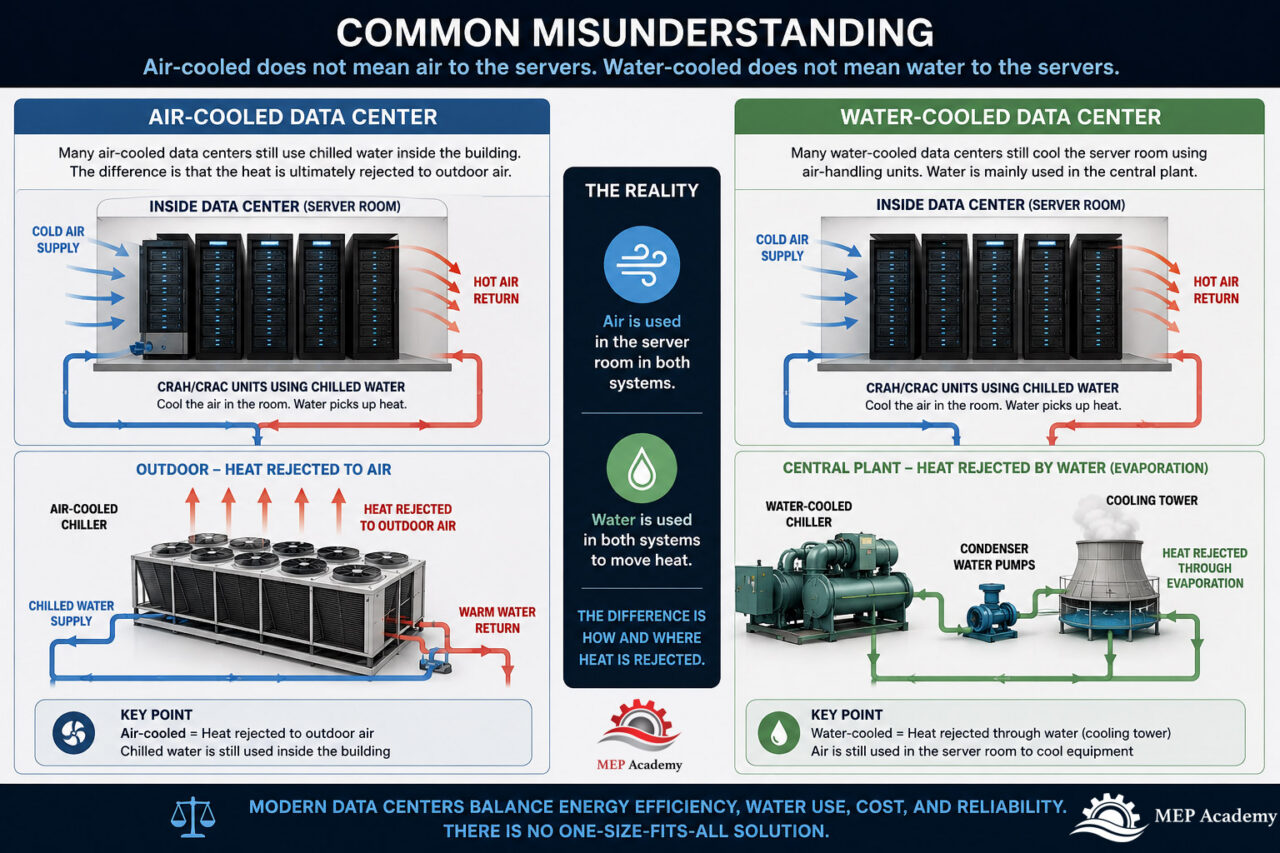
Many people assume that air-cooled and water-cooled systems describe how servers are cooled.
That is not always true.
Many air-cooled data centers still use chilled water inside the building.
The difference is that the heat is ultimately rejected to outdoor air.
Likewise, many water-cooled data centers still cool the server room using air-handling units and traditional airflow management strategies.
The water is primarily used within the central plant to transport and reject heat more efficiently.
The distinction is usually about the heat rejection system, not necessarily how air is delivered to the servers.
High-Density AI Workloads Are Changing Everything
Artificial intelligence is dramatically increasing data center cooling requirements.
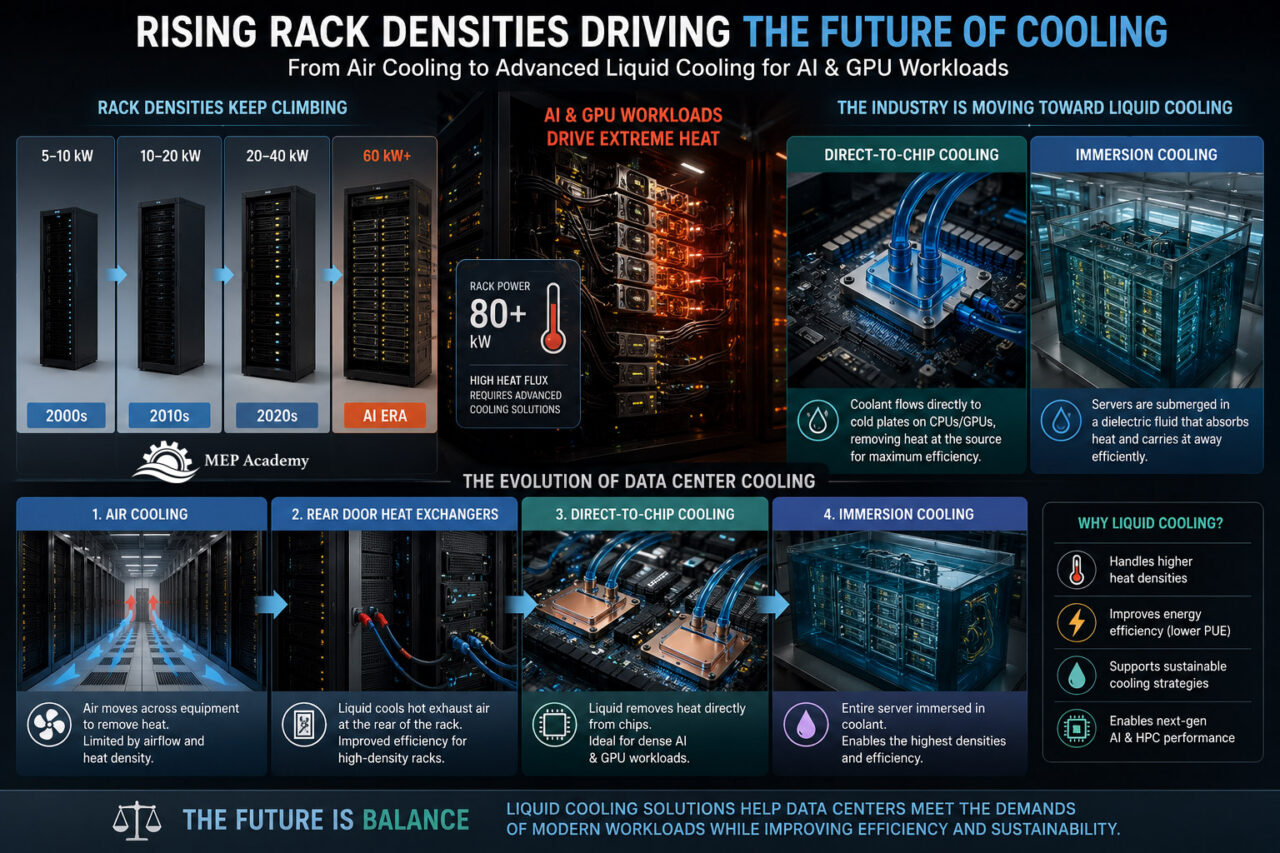
Modern GPU clusters can generate significantly more heat than traditional server environments.
As rack densities continue to climb, operators are exploring technologies such as:
- Direct-to-chip liquid cooling
- Rear-door heat exchangers
- Immersion cooling
- Advanced liquid cooling systems
These technologies use liquid much closer to the IT equipment itself, allowing heat to be removed more effectively than traditional air cooling alone.
Although air-cooled and water-cooled central plants remain important, AI workloads are accelerating the industry’s move toward liquid cooling solutions.
Air-Cooled vs Water-Cooled: Side-by-Side Comparison
| Feature | Air-Cooled | Water-Cooled |
|---|---|---|
| Water Usage | Very Low | Higher |
| Energy Efficiency | Moderate | Higher |
| Cooling Towers Required | No | Yes |
| Water Treatment Required | No | Yes |
| Mechanical Complexity | Lower | Higher |
| Maintenance Requirements | Lower | Higher |
| Suitable for Large Loads | Moderate | Excellent |
| Supports Economizers | Limited | Excellent |
| First Cost | Often Lower | Often Higher |
| Operating Cost | Often Higher | Often Lower |
Which Cooling Method Is Better?
There is no universal answer.
The best cooling strategy depends on several factors:
- Climate
- Utility costs
- Water availability
- Rack density
- Sustainability goals
- Facility size
- Long-term operating costs
A smaller facility in a drought-prone area may favor air-cooled systems.
A large hyperscale campus may benefit from the efficiency of water-cooled central plants.
Many modern facilities are now exploring hybrid approaches that combine the benefits of both technologies.
Final Thoughts
Air-cooled and water-cooled data centers are both designed to accomplish the same objective: safely remove heat from mission-critical IT equipment.
Air-cooled systems reject heat directly to outdoor air and minimize water usage.
Water-cooled systems use water and evaporation to improve heat transfer and energy efficiency.
As AI, cloud computing, and high-density computing continue to increase cooling demands, the balance between energy consumption, water usage, reliability, and sustainability will become even more important.
Understanding the strengths and limitations of both approaches is essential for anyone involved in designing, operating, or maintaining modern data centers.
Currently Published
- How Data Centers Actually Work
An overview of how modern data centers operate, explaining the critical electrical, mechanical, and IT infrastructure required to keep servers running 24/7. - Data Center Power Flow: From Utility Grid to Server Rack
Learn how electrical power travels from the utility grid through switchgear, UPS systems, generators, and distribution equipment before reaching server racks. - Data Center Cooling Methods Explained
Learn how CRAC units, chilled water systems, and airflow management remove heat from server environments. - Data Center Redundancy Explained (N, N+1, and 2N Systems)
Understand how redundancy strategies like N, N+1, and 2N designs protect data centers from outages and ensure continuous operation. - How Data Center Electrical Systems Work
Understand how data center electrical systems deliver continuous power using switchgear, UPS systems, generators, and redundancy design. - Data Center Refrigerant Economizer
Discover how refrigerant economizer systems improve cooling efficiency by using outdoor conditions to reduce compressor operation and lower energy consumption. - Data Center HVAC Systems
- How Data Center UPS Systems Work
Understand how UPS systems provide instant backup power and protect data centers from outages and power disruptions. - Hot Aisle vs Cold Aisle Containment
Hot aisle vs cold aisle containment explained. Learn how airflow control improves data center cooling efficiency and reduces energy costs. - Data Center Chilled Water Systems Explained
Learn how chilled water systems cool data centers, including chillers, CRAH units, pumps, and how the entire system removes heat efficiently. - CRAC vs CRAH Units Explained
Learn the difference between Computer Room Air Conditioners and Computer Room Air Handlers, including how DX refrigerant cooling compares with chilled water cooling in data center environments. - Air-Cooled vs Water-Cooled Data Centers
Learn the difference between Computer Room Air Conditioners and Computer Room Air Handlers, including how DX refrigerant cooling compares with chilled water cooling in data center environments. - Immersion Cooling Explained
Discover how immersion cooling is transforming AI data centers by submerging servers in a non-conductive dielectric fluid for highly efficient heat removal. Learn how single-phase and two-phase immersion cooling work, why AI is driving their adoption, and how these systems compare to traditional air cooling. - AI Data Centers Explained
Learn how high-density GPU data centers deliver massive amounts of electrical power and remove the resulting heat using liquid cooling, CDUs, and advanced cooling infrastructure.