


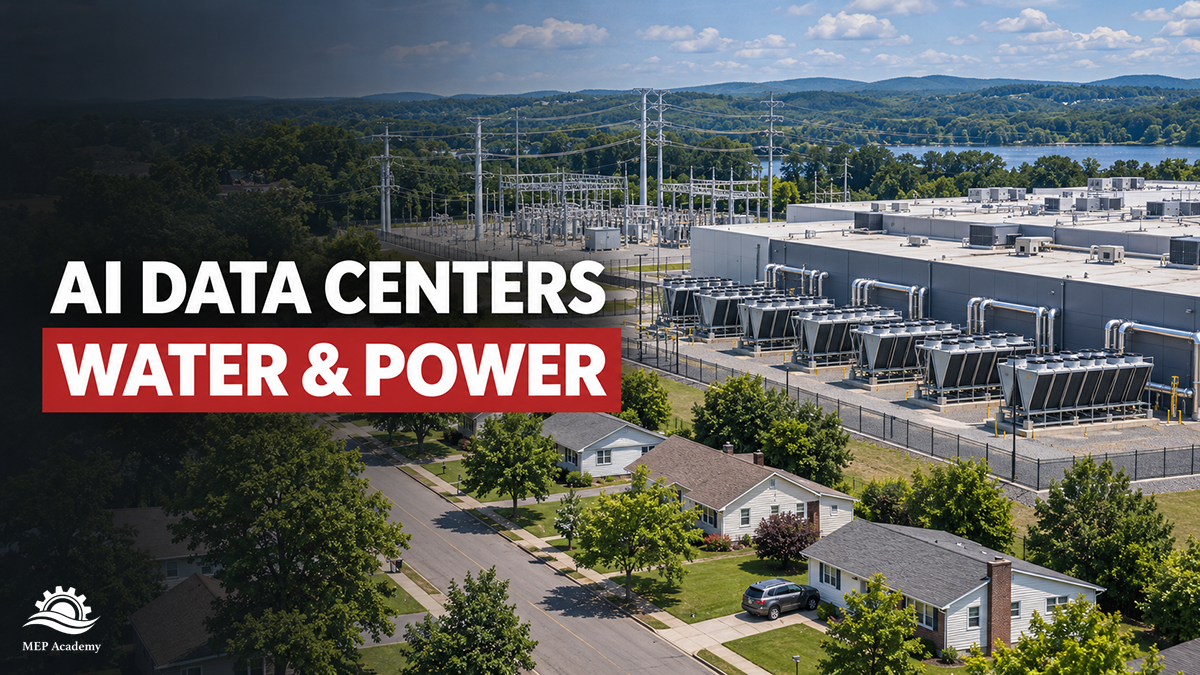
Imagine an AI data center is coming to your town. The developer says it can cool its servers without evaporating water in cooling towers. It may even generate some of its own electricity. Then you hear one more detail. The liquid going into the server racks can be 113°F. That’s hotter than a typical hot tub. How does that cool anything? And why might it matter to the people living next door?
There’s a second question worth holding onto. Picture the hottest afternoon of the year. Air conditioners across town are running, the AI servers are still working, and the data center’s chillers may have to come on. How much water does the site still need, and how much power could it still draw from the grid? The answers tell you more about the project than its annual efficiency figures alone.
Why communities are pushing back
At a public meeting, the national debate about AI gets specific fast. Where will the facility get its water? Will the utility need a new substation or transmission line? Who pays for those upgrades? If the facility generates power on site, what will nearby residents hear, and what will the equipment emit?
In July 2026, Reuters reported coordinated data center protests across 42 states, including California, where residents in Imperial County raised concerns about water use. The issues vary from place to place. In a water-stressed area, the source of the water and what happens during a drought may dominate the discussion. In another community, the main question might be how a large new customer affects utility bills. A town may also welcome construction work, permanent jobs, or tax revenue and still ask the developer to show what those benefits and costs look like locally.
The scale of the buildout helps explain the urgency. Lawrence Berkeley National Laboratory estimated that all U.S. data centers accounted for about 4.4% of national electricity consumption in 2023. Its 2024 report modeled scenarios in which that share could reach 6.7% to 12% by 2028. The range reflects different assumptions about how much computing equipment gets installed, how it operates, and how efficiently facilities cool it. For a town considering a project, the practical question is what its own utility can supply and what new infrastructure the project would require.
Does the United States need to lead the AI race?
The White House’s 2025 AI Action Plan makes the case for U.S. leadership and puts domestic infrastructure alongside innovation and international security. There’s a question worth asking here. How important is it for the United States to lead the AI revolution, and what would leadership actually mean? It could mean developing the most capable systems, having dependable domestic computing capacity, or turning that capacity into advances in science, industry, and national security.
There’s also a question of who bears the costs. The benefits of domestic computing capacity may reach customers and researchers across the country. A new water connection, transmission line, or power plant has a specific address. Someone can see value in U.S. leadership and still ask whether a particular site makes sense, whether its resource commitments can be verified, and who pays if demand grows beyond the original plan.
That brings us back to the 113°F liquid. It’s one example of how a design decision inside a server rack can change what the facility asks of the community outside.
Why warmer liquid can cool an AI chip
Picture a metal cold plate attached to a processor. Liquid flows through channels inside the plate and carries heat away. The chip is hotter than the coolant, so heat flows from the chip into the liquid even when the incoming liquid is 113°F. That number refers to the coolant entering the rack. The temperature inside the chip depends on how much heat it produces and how effectively the cold plate and flowing liquid remove it. NVIDIA says its Rubin platform can operate with coolant supplied at up to 113°F (45°C).
Now follow that heat outside. The warmed rack coolant returns to a coolant distribution unit, or CDU. A heat exchanger inside the CDU passes the heat into a separate facility loop. The facility then has to get rid of that heat. One way is to move it through an outdoor dry cooler, which works much like a car radiator. Fans pull air across a coil, and the heat goes into the air. An evaporative cooling tower rejects heat partly by evaporating water and needs makeup water to replace what it loses.
Here’s where the warmer coolant pays off. If the rack can accept warmer liquid, the outdoor air can also be warmer before the cooling plant needs help from a chiller. A dry cooler still needs enough temperature difference to move the full heat load. Outdoor air can be cool enough to take some heat out of the returning fluid while the system still needs a chiller to reach its supply temperature. That difference determines when the compressors can stay off.
How Daikin’s design handles a hot day
Daikin Applied’s D60-W reference design supports a 60-megawatt IT load. That figure describes the computing equipment the cooling design supports. The campus also needs electricity for cooling and other building systems. Daikin uses dry coolers for outdoor heat rejection and describes three ways the liquid-cooling plant can operate as conditions change.
| Operating mode | What happens to the heat | What the chillers do |
| Dry cooling | The dry coolers can carry the load through the waterside economizer. Daikin allows the facility supply to rise to 105.8°F, corresponding to 113°F supply at the rack. | Compressors stay off. Fans and pumps still use electricity. |
| Hybrid cooling | The dry coolers precool the returning facility fluid. | The chillers provide the remaining cooling to reach the supply setpoint. |
| Full mechanical cooling | Outdoor conditions are too warm for useful economizer precooling. The dry coolers still reject heat from the chiller condenser loop. | The chillers provide the cooling needed to reach the facility supply setpoint. |
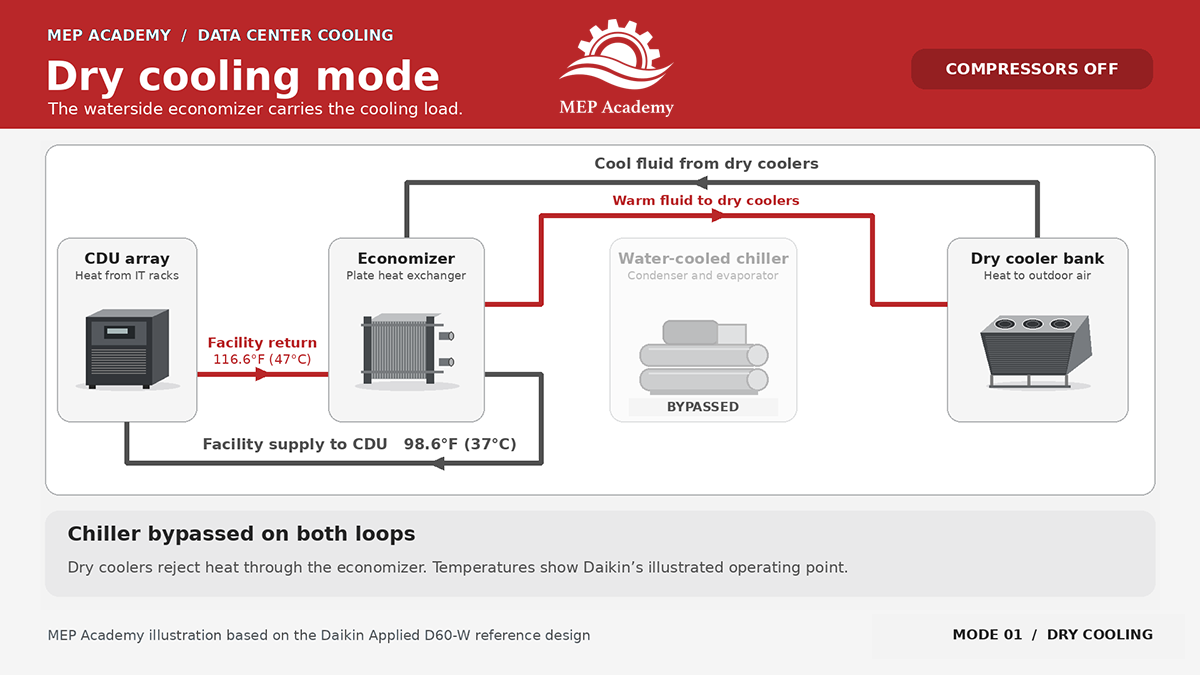
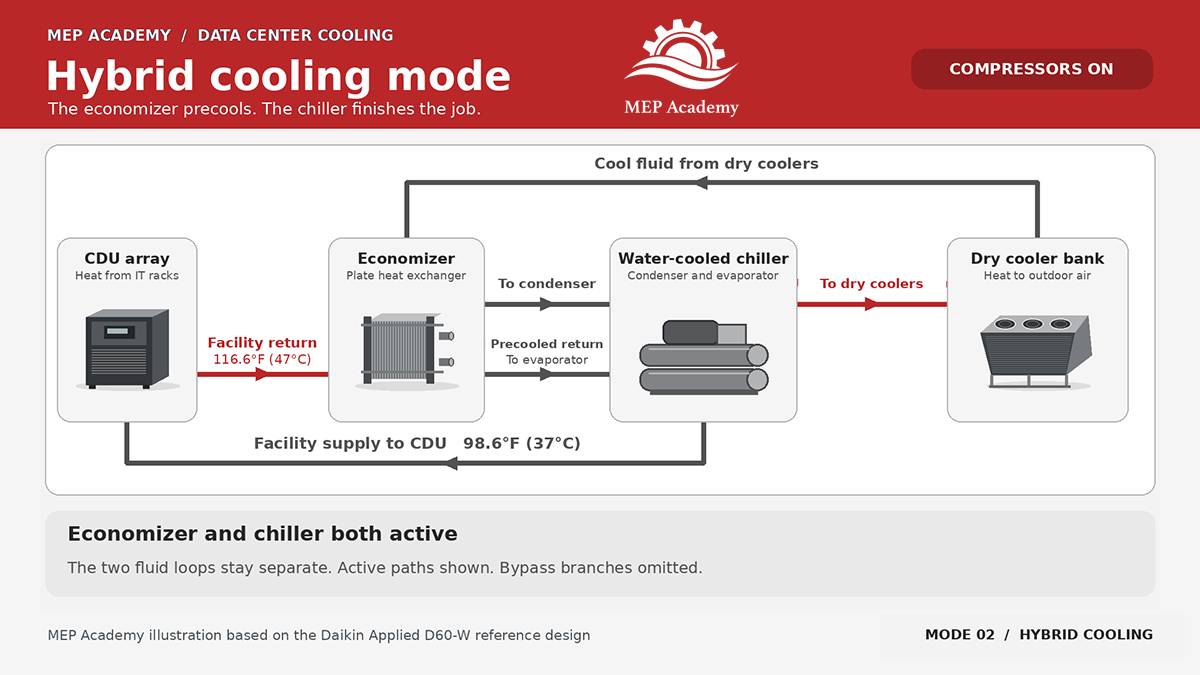
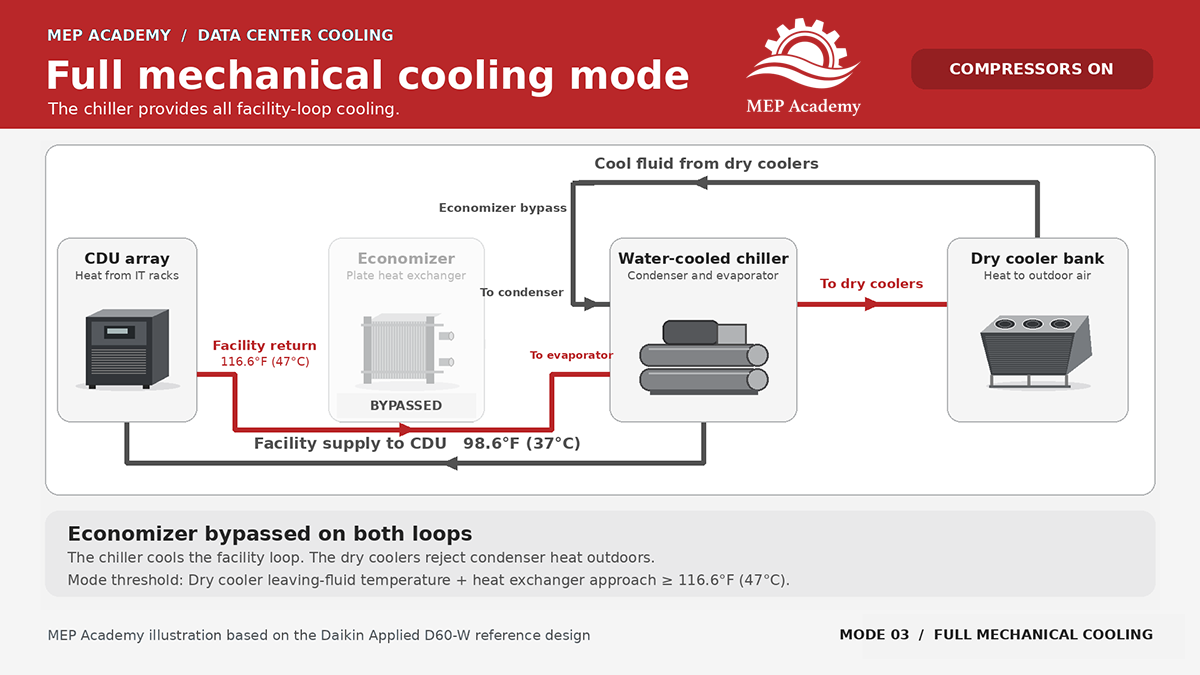
Daikin expects dry coolers to carry the load for much of the year in suitable climates. More compressor-off hours can reduce annual cooling electricity use. The design also eliminates cooling-tower makeup water in all three modes because final heat rejection uses dry coolers. The site can still use water for other purposes, and the cooling plant can still draw substantial power on a hot day. Those are two different outcomes worth measuring.
How developers are changing what they build
Some developers are pursuing sites and systems with lower water use, more efficient cooling, or a dedicated source of power. Microsoft, for example, announced a new design that uses chip-level cooling without evaporating water for cooling. It has identified new Arizona facilities where it plans to use that approach. Microsoft also pledged to publish regional water-use information and pay utility rates intended to cover the electricity costs its data centers create. Those announcements give communities concrete commitments to ask about when a specific project comes up for approval.
Climate is part of the site decision. A location with more hours of favorable outdoor temperatures can give a dry-cooling plant more time with the compressors off. Water availability, grid capacity, and the type of power available also shape the result. And as campuses expand, a more efficient design can use less energy per unit of computing while the campus as a whole uses more electricity. Both figures matter when a developer describes a project as more sustainable.
Can a data center bring its own power?
Some developers are planning to generate power where they use it. In November 2026, NTT Data announced an agreement with Bloom Energy for 900 MW of on-site fuel-cell generation across multiple projects, with initial shipments planned for 2027. NTT described the fuel cells as a primary power source that could help bring facilities online in markets with limited power availability. That illustrates how a developer can address one constraint through the power supply itself.
On-site power raises a new set of local questions. What fuel does it use? How often will it operate? What emissions and noise will it produce? How much grid capacity will the facility still need if part of its generation is down? In the Memphis–Southaven area, xAI’s use of on-site gas turbines drew opposition over local air quality. Gas turbines and fuel cells are different technologies, so the local impacts depend on the equipment and how it’s operated.
Back to the hottest afternoon
Now put the pieces together. The servers are running hard. The cooling plant has saved electricity during all those hours when the chillers could stay off. This afternoon, the chillers may have to run. In Daikin’s design, the dry coolers still reject the heat without evaporative cooling towers. The water-saving feature still works on the very afternoon when the electrical question matters most. How much power comes from the grid at that moment depends on the total site load and what any on-site generation can reliably deliver.
If you were sitting in that public meeting, here are three questions that would bring the discussion down to the actual project.
- Water: How much water will the whole site use in a typical year, where will it come from, and what changes during a drought?
- Power: How many megawatts could the site draw from the grid on a peak summer afternoon, including when on-site generation is unavailable, and who pays for the upgrades?
- Local impacts: What emissions and noise would the cooling and power equipment produce, and how will the community verify the projections after the campus opens?
You can believe that leading in AI matters and still want clear answers to all three. You can also look at those answers and decide the costs are too high for a particular site. The engineering gives communities more options. The hottest afternoon is where you find out what those options deliver.
Explore more from MEP Academy
MEP Academy
Sources and further reading