Air Handling Units. How they work and how they’re built.
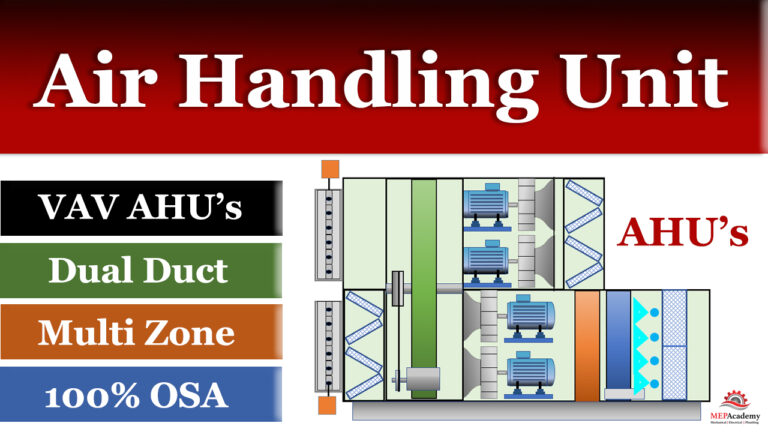
In this presentation we’ll be learning how Air Handling Unit (AHU) works within various commercial and healthcare buildings. We’ll show you how custom Air Handling Units are built with the selection of various options such as humidifiers, heat wheels, heating and cooling coils, dampers, economizers, UV lighting and the various types of fans being used.
We’ll explain the different types of air handlers used including VAV, CAV, Dual-Duct, Multizone and 100% Outside air units.
For the YouTube video of this presentation, scroll to the bottom.
The Basic Air Handling Unit Configuration
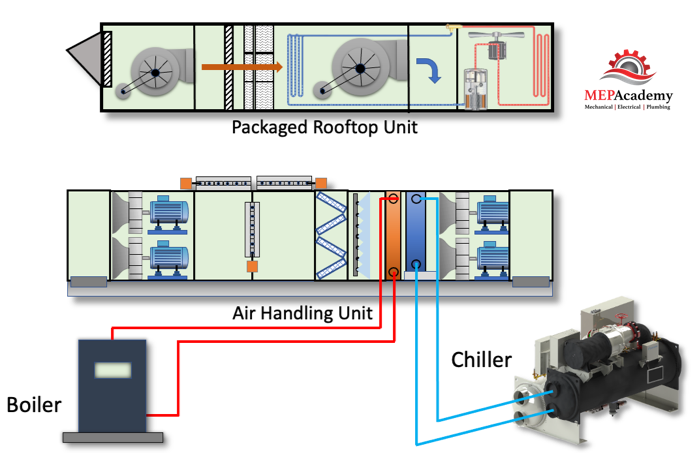
The main differences between an air handling unit and your typical air conditioner is that the air handler doesn’t provide the source for heating or cooling. Also, air handlers are available in much larger sizes up to and over 400,000 CFM . Air handling units also allow greater customization to fit project specifics.
Air Handling Unit vs Packaged Air Conditioner
The air conditioner has the refrigeration cycle as part of the equipment, where the compressor circulates the refrigerant that does the cooling and/or the heating. The air handling unit will do its cooling using chilled water from a chiller or refrigerant from a remotely located compressor, and do its heating using heating hot water or steam from a boiler.
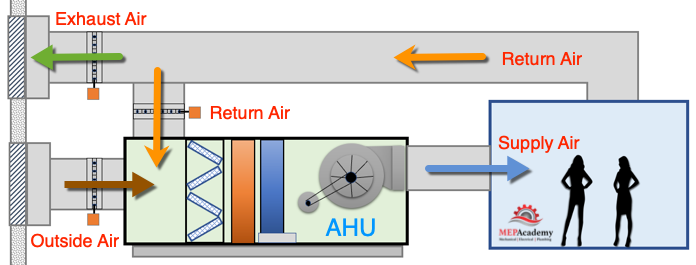
Air Handling Unit Flow Diagram
As you can see the Return air system has two options, it can return air back to the inlet of the supply, or it can exhaust the air outside. The rest of the air systems only have one option as shown by the directional arrows.
How to Build a Custom Air Handling Unit
Let’s build a custom air handler like the manufacture would using the engineers project requirements and the available air handler sections.
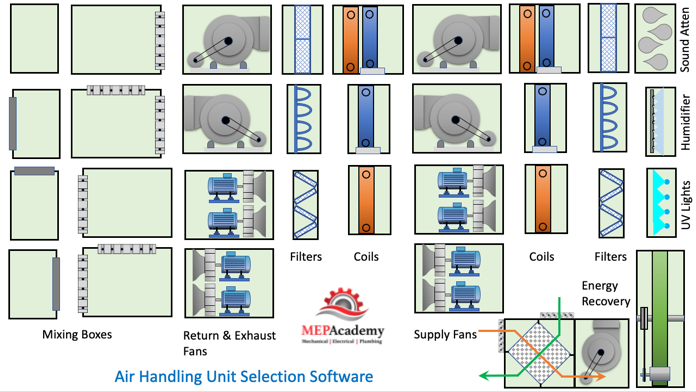
The air handling unit manufacture will use their software program to assemble a unit based on the project specifics. Looking at a screen of options the air handlers engineering team will start building the air handler maybe starting with the inlet options.
Options available for a Custom Air Handler
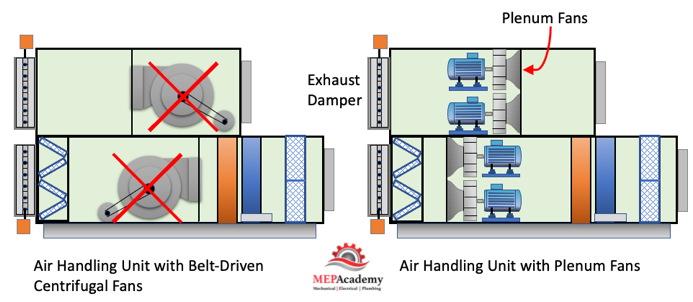
We’ll build our air handling unit using plenum fans because they provide better acoustics and allow for some redundancy incase a fan burns out. As you can see we added them on the supply inlet and on the exhaust.
Since this is an operating room will add a UV (Ultraviolet) lighting system to kill any bacterial, viral or fungal organism in the air and on or near the cooling coil, including the drain pan where water accumulates before draining.
100% Outside Air Handling Unit with 100% Exhaust Air.
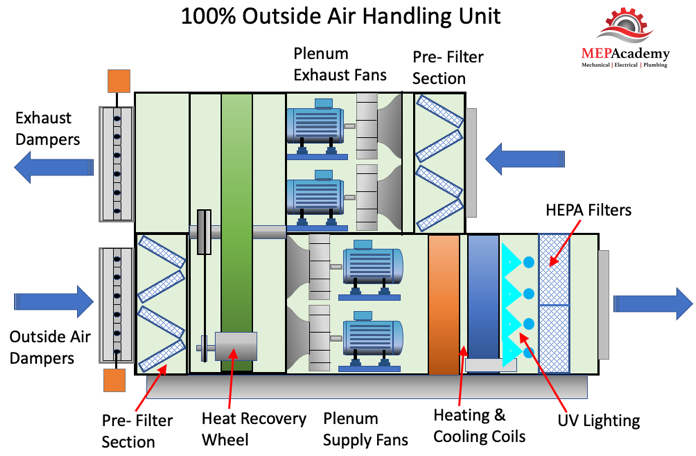
We added an energy recovery wheel to save energy and capture the heat that is being wasted. Using 100% outside air is energy intensive as we are spending energy to cool the air and then we are exhaust all of that air out of the building. To capture this energy there are several choices like the heat recovery wheel, heat exchanger or a run around coil. We’ll explain these in another video. We also added filters on the exhaust stream to keep the energy wheel clean.
100% Outside Air Handling Unit
The first section will be our pre filter section to clean the air that’s coming in, and then the Heat Recovery Wheel, then our supply fans. The fans are what pull the air from the outdoors and push the air into the operating room. Then we’ll have a hot water and chilled water coil to temper the air, the UV Lighting system, and finally we’ll have a HEPA filter to clean the air as there’s additional requirements for the operating room, since you’re cutting people open the air has to be super clean. And then on the exhaust side we need an exhaust damper and an exhaust fan to take the air from the room and exhaust it out.
Air Handling Unit using 100% Outside Air
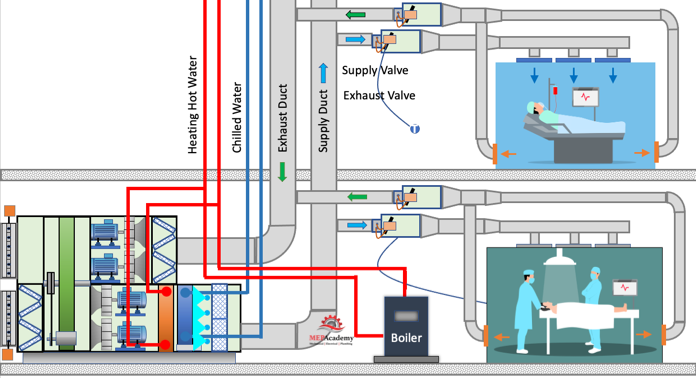
Now we’ll take this air handler that we’ve built and put it in the mechanical room in the hospital. You see we got our two operating rooms. We’ll set our Air Handler that we just built, and then the HVAC contractor will run the main ducts, exhaust and supply mains, and from there they’ll tie into branches through exhaust and supply valves feeding the operating room with laminar Flow grilles and low return.
Then the contractor will rig and set in a boiler, hook up all the hot water piping to the hot water coil, and then make a connection from the chiller to the chilled water coil, or if you’re using a compressor you can run DX refrigerant piping.
We just showed you how you can customize any air handler according to the project requirements, now we’ll show you a few more systems where air handlers are used.
Dual Duct Air Handling Unit
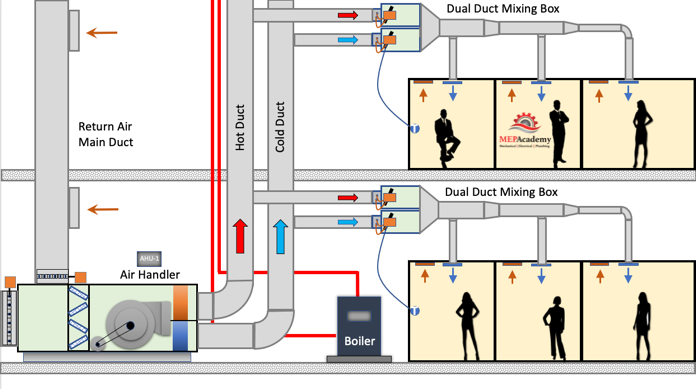
This is a dual duct air handling unit that provides Cold air and warm air to travel down two different main supply ducts to dual-duct VAV mixing boxes. After the Dual Duct mixing box the air leaves in one common duct with the correct mixture of cold and warm air to satisfy the temperature setting of the space.
Dual-Duct Air Handling Unit with Mixing Boxes
The air handler supply’s air over the cooling and heating coils simultaneously and the dual-duct boxes decide how much of each to open depending on the requirements of the room temperature sensor. One dual duct mixing box could be providing cooling while another is providing heating.
Multi-Zone Air Handling Unit
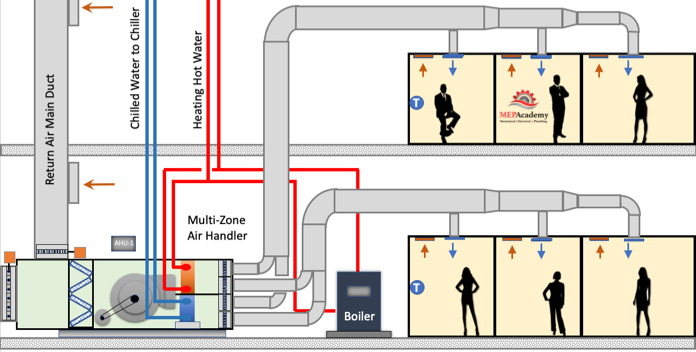
This is a multi-zone air handling unit. Each of the zones has a hot and cold deck damper at the air handler unit, which is different than the dual duct air handler we just showed you. Each zone has its own supply air damper at the heating coil and another at the cooling coil.
Multi-Zone Dual-Duct Air Handling unit
This air handler has a mixing box that allows for return air and outside to mix. The outside air damper will modulate to maintain the minimum amount of ventilation air as required by code. It’s possible to control the outside air using a CO sensor in the space being served by this air handler, to allow for energy conservation.
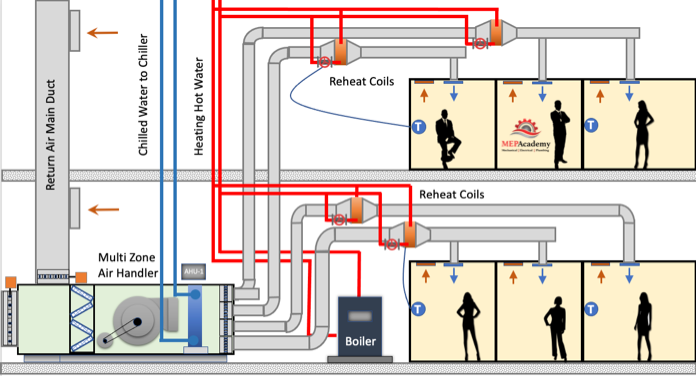
This is another version of the multi-zone air handler, except instead of a dual duct system with two coils in the air handler, this unit uses only a cooling coil. The heating if required is provided by an in-duct reheat coil.
Multi-Zone Air Handling Unit
VAV Air Handling Unit
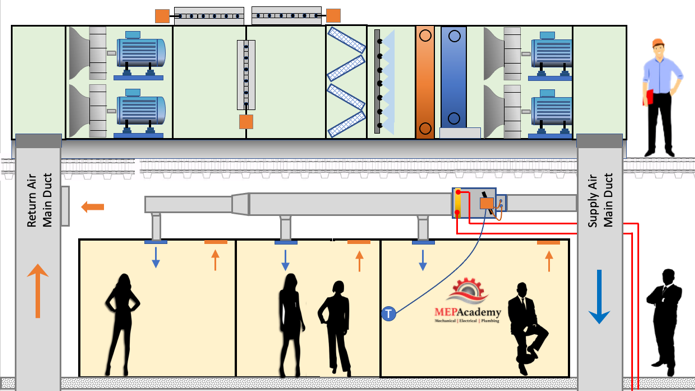
Here is a Variable Air Volume VAV Air Handler mounted on a roof. The VAV Air Handler is probably the most common system used in medium to large commercial buildings.
Typical Custom Air Handling Unit
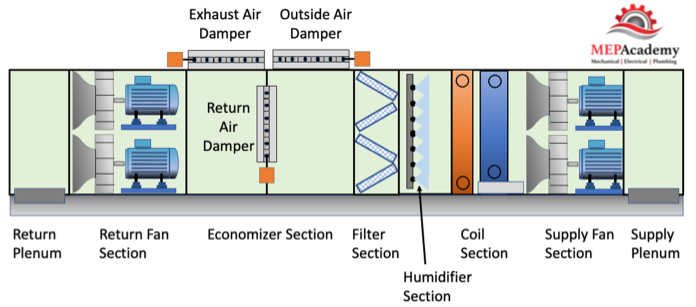
This custom air handler starts with the return air section, then travels through the return air fans. The air next enters the economizer, where the air can be exhausted out of the building or returned to the system. The next set of dampers is the outside air dampers that work with the economizer to bring in code mandated ventilation air. As the outside air damper opens to let more ventilation air in, the exhaust damper will open approximately the same amount to let air out.
VAV Air Handling Unit
Economizers save energy by using the outside air to cool down the building when the temperature is lower than the return temperature or some set value.
Next the air enters the filter section to clean the air. Various quality of filters can be used depending on the cleanliness requirements of the air. Next the air travels through a humidifier to add moisture to the air stream before entering the coil section and then through the supply fan that will push the air through the ductwork to the VAV boxes at each zone. The VAV boxes will open and close their damper to satisfy the temperature in this space.
Video on the different types of Air Handling Units
How Electrical Transformers work. Learn why we use transformers between the point of power generation and transmission, and again near your home or business, how they work, including step-up and step-down transformers, and how they’re built.
Any work on an electrical system should be done by a qualified licensed contractor as serious injury or death can occur.
The transformer was developed with the contributions of William Stanley to solve the problem of transmitting electricity efficiently over long distances. A transformer is used to change the voltage between two separate circuits using induction.
To watch the YouTube version of this presentation, scroll to the bottom.
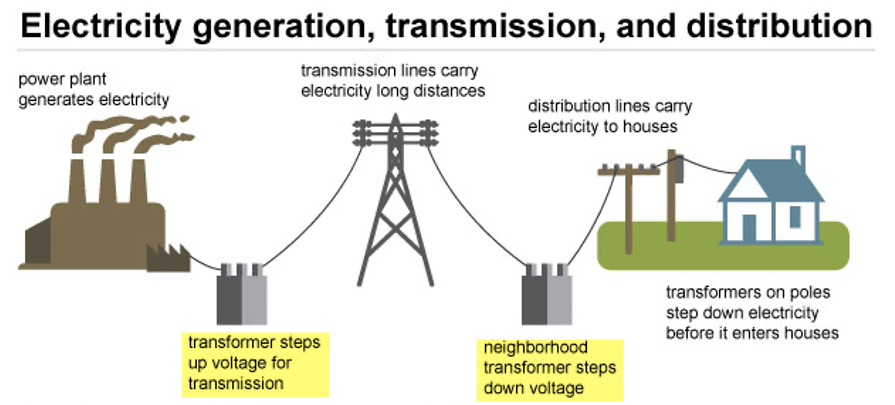
A step-up transformer increases the voltage of electricity in the transmission power lines to allow electricity generated at the power plant to be transmitted long distances to where it is needed.
The use of Electrical Transformers from power generation to your Home or Business
Transmitting electricity long distances is less expensive and more efficient at higher voltages. When the electricity arrives at your home or business the voltage is stepped down (decreased) through a transformer to a lower voltage. At the power plant transformers increase (step up) the voltage and then when needed for home or office use the voltage is reduced (step down) to a safer level.
A transformer receives electric power in its primary windings and transforms it into electric power in the secondary windings of the same frequency. The voltage can be increased or decreased but will have a proportional decrease or increase in current.
Physical Construction of Transformers
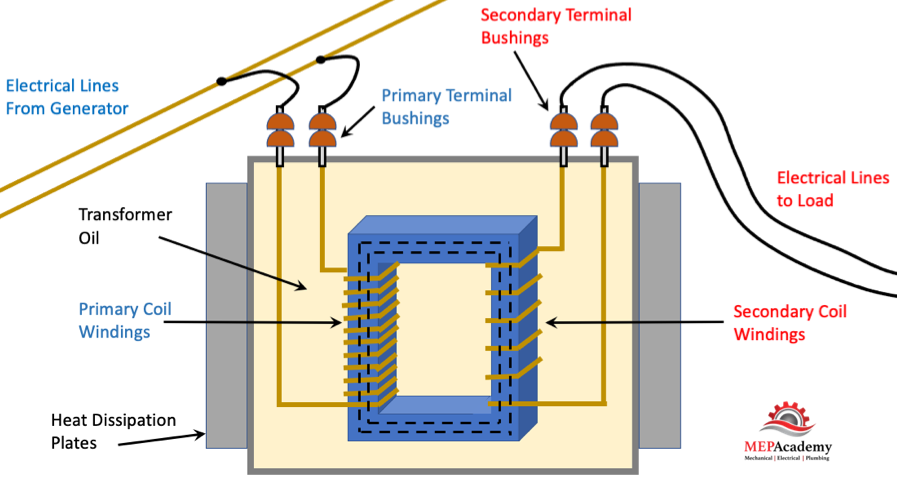
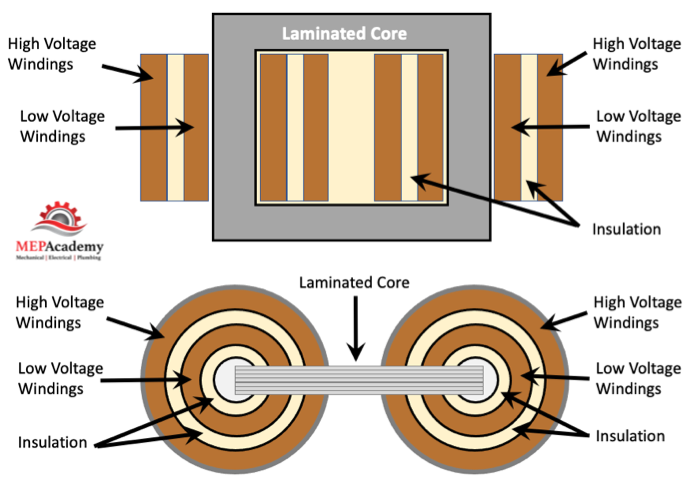
In the three-phase transformer the windings are tightly housed in some form of sheet-metal container. A layer of insulation will separate the windings from each other and from the housing. The coils sit between a layer of insulation to keep them separated while still allowing magnetic induction to occur.
How an Electrical Transformer is Built
The housing will be filled with oil or a synthetic fluid that serves two purposes, one to keep the transformer cool, and the other as an additional insulating material. You may see transformers with corrugated sides to provide additional surface area for cooling. The heat is transferred from the core and windings to the oil and then to the shell of the transformer where it radiates out to the atmosphere.
The electrical leads penetrate the transformer housing with protective bushings of porcelain or oil-filled and capacitor types for high voltage applications.
How a Transformer Works
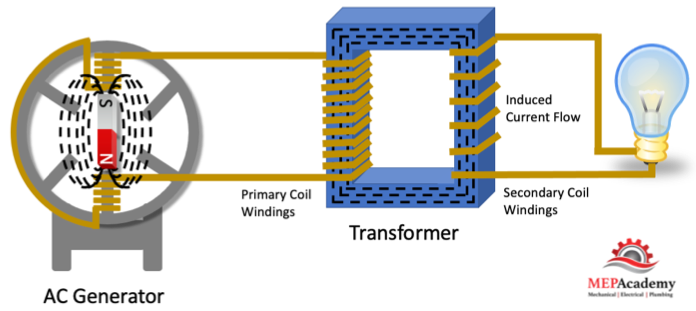
The transformer has two circuits, a primary coil winding and a secondary coil winding linked by a common magnetic flux. The primary and secondary windings are separate coils but are magnetically linked.
When current flows through a conductor like a wire, a magnetic field is created around the wire. When a bunch of that wire is wound closely together like in a transformer then the magnetic field becomes much stronger, allowing for the transfer of power by magnetic induction from the primary coil to the secondary coil. This magnetic field induces a current to flow in the secondary side of the transformer if the circuit is closed. The alternating current will push and pull on the electrons causing the current to flow.
How a Transformer Works by Magnetic Induction
When the magnetic flux lines from the expanding and contracting magnetic field of the primary windings overlap the secondary windings, a voltage will be induced in that coil.
With the use of magnetic induction, we can transfer energy from one set of coils in a transformer to another set of coils. The alternating current produces this magnetic flux. The electricity flows from the primary coil which receives the AC power from the generator to the secondary coil that will serve the load where the electricity will be used. This transfer of electricity occurs without a change in frequency.
For current to flow in the secondary windings the circuit must be closed and connected to a load, like a motor.
The magnetic core of the transformer becomes magnetized from the alternating current that is created from the incoming alternating voltage hitting the primary windings.
Transformers can only work with AC or alternating current electricity, and not with DC or direct current electricity.
Step-Up and Step-Down Transformers
We mentioned that the voltage at the power plant is stepped up to increase the voltage for greater efficiency when transferring the power over long distances, this is because higher voltages require less current or amps, which means smaller wires for transmission, which equals less cost for transmission.
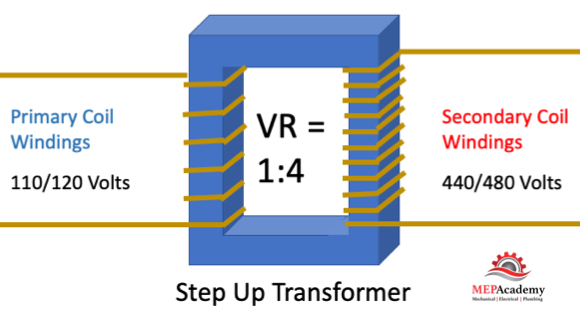
Step-up Electrical Transformer Diagram
The step-up transformer Increases the voltage while decreasing the current. This is done by having more turns of the coil windings on the secondary side compared to the primary as indicated by the turn ratio.
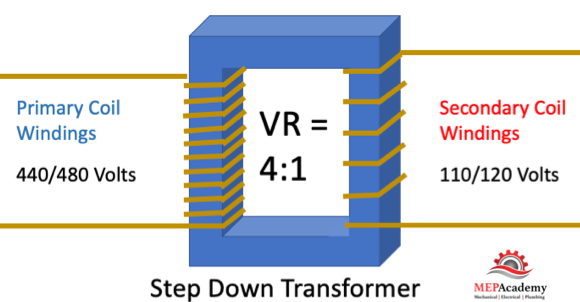
Step-down Electrical Transformer Diagram
The step-down transformer decreases the voltage and increases the current. This is done by having less turns of the coil windings on the secondary side compared to the primary.
Each coil of the transformer contains a certain number of turns of wire that wrap around within the transformer. The turn ratio compares the amount of turns of wire on the primary coil windings to the secondary side. This turn ratio can be expressed with an equation.
Turn ratio = Np/Ns
Np = number of turns on the primary coil windings
Ns = number of turns on the secondary coil windings
Voltage Ratio
The voltage of the coil windings in a transformer is directly proportional to the number of turns on the coil windings.
Vp/Vs = Np/Ns
Vp = voltage on primary coil
Vs = voltage on secondary coil
Np = number of turns on the primary coil
Ns = number of turns on the secondary coil
The voltage ratio (VR) is expressed as the relationship of the primary voltage to secondary voltage.
A voltage ratio of 1:4 means that for each volt on the primary, there will be 4 volts on the secondary. This would be a step-up transformer as the voltage on the secondary side has increased. (See image above)
A voltage ratio of 4:1 means that for every 4 volts on the primary, there will be 1 volt on the secondary. This would be a step-down transformer as the voltage on the secondary side has decreased. (See image above)
For example, if we have a transformer that reduces voltage from 120 volts in the primary to 12 volts in the secondary, and the primary windings has 300 turns and the secondary has 30 turns, the voltage and turn ratio would be as follows,
VR = Vp/Vs = 120/12 = 10:1
TR = Np/Ns = 300/30 = 10:1
Three Phase Transformers
Using a three-phase transformer is like a single-phase transformer except that we have three single-phase windings instead of one. With these three windings we can connect them together in a wye or delta configuration, or a combination of the two.
The 3-phase power is the most common way that power is produced. Large scale power plants generate voltages of 13 kV or higher. This electrical power gets sent over the transmission wires at much higher voltages of 110, 132, 275, 400 and 750 kV. These voltages are increased by three phase step-up transformers for higher efficiency transmission. The transmission voltages then arrive at the load centers where they are reduced to distribution voltages of 6,600, 4,600 and 2,300 volts. This distribution voltage than gets reduced or stepped down to utilization voltages that the consumer uses at voltages of 440, 220 or 110 volts. Transformers are highly efficient at full load with efficiencies running 95% or greater.
Delta Connection
All three phases are connected in series to form a closed loop using a delta connection.
Wye Connection
The common end of each of the three phases are connected at a neutral terminal, while their other ends are connected to three-phase lines in a wye connection.
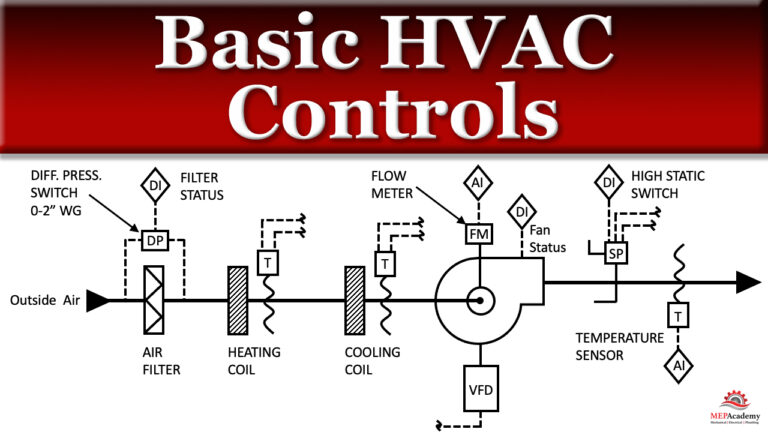
Basic HVAC Controls. Most modern residential and commercial building are built with some form of an HVAC systems to control the interior environment. These HVAC systems are used to control temperature, pressure, humidity, flow, and air quality. In this video we’ll show you how these HVAC systems use various controls to respond to the needs of the environments that they seek to control.
Scroll to the bottom for a FREE YouTube Video of this Presentation.
The importance of the HVAC system is usually appreciated on the hottest or coldest days of the year when you really notice the difference between outdoors and the controlled indoor environment. The HVAC systems are designed to be able to meet the peak demand for each of the seasons, summer highs and winter lows. Most of the year the HVAC system will run at partial load, where the full capacity of the system is not used.
The demand on the HVAC system changes throughout the year and daily. HVAC systems are sized based on Heating and Cooling loads, often performed by load calculation software. Below are some of the most common load calculation and energy modeling software.
HVAC Load Calculation and Energy Modeling Software
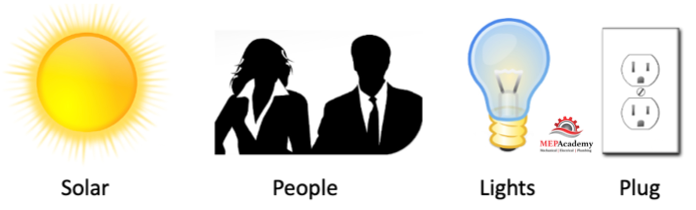
The load calculations will take into consideration the solar load on the structure, the quantity of people in each space, heat from lights, and the plug load, which is all the equipment and appliances that use power and generate heat within the building.
HVAC Cooling Load Sources
The HVAC control system will need to respond to these changes to maintain the environmental conditions such as Temperature, Pressure, Humidity, and Air Quality. HVAC systems can be used to control the environment for people, food, cleanroom processes for computer chip manufactures or pharmaceutical drugs, animals, IT equipment in data centers, and hospital procedures. The scope of application is endless, but we’ll stick to the control of the environment for humans.
HVAC systems use some form of controls from the very basic to the very sophisticated BMS, Building Management Systems that can monitor and control everything from the HVAC system, lighting, fire systems, and security systems.
We can control a simple single standalone piece of equipment like a home air conditioner or hundreds of pieces of HVAC equipment all networked together and controlled from a frontend computer in the facility managers office or remotely.
On/Off Control
The most basic form of control is to turn on and off a piece of equipment with an on/off switch. You have two options, either the equipment can be on or off. This can be done with a simple light switch as an example.
Carbon Monoxide Garage Exhaust System
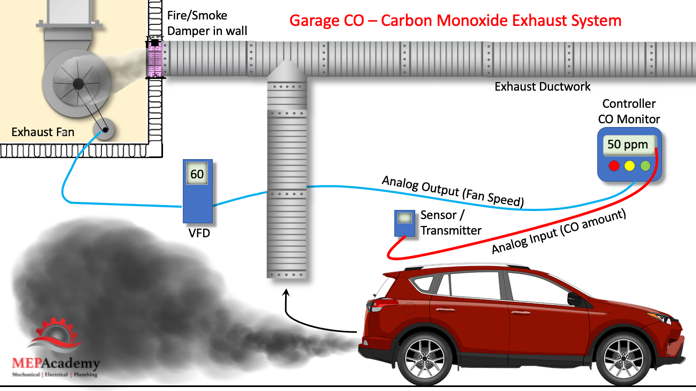
We’ll use an underground parking garage for our example, as everyone has been in one of these. With a simple on/off switch we can turn the garage exhaust fan on when the garage is occupied and shut it off when all the cars leave. Not very efficient, and against code in most jurisdictions.
We can automate this by adding a carbon monoxide controller and sensor to activate the fan when the total CO level reaches the setpoint of the controller.
Carbon Monoxide Controller for Garage Exhaust System using a VFD for Fan Speed Control
The CO Sensor will send an analog input signal to the carbon monoxide controller indicating the current CO concentration, and when the set point of the controller is reached, meaning that the level of CO in the garage has reached a level that requires the exhaust fan to be turned on, the controller will send a binary signal to the fan to start.
This input device or CO transmitter senses if there is a buildup of car exhaust. We can now add more controls for better energy efficiency, such as a VFD.
Now the CO sensor sends the current concentration of CO in the garage to the controller. The controller will compare that to the setpoint, if the input signal CO levels is greater than the controller setpoint, the controller will send an analog output signal to the VFD, variable speed drive to speed up the fan. The output signal is considered an analog signal because it can vary. The speed of the fan will be based on the level of CO in the garage. Instead of on/Off, we can provide the proper fan speed to match the exact conditions in the garage, helping to avoid using too much energy.
Additional Binary Output Devices
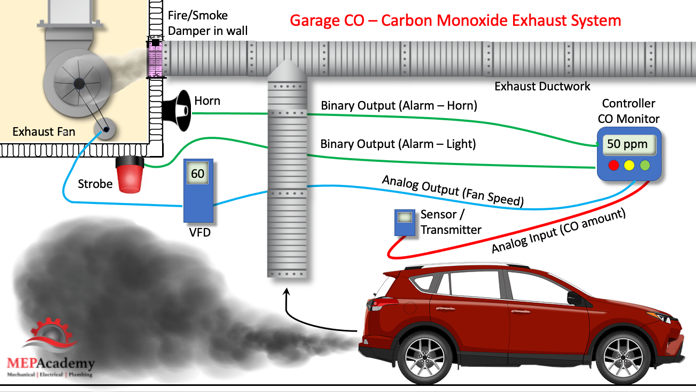
We can still add a few more binary output devices to bring attention to a dangerous situation. By adding two more output devices, a strobe light, and a horn we can notify garage occupants that the levels of carbon monoxide have reached a dangerous level. The carbon monoxide controller will have a setting that sends a binary signal to the horn and emergency strobe light to turn on when the CO exceeds a hazardous level.
Garage Exhaust – Carbon Monoxide Controller and Sensor with Emergency Horn and Strobe Light
You can see that using a controller allows you to add input and output points to any system. The garage exhaust fan can be setup to run at low and high speed or if acceptable to the local code be run using a VFD.
Controllers, Sensors and Controlled Devices
Now we’ll explain the function of the controller, sensors, and controlled devices.
There are four basic elements of a control system: controller, sensor, the controlled device, and the source of energy, such as electrical or pneumatic.
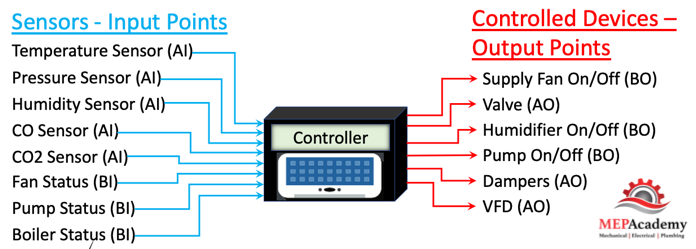
These special sensors monitor and measure variables like, temperature, humidity, pressure, flow, and air quality and provide controllers with the status of the space. These parameters can’t be done with a simple on/off setting. The analog input and output devices send or receive a variable current, voltage or resistance between a minimum and maximum value. This allows for an accurate measurement.
HVAC Controls Input and Output Points – Analog and Binary
There are different types of signals produced by sensors, which include: Electronic, Pneumatic or Electric Sensors. Pneumatic systems are prone to leaks and are being changed out whenever possible as they are less energy efficient than DDC.
Pneumatic sensors put out a 3 psig to 15 psig pressurized air signal, electronic sensors can be resistance, voltage, or current based sensors, with a voltage signal range of 0 to 10vdc, a current signal range of 4 to 20 mA (milliamps)
Controller
The controller is the brain that makes the decisions based on settings entered by the controls company according to the specifications and sequence of operation. The controller receives inputs from sensors and compares that to the controllers setpoint and then provides a response to output devices. The inputs inform the controller of the existing environmental condition, and then the controller directs the output devices to change the environment to meet the setpoint.
Much like your brain is the controller taking input from your senses, like taste, smell, hearing, vision, and sense of touch. The brain will take the input from your senses and direct an output signal on what the body should do with that information, such as move hand away from hot stove, or spit out a hot pepper, or a visual input of a man with gun, will provide the response or output to run away fast.
There are all kinds of input and output devices for controlling the environment. Each device is meant to serve a particular purpose.
Binary and Analog inputs and Outputs
The difference between a binary and analog input or output device is the number of positions or steps you can have. A binary input or output device has two options, such as either on/off or start/stop, while an analog device can vary, such as in reading various temperatures and pressures, or in modulating a valve or damper position to increase flow in varying amounts, not just full open or full close.
Analog is used when the environmental element being measured has more than two options. Binary provides for two states, either on/off, low/high, start/stop, etc.
Inputs provide the controller with the information it needs to make a decision, while the outputs are where the controller sends its messages to make adjustments as required to meet the settings of the controller.
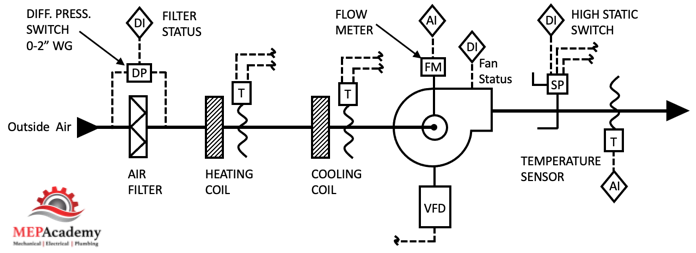
A binary input to the controller could be the fan status, whether it’s on or off, while the binary output to the fan from the controller could instruct the fan to start or stop. Each of these inputs and outputs have two options, on/off or start/stop.
An analog input to the controller could be the current speed of the fan when using a VFD, while the analog output could be used to change the speed of the fan using the VFD. Using an analog input or output allows for a range of fan speeds to be used.
Universal inputs allow for either a binary or analog input.
Now we’ll step back to explain a couple simpler devices.
Split System HVAC Unit
Using an on/off switch for your home heater or air conditioner would not be very effective because as we now know there are sensors that can measure the indoor temperature and turn on and off the HVAC unit as required. The typical home thermostat acts as the controller and temperature sensor all in one. You set the desired temperature and the thermostat will try to maintain that setpoint.
To control these environments, you need to monitor or sense the existing condition and compare it to the desired setpoint you’re trying to achieve for the space.
To automate this, we could add a simple bimetal thermostat that would sense the air temperature surrounding the stat or temperature sensor and feed that information to the HVAC equipment. When it got warm in the room the bimetal would expand and make contact in the electrical circuit, causing the air conditioner to turn on. When the air has cooled down it would cause the bimetal in the thermostat to contract and pull away from the electrical contacts, thereby turning off the air conditioner. Now at least you have the HVAC system automated according to temperature.
Scheduling – Time Clock Function
Adding a time clock to the thermostat or BAS will allow additional control based on day of the week or time of day. For example, you could have the thermostat turn on the air conditioner an hour before you get home from work so that the home is already cool when you arrive. A simple timeclock allows the HVAC system to have its own schedule based on time, while the thermostat will be based on temperature. So, with a simple thermostat we can control temperature and time.
With the increase in mobile apps, most of this can be done on your phone, but you’ll still need the hardware component to communicate with your AC unit.
Scheduling is important in commercial buildings because you don’t want the occupants to arrive in the morning on a very cold day to find their offices freezing cold. Another reason is that you want to make sure that the HVAC system can’t run on weekends or during the night when the building is unoccupied as this would be a big waste of energy and money.
With building automation software and their control logic the schedule and the temperature and be optimized beyond just starting an hour before the occupant’s arrival. The automation software will look to optimize the starting and stopping of the HVAC system to provide for energy savings. So, the control program will check with other input devices such as an outside air temperature sensor and zone temperature sensors to determine when to bring on the heating or cooling to meet the design temperature before the occupants arrive.
This will help the controls program calculate how long it might take to heat up the building before the occupants arrive. The colder the outside air the longer it will take to warm up the building, so the earlier the HVAC system heating mode will be turned on.
VAV Box Control
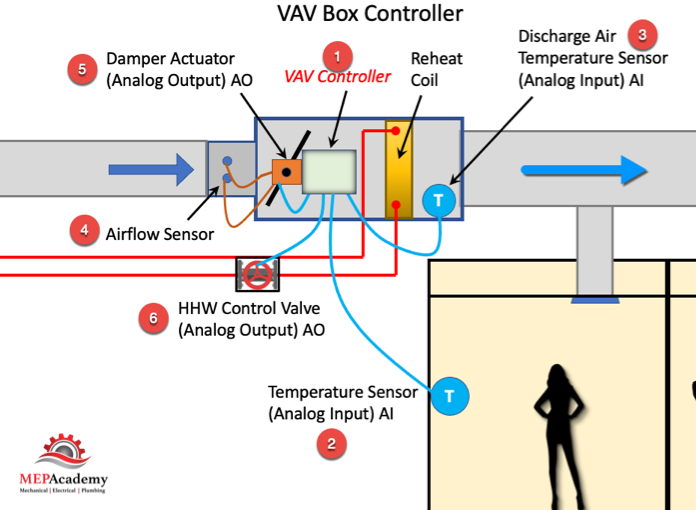
A VAV box is commonly found in medium to large commercial buildings, so this will help explain the basic control sequence for this design. You can see that the VAV Box Controller (#1) is mounted on the VAV box and receives an analog input from the room temperature sensor (#2), meaning it can provide a wide range of temperature readings, the Discharge Air Temperature sensor (#3) is another analog input device, and Airflow Sensor (#4).
VAV Box Controller Diagram
In heating mode, the VAV box controller receives input from the room’s temperature sensor that it’s too cold in the space, the controller then sends a signal to the Damper Actuator (#5) which is an analog output device, to close the damper to minimum position and start to modulate the Heating Hot Water control valve (#6) open, another analog output device.
The controller being the brains, receives input information on which to compare against the setpoint, and then sends an output command to various components to achieve the desired environmental conditions set for this space.
In heating mode, the VAV box damper will be at the minimum open position to avoid wasting energy, as the air arriving at the VAV box has been cooled down at the Air Handler to around 55°F (13°C). We will build on this system by introducing the VAV system and additional control points.
VAV Air Handler System Control
In a VAV system we can add another component of control and that is fan speed. Fan’s use a lot of energy and so being able to reduce their speed will save money. See our video on fan laws to understand the savings potential, and our video on VAV systems which are commonly used in larger commercial buildings.
Fan speed is accomplished by adding a static pressure sensor in the main supply air ductwork. The static pressure sensor is an analog input device which measures the static pressure in the duct. As VAV zone dampers reduce their need for air, they close their dampers causing the pressure in the main supply air duct to increase which is sensed by the static pressure sensor.
The controller will receive the input signal from the pressure sensor that the pressure has increased, and then send a message to the fan to slow down by use of a VFD, variable speed drive. The controller compares the static pressure in the main supply duct to the setpoint and then modulates the supply fan VFD to maintain that static pressure setpoint. As the demand for cooling decreases more, the static pressure setpoint can be reset downward to save additional energy. To learn more about variable speed drives see our Video on VFD’s.
Fan Coil System Control
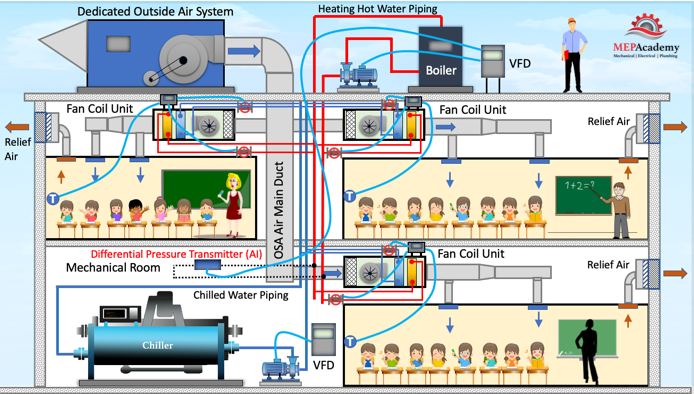
A similar device in a water-based system would be a differential pressure controller combined with two-way valves on the coils. In a heating hot water or chilled water system, as the modulating 2-way control valves at each coil begin to close, the increased pressure is sensed by the differential pressure controller, an analog input device. This sends a signal to adjust the pump speed using a VFD to reduce the frequency or hertz delivered to the motor on the pump, thereby reducing the flow of water. VFD’s are used to control cooling towers, chillers, pumps, and fans.
Fancoil system HVAC controls
All these points can be monitored by the BAS, building automation system for a more optimized and energy efficient system.
Flow Control Valve
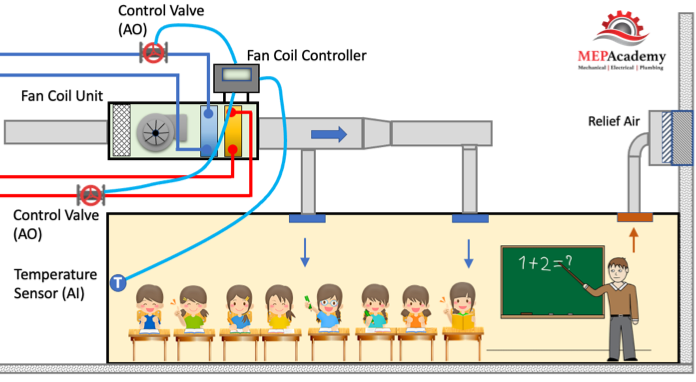
Using a thermostat with a control valve connected to a fan coil or radiator we can control the flow of heating hot water or chilled water, either of two ways. First, the 2-way flow control valve can be either a two-position valve, that is either open or closed (binary), or modulating (analog). Using a two position control valve, when there is a demand for cooling or heating, the control valve opens all the way and you get full water flow whether you need it or not.
HVAC fan coil controls
The second method would have a modulating or proportional control valve accept a varying analog signal, like 4 to 20 milliamps. Instead of two positions, full open or full closed, the valve will have various percentages of open. The analog input temperature sensor sends a signal to the fan coil controller indicating the current temperature of the space. The controller compares the current temperature in the space to the desired set point. The greater the distance from the setpoint, the greater will be the response to open the valve.
The controller accepts the input temperature from the sensor, compares it to the set point in its control logic, and then sends an analog output signal to the device being controlled. The controlled device then responds by trying to change the controlled environmental element, in this case it’s the temperature by opening the 2-way control valve an increasing the flow of hot or cold water through the coil.
Sequence of Operation
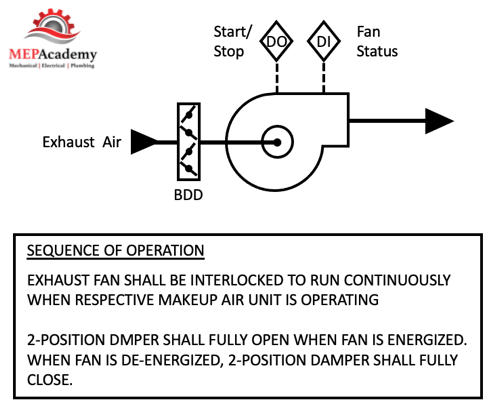
In the commercial controls industry, you’ll hear the term sequence of operation. This is the defined method or sequence upon which the controls are to respond as defined by the mechanical or controls engineer. It defines how the controller along with the input and output devices will achieve control of the environment or space, whether that is a room occupied by humans, animals, or equipment, whether it’s an ice box or central plant. The sequence of operation explains how the system is designed to operate.
Sequence of operation – control of exhaust fan
Points List
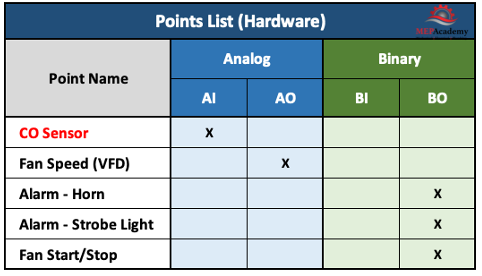
The points list is a quick reference chart that list all the input and output points required to meet the sequence of operation strategy. You’ll find these on commercial construction control drawings. Here is the one for our simple Garage Exhaust CO Monitoring Controls System.
Lumens and Footcandles. We’ll show you how to choose the correct light bulb when switching out an old incandescent bulb, we’ll explain lumens, footcandles and Lux for those using the metric system. We’ll show you how footcandles change with the square of the distance, and how to calculate foot candles.
If you prefer to watch the YouTube version of this presentation, scroll to the bottom.
Replacing Light Bulbs – Buy the Lumens, Not the Watts
It used to be easy to switch out incandescent light bulbs based on how many watts they used, because all you had to do was go to the store and pickup one that matched the watts. With the need for increased energy efficiency and the increased use of LED lights, this doesn’t work anymore.
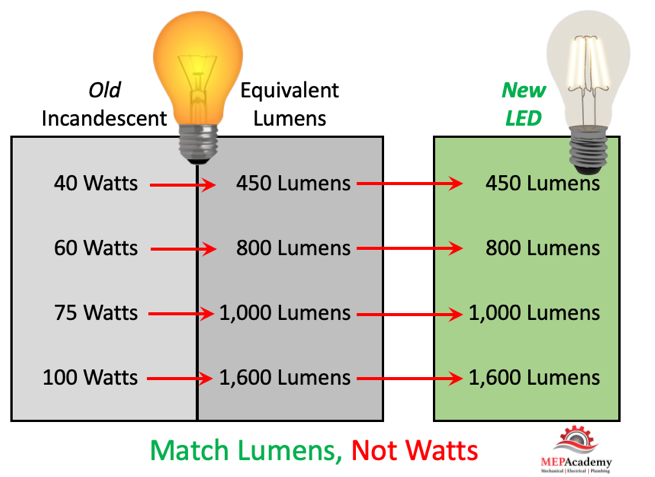
The latest bulbs use up to 80% less power to give you the same amount of light. Switching from incandescent to LED using the same watts doesn’t work. It’s the lumens that you want to match. Buy the Lumens, not the watts. The higher the lumens, the brighter the light.
Match the Lumens of your Old Incandescent with the Lumens of a new Energy Efficient light
When changing from incandescent to LED or other energy saving bulb, it’s the lumens that represents the brightness, not the wattage. If you maintain the same distance from the light bulb to the floor or task area, then getting the equivalent lumens should work.
Here is a rule of thumb from the government energy savers program.
When replacing an incandescent bulb
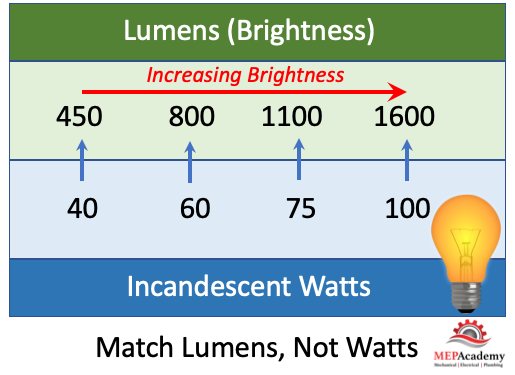
Replace a 100-watt incandescent bulb with a light bulb that provides about 1,600 Lumens.
Replace a 75-watt light bulb, with one that provides about 1,100 lumens.
Replace a 60-watt light bulb, with one that provides about 800 lumens.
And replace a 40-watt light bulb, with a light bulb that provides about 450 lumens.
Replacing incandescent light bulbs with equivalent in Lumens, not watts
Lighting Facts Label
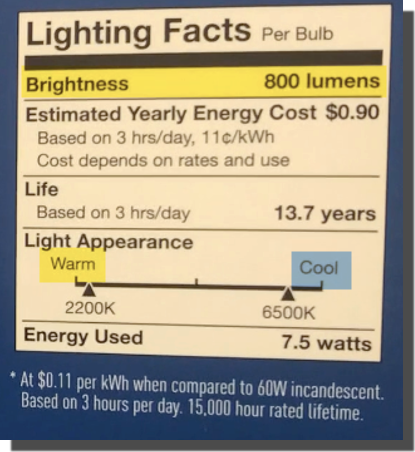
When shopping for light bulbs, look at the label on the package and you should see the lumens listed as shown here.
Lighting Facts Label on all Light Bulb Packages
The label will provide you with the lumens, the estimated savings based on an assumption of your cost per kw, the projected life of the bulb based on daily hours used, the appearance of the light from a warm yellowish color to a cooler blue appearance, and the energy consumed in watts.
What is a Footcandle?
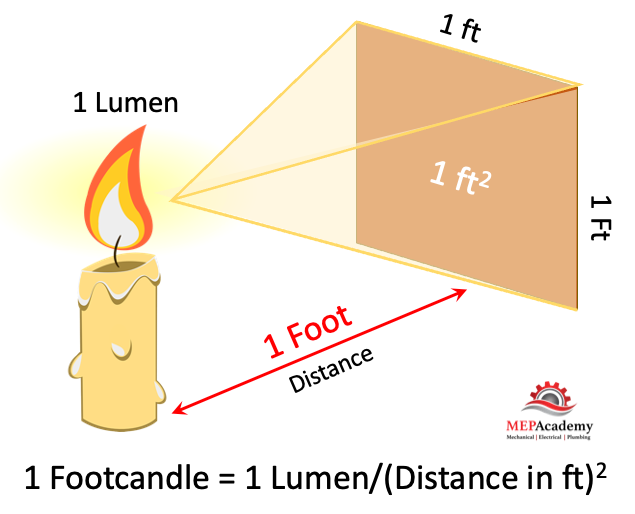
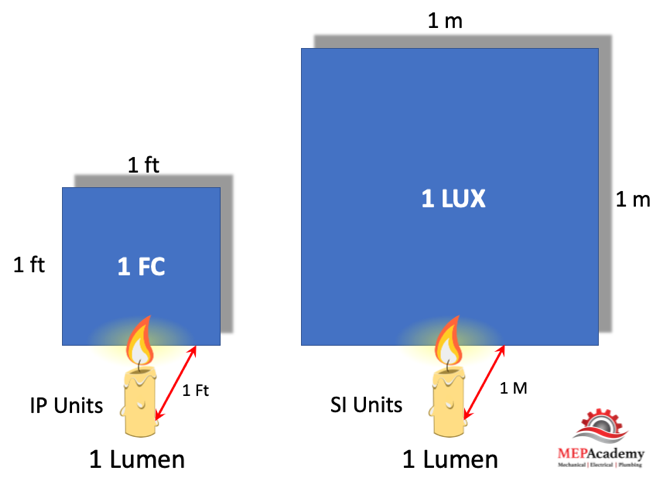
A footcandle is defined as a measurement of the light’s intensity. One foot candle equals the amount of light to saturate a one-foot square with one lumen of light.
Footcandle.
What this means is that the number of lumens produced by the light source, whether that’s an office light fixture or a lamp at home is measured not by how many lumens leave the bulb, but by how many reach the surface being measured and it’s expressed in foot candles.
Footcandles would tell us how much of the light that leaves the fixture arrives at the surface where it’s needed.
Why use Footcandles
Using footcandles allows different sources of light to be compared and provide a standard that can be measured. Footcandles are directly affected by the distance from the source of lumens and can be expressed in a simple formula.
Footcandles = Lumens/ (Distance in Feet)2
This makes the distance from the source a main factor, and the distance works inversely with the footcandles.
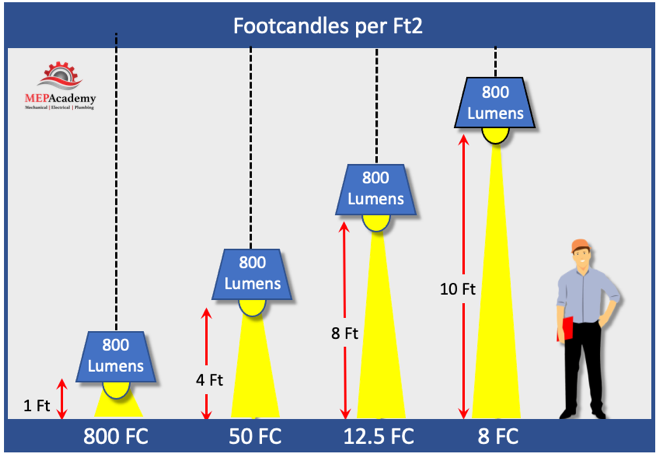
If you had a 10-Watt LED light with 800 Lumens, then you could figure your footcandles using the formula starting with the lamp 1 foot off the floor we get
Footcandles = 800 Lumens / (1 foot) 2
Footcandles = 800 / 1 = 800 Footcandles.
The lumens and the footcandles match as the distance is only 1 foot.
Moving the lamp to 4 feet above the floor we now get
Footcandles = 800 Lumens / (4 feet) 2
Footcandles = 800 Lumens / (16) = 50 FC
Again, this time at 8 feet above the floor we get
Footcandles = 800 Lumens / (8 Feet) 2
Footcandles = 800/64 = 12.5 FC
Using that same 10-watt LED light, but hanging it at 10 feet, instead of 8, the footcandles or amount of useful light changes at the surface.
Footcandles = 800 Lumens / (10 feet) 2
Footcandles = 800/100 = 8 FC
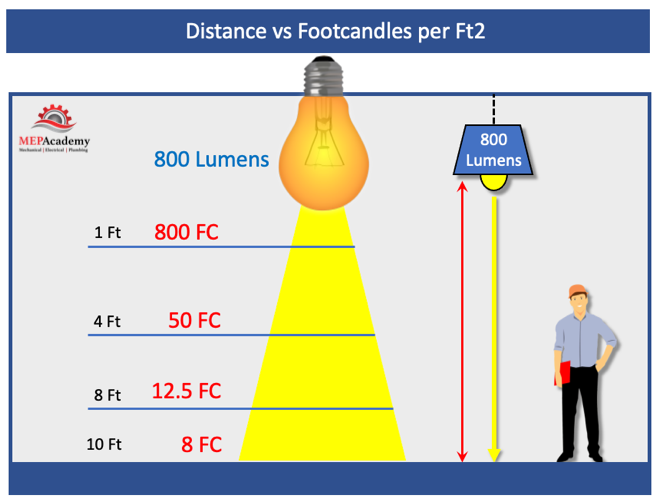
This clearly shows the relationship between distance and footcandles, and that the lumens can remain the same but have very different results based on height.
Footcandles and the effects of distance.
This is common sense to all of us, but this formula makes it easy to calculate the affect and gives illuminating engineers something to use in laying out the lighting design to ensure proper lighting for the various areas of the building.
We can see that if the distance is only 1 foot, then our lumens will equal our footcandles as that is the definition.
What does the IES Recommend?
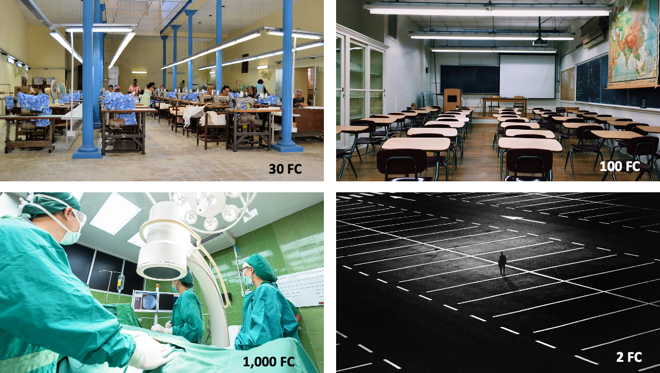
The IES, or better known as the Illuminating Engineering Society provides a standard for lighting levels for various surfaces, such as the following: Operating room 1,000 Footcandles. This is definitely important because the medical staff needs to see clearly. Classrooms 100 footcandles, Gymnasium 100, offices 50, factory floor 30, hallways 10 and a parking lot only 2 footcandles.
IES Requirements for Footcandles based on space type
For anyone trying to read in a parking lot at night, now you know why its difficult, because they’re only designing to achieve a few footcandles of light.
LUX and the Metric System
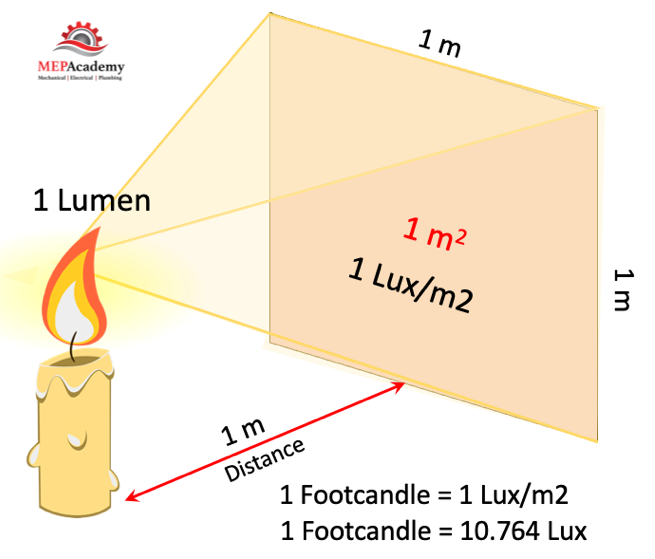
For those using the metric system, this would be expressed in LUX. One footcandle is equal to 10.764 Lux.
Lumens expressed in SI Units of Lux per square meter
Remember that our formula for footcandles was based on 1 square foot. Since a square meter has 10.764 square feet, then we need to multiply our footcandles by 10.764 to get the equivalent footcandles/m2.
Lumens expressed in IP and SI units. (Footcandles and Lux)
It’s the same amount of footcandles, it’s just expressed for a larger area, because instead of 1 square foot, we are using 10.764 square feet or 1 square meter.