

Home Blog Page 53

How Chillers Work Water vs Air-Cooled Chillers

Chillers are used to cool water that is then used to cool the occupants of buildings. The Chiller comes in two basic condenser side designs, either it’s water-cooled or air-cooled. This designation is referring to how heat is rejected from the system, either the heat is rejected by water or air.

If you prefer to watch our FREE YouTube version of this presentation, scroll to the bottom.

Air-Cooled vs Water-Cooled Chillers

Main Chiller Components

There are four main components in a chiller. These same four components can be found in all air conditioning units with slight differences in configuration.

  • The Compressor (The Refrigerant Mover)
  • The Evaporator Coil (Heat Exchanger) – Absorbs Heat
  • The Condenser Coil (Heat Exchanger) – Rejects Heat
  • The Expansion Valve or Metering Device (Refrigerant Traffic Cop)

The difference between an air-cooled and a water-cooled chiller begins with the method on which they eject heat, and as their prefixes imply, one ejects heat with air the other using water. They both use the basic refrigerant circuit with modifications. Below is the standard refrigerant circuit you’ll find in just about every piece of air conditioning equipment including chillers with some modifications.

Refrigerant Circuit
Refrigerant Circuit

Basic Refrigerant Circuit

Notice that the evaporator and condenser both use a fan to blow air over a coil to absorb or eject heat from the refrigerant circuit. See our video on Refrigerant Circuits.

Refrigerant Circuit for Air-Cooled Chiller

The refrigerant circuit for an air-cooled chiller replaces the evaporator fan with a Shell and Tube Heat Exchanger. (See image below). The low side liquid refrigerant will enter the shell and tube heat exchanger and absorb the heat from the chilled water return. The refrigerant surrounds the tubes while the chilled water enters the tubes, the two never mix. The refrigerant circuit is completely isolated and separate from the chilled water circulating.

Refrigerant Circuit of an Air-Cooled Chiller

Refrigerant Circuit for Water-Cooled Chiller

With a water-cooled chiller we have eliminated both the condenser and evaporator fans, as water is the medium by which the heat will be passed around. We have replaced the condenser fan with a Shell and Tube Heat Exchanger where condenser water will take the heat from the High Pressure Refrigerant and eject it through a cooling tower of some sort.

As you see from the three refrigerant circuits there are always the same four components, Evaporator, Condenser, Compressor and Expansion Valve. The only real difference is in the method they absorb and reject heat (Air or Water).

efrigerant Circuit of a Water-Cooled Chiller
Refrigerant Circuit of a Water-Cooled Chiller

Heat Source

Remember that the basic function of the chiller is to move HEAT. To absorb heat from within the building and then to toss it out of the building. It’s the process of evicting heat from the building. Remember that you make the air cooler by removing heat. Heating and cooling is accomplished by either adding heat or removing heat from any medium. Heat moves from the warmer source to the cooler one.

Where does the heat come from? It comes from the People, lights, plug loads and solar through walls, windows and the roof. There will also be heat and moisture brought in from the code required ventilation air or outside air and infiltration, air that leaks into the building. See Video on “Calculating Cooling Loads“.

Sources of heat Load for Building Cooling System
Sources of Heat

Heat Absorption Cycle

The process begins by absorbing heat from the space and any ventilation or outside air added at the Air Handler. The heat enters the air handler from the return air brought from the occupied spaces along with outside air added for ventilation. This air blows over the Chilled Water coil located in an Air Handler where it gives up its heat to the chilled-water being circulated from the chillers evaporator. The cooled air is then supplied to the room from the air handlers supply fan through sheet metal ductwork to air diffusers in the occupied space.

The chilled-water supply enters the cooling coil at about 44°F (6.6°C) and the heat is taken back to the chiller in the chilled-water return piping at approximately 54°F (12.2°C). The chilled water has increased 10°F (6.6°C) by absorbing the heat from the space (return air). The chilled water will then be returned to the chiller will it will give up its heat to the evaporators heat exchanger as part of the refrigeration cycle. 

Chilled Water Circuit - Heat Absorption Cycle
Chilled Water Circuit – Heat Absorption Cycle

Heat Rejection Cycle

Now that we have absorbed the heat from the building space and any ventilation air, we’ll need to toss this heat out of the building. The chillers refrigeration cycle will transfer the heat from the evaporator to the compressor where it will be increased in pressure and temperature.

After the compressor the refrigerant is now in the high-side of the refrigerant circuit where it enters the condenser. The condenser will rejects this heat into the air or water depending on the type of chiller (air-cooled vs water-cooled). 

Heat Rejection Cycle Water-Cooled Chiller

Heat Rejection Air-Cooled vs Water-Cooled Chillers

As previously discussed water-cooled chillers use some form of cooling tower to reject the heat, see our video on “How Cooling Towers Work”. The high side refrigerant gas that enters the water-cooled chillers condenser will change from a refrigerant gas to a liquid as it gives up its heat to the condenser water circulating through the shell and tube heat exchanger. That heat is taken in the condenser water to the cooling tower where it is transferred to the ambient air passing over the tower fill.

An air-cooled chiller is a mostly self-contained unit, although there are version of the air-cooled system that can have separated sections, the most common is a one-piece unit. 

Space Requirements

Of course one of the difference between the two style of chillers is that an air-cooled chiller will be located outside, while a water-cooled chiller is almost always located indoors. This will require real estate for either style, whether that is outside or inside. In addition the water-cooled chiller will require a cooling tower that is often located on the roof or somewhere on grade. Depending on the size of this equipment, they can become very heavy requiring structurally engineered supports, especially roof mounted cooling towers and chillers. 

Water-Cooled Chiller Basement Level - Ground Floor Cooling Tower
Water-Cooled Chiller Basement Level – Ground Floor Cooling Tower

Water-Cooled Chiller with Ground Mounted Cooling Tower

Above we show a Water-Cooled chiller located in the basement of an office building with the Cooling Tower on ground level. Chiller feeds the air handlers on each floor with chilled water, and then the fan of the air handler blows cold air into the occupied spaces.

Water-Cooled Chiller Roof-mounted Cooling Tower

Water-Cooled Chiller with Roof Mounted Cooling Tower

In the above image we show the Water-Cooled Chiller in a ground level mechanical room with a cooling tower on the roof. The cooling tower is going to require that the roof be reinforced to handle the additional weight of the tower.

ir-Cooled Chiller Ground Floor Level
Air-Cooled Chiller Ground Floor Level

Air-Cooled Chiller Ground Mounted

As shown in the above image an Air-Cooled Chiller has a much easier layout without the requirement for a cooling tower to reject the heat. 

Main Components of a Chiller

The first component is the compressor which provides the energy to move the refrigerant around the refrigerant circuit.

The second component is the evaporator where heat is absorbed from the building and the water is cooled down to be used within the building to cool the space.

The third component is the condenser which rejects the heat from the building into the water going to a cooling tower or in an air-cooled chiller the heat is rejected to the outdoor ambient air.

The expansion valve or metering device, is called by various names but it functions as the gate keeper between the high-side (Condenser) and low-side (Evaporator), and is the forth component. This valve meters the amount of refrigerant that can pass from the high-side to the low-side based on the demand for cooling. More cooling required will cause the expansion valve to allow more refrigerant to pass through it, going from the high-side to the low-side of the system.

Water-Cooled Chiller Circuit

Water-Cooled Chiller

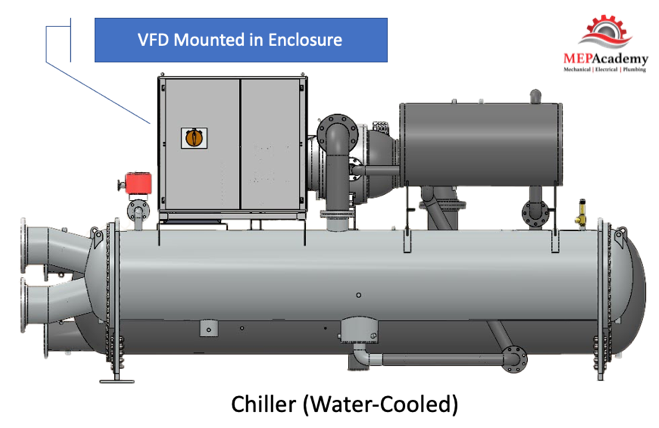
When looking at any water-cooled chiller there are several ways to spot which of the two shell and tube heat exchangers is the evaporator vs the condenser, as they both physically look the same. The evaporator should have insulation on it to avoid absorbing heat from the surrounding mechanical room. The condenser doesn’t need insulation. Also, the evaporator should have a short stub of pipe coming off of it into the center of the compressor.

Water-Cooled Chiller

The condenser doesn’t need insulation and you should notice that the compressor discharges off its periphery into the condenser with a short stub of pipe.

The expansion valve or metering device is often hidden underneath, but will be located between the two heat exchangers. 

Air-Cooled Chillers

These are easy to identify as they are most always located outside and you’ll see the fans located on them, mostly on the top an using axial fans that induce air over the condenser coils. These chillers have all the same components as a water-cooled chiller except a shell and tube type condenser isn’t used. The Air-cooled chillers use an condenser exposed coil with ambient air induced or blown over it to reject the heat. 

Air-Cooled vs Water-Cooled Chiller

Summary

You may be thinking, if Air-Cooled chillers only require a single piece of equipment as opposed to water-cooled chillers that require a cooling tower of some sort, than why don’t all mechanical engineers specify only Air-Cooled Chillers. Several reasons are that air-cooled chillers aren’t as efficient as water-cooled chillers and some codes restrict the total tonnage of air-cooled chillers that can be used at one facility.

When looking at any piece of air conditioning equipment or chiller, look to identify these four components. The difference between water-cooled and air-cooled chillers are in how the heat is rejected from the system. In a water-cooled system, water is used as the method for heat rejection, while air-cooled chillers use air as the heat rejection method, hence the naming.

If you haven’t seen our video on refrigerant circuit, then be sure to watch that for a more in-depth explanation of the refrigeration cycle.

New Refrigerant Codes and Standards

Overview

The push for lower global warming potential (GWP) refrigerants is causing a shift in the refrigerants that will be used in future equipment. The recently passed legislation of the American Innovation and Manufacturing (AIM) Act, which was part of the December 2020 COVID stimulus bill, has given the EPA authority to regulate refrigerants based on GWP.

The proposed new regulations and standards will mean additional training for technicians doing the installations as the flammability of the proposed replacement refrigerants are slightly higher than what is currently being used. 

Refrigerant Codes and Standards - Montreal Protocol - Kigali Amendment - CARB - EPA
Refrigerant Codes and Standards – Montreal Protocol – Kigali Amendment – CARB – EPA

For those in California, one of the more progressive states for energy and the environment, these phaseout dates may come faster than a federal mandate. The California Air Resources Board (CARB) is looking at January 1, 2025 for the implementation of a maximum GWP of 750, which would eliminate the widely used R-410A in most unitary and split systems. 

EPA Aim Act vs CARB - Reduction of R-410A Refrigerant
EPA Aim Act vs CARB – Reduction of R-410A Refrigerant

Refrigerant Safety Codes and Standards

The use of these new A2L refrigerants will require that the building codes of state, cities and municipalities be updated before the wide spread adoption. The majority of these requirements will be written into UL 60335-2-40 3rd edition, ASHRAE 34 and ASHRAE 15 – 2019. (ASHRAE 15.2P – Residential).

The new ASHRAE 15.2P for residential application is set to be ready for the January 1, 2025 transition.

Mechanical Code Cycle

Mechanical ASHRAE 34

ASHRAE 34 classifies refrigerants for safety. The first letter as shown below represents the toxicity class of the refrigerant. The second number/letter identifies flammability.

ASHRAE 34 - Refrigerant Safety - Toxicity and Flammability
ASHRAE 34 – Refrigerant Safety – Toxicity and Flammability

There are two classes of toxicity, class A or B, with B considered more toxic. 

ASHRAE 34 Toxicity of Refrigerant

Flammability has four classes (1, 2L, 2, or 3), with 3 being the highest flammability.

ASHRAE 34 Refrigerant Flammability

ASHRAE 15

Those familiar with ASHRAE 15 for commercial projects are aware of the requirements, but what about the new proposed ASHRAE 15.2P for residential projects. ASHRAE Standard 15 is a Safety Standard for Refrigeration Systems in the event of a catastrophic leak. ASHRAE is getting close to finalizing the standard that will apply to residential buildings (ASHRAE 15.2P), but there are still the state and local code authorities that will need the standard adopted into their code, during their code cycles.

The desire for ASHRAE is to have a model standard (ASHRAE 15.2P) adopted by building codes, thereby giving guidance on the safe application of the use of A2L refrigerants in residential settings.

Checkout Refrigerants here

The slight increase in flammability with the proposed use of A2L refrigerants like R32 & R454B will require additional safety measures to ensure that a catastrophic leak will not cause harm to the occupants. This hazard can be mitigated by making sure that the amount of refrigerant charge is limited based on floor area or that some form of ventilation is activated when a leak is detected.

Refrigerant Safety Class

Why hasn’t ASHRAE standard 15 applied to residential properties before? The classification (A1) by ASHRAE Standard 34 of the refrigerants currently used in residential properties were considered safe if a leak occurred within the occupied space. The assumption was that the acute toxicity exposure limit would not be exceeded in a catastrophic leak. The proposed new classification of refrigerants (A2L) to be used in residential properties are considered slightly flammable to a greater extent. 

The move to the A2L refrigerants is driven by the desire to have a lower global warming potential (GWP) refrigerant. 

So what will be some of the new requirements? Since the new A2L refrigerants are slightly more flammable, there needs to be a way to mitigate any chance of a fire.

ASHRAE Standard 15.2P

This standard will cover the safe design and installation of residential refrigeration systems. Historically residential refrigerant system were considered safe because they use class A1 refrigerants and the level of acute toxic exposure wouldn’t be exceeded in a catastrophic leak.

The push for lower global warming potential (GWP) refrigerants has manufacturers proposing refrigerants classified as A2L (Low toxicity & Low flammability), such as R32 or R454-B. Currently the widely used R410A in packaged and split systems is classified as an A1 (Low Toxicity & No Flammability) refrigerant. This increase in flammability is what has generated the additional concern and need for additional safety measure.

Refrigerant Tool Compatibility

Can you use the same tools that you have been using for R-22 and R-410A with the newer refrigerants?

Changing from R22 to R32

R32 operates at a higher pressure than R22, and R32 uses a different type of oil. The oil from the R22 system could cause sludge or other issues, therefore all the tools used for your R22 systems should not be used for R32, such as gauge manifolds and hoses. Have a dedicated manifold and hoses just for your R32 systems.

Changing from R410A to R32

Since R32 uses has similar operating pressures and oil properties as R410A, so the use of separate manifolds and hoses isn’t required if so stated by the tool manufacture.

So, you won’t be able to replace just one component of an R-22 system with that of an R-32. If you replace an R-22 Outdoor unit, you’ll need to replace the coil, but you maybe able to use the refrigerant piping.

Refrigerant Tool Compatibility between R22 R410A and R32
  • *1: R22 type can be used for R32 & R410A by changing the work process.
  • *2: Dimension of width across flats of flare nut is different between R32 & R410A and R22 (4/8″ & 5/8″ only. Other flare nuts can be shared)
  • *3: When using an R22 type for R32 & R410A, use with a reverse flow preventive adapter.
  • *4: HFC recovery systems can be shared if they have been certified by the manufacturers to be supporting the relevant HFC’s.
  • *5: Even if a detector supports R22, if the detector does not support HFC (R32, R410A), it cannot be shared. Always check with the tooling manufacturer.
  • *6: Sharable when temperature is recalculated

Additional Safety Measures

These additional safety protocols will fall partly on the installing technician and contractor. This will include additional safety training and site analysis for spaces that maybe too small to handle a catastrophic leak and maintain the maximum exposure limit of the refrigerant. One of the questions becomes, is a refrigerant leak detection system required?

Also keeping track of sources R410A before the 40% reduction occurs in 2024 will be important for servicing existing equipment. 

The equipment manufactures need to provide clear installation instructions based on the safety parameters required of their choice refrigerant and the size or quantity of the refrigerant. But how does this work with a split system, where you won’t know the total volume of refrigerant until all the piping has been installed. 

Additional Requirements for Technicians

Will the service technicians be required to calculate the total refrigerant in the system to ensure it doesn’t exceed the allowable limits? Will the service technicians be required to calculate the allowable area of the spaces served?

It has been mentioned that there could be lookup tables to help the technician determine the allowable floor area based on the refrigerant charge as shown in this chart for Daikin European model of their wall-mounted unit using R-32 refrigerant.

Daikin Wall Mounted Unit using R-32 Refrigerant in Europe

In the example shown in the chart above, if you have 2 kg (4.4 Lbs) of R32 in the system, then the minimum floor area is shown to be 4 m2 (43 Ft2).

You won’t just be able to change out an old outdoor unit that was using R410A without also replacing the indoor coil, as both must be UL rated for the new refrigerant class A2L. It appears that you will be able to use the existing piping but will have to ensure through a more rigorous testing protocol that there isn’t any existing leaks.

There is still plenty to be worked out before we know exactly what the installing technicians will be required to do in addition to what was the standard protocol using R22 or R410A. How much time will this add to an installation, or how much training will be involved, or for that matter, record keeping?

Refrigerant Safety Training

There is training currently available for flammable refrigerants that you can find provided by the Air Conditioning Contractors of America (ACCA) and by the North American Technician Excellence (NATE) in addition to other trainers. 

UL Standards

Here are some for the highlights for the updated UL standard;

  • Products using flammable refrigerants are required to be constructed so that any leaked refrigerant will not flow or stagnate near ignition sources such as electrical components.  
  • Enhanced requirements are applied to the refrigerant tubing, joints and fittings on equipment having a flammable refrigerant, to reduce potential sources of leaks by minimizing the number of joints and additional protection from physical damage.  
  • Any products using a flammable refrigerant other than a 2L must be factory sealed, factory charged single package units and service ports are not permitted. 
  • No hot surfaces greater than 700-degree C are allowed in an area that may be exposed to leakage of flammable refrigerants.  

In addition, there will be a limit to the amount of refrigerant in a system based on the Lower Flammable Limit (LFL) of the refrigerant being used in relationship to the floor area it serves. This is not a problem with small system, but as the Refrigerant system gets larger there will be a corresponding need to ensure that any of the rooms served are large enough to handle a catastrophic leak and stay within the LFL limits.

If you exceed those limits than you’ll need some form of mitigation strategy, like a continuously circulating supply fan to help dilute the leak or you’ll need a leak detection system.

Using a leak detection system will activate several key functions to ensure a safe environment. The leak detector when activated can ensure that the supply fan is locked to run continuously to dilute the space while at the same time turning off the compressor to avoid pushing more refrigerant into the space. Also, close any safety shutoff valves in the refrigerant system to stop the bleeding of refrigerant into the space while opening zone dampers to allow more air circulation. Refrigerant systems located within a closet or whose volume of refrigerant is large may require natural and/or mechanical ventilation.

Refrigerant Leak Detection Systems

When are refrigerant detection systems required? What are the defining characteristics of the HVAC refrigerant system that mandate you install a refrigerant detector? The refrigerant detector needs to indicate the type of refrigerant used.

The refrigerant detector can’t have an adjustable set point to initiate mitigation action. You can see why this could be a problem if it was adjustable. If allowed the ability to adjust, then it’s possible the setting would be set higher than the allowable safe limits.

For spaces that exceed the allowable quantity of refrigerant for the floor area served a refrigerant leak detector that senses a loss of pressure in the refrigerant circuit would be required.

If the leak detector senses a loss of pressure than the controls would activate the supply fan to provide dilution air to lessen the accumulation of concentrated amounts of refrigerant. The HVAC equipment is not allowed to have an internal ignition source due to the risk of flammability of the class A2L refrigerants, per UL 60335-2-40.

Requirements for Refrigerant Leak Detection Systems per UL

  1. Indicating type detectors are required to be factory installed by the manufacturer with sensors optimally located to detect any leaks.
  2. Refrigerant leak detector sensor set point is factory set and sealed with no field adjustment permitted. Routine factory inspections are conducted by UL as part of the listing requirements. Detector markings identify the manufacturer and refrigerants used.
  3. The leak detection system is required to activate at a maximum concentration of < 25% of the LFL of the refrigerant being used in the equipment. This 4-times safety factor helps ensure flammable concentrations are not reached.
  4. Detectors turn on available mitigation devices such as circulation fans.
  5. Self-test protocols run every hour to ensure proper operation and function. In the event of detector failure, the circulation fans activate and maintain a required airflow to prevent flammable concentrations from forming. This fail-safe mode is maintained until the detector is replaced.
  6. The sensor shall not be subject to poisoning due to common household and workplace contaminants that shall not damage the sensor or produce false alarms or nuisance trips per Annex LL of UL 60335-2-40.

Various Refrigerant leak detectors are currently being evaluated by the Air-Conditioning, Heating and Refrigeration Technology Institute (AHRTI). The Institute is assessing the capabilities of currently available refrigerant detectors to meet the response time required by the safety standards, with setpoint(s) determined in a manner to meet the safety standard considering related issues such as upper detection limits, accuracy and calibration, drift over time, sensitivity to environmental conditions (temperature, pressure, humidity and vibration).

Residential installation was simple before this quickly arriving change that will require a safety review of your companies handling and installation practices for these refrigerants.

Some equipment may come with a designated minimum allowed room area right on the equipment label, such as with spot coolers or room air conditioners.

HVAC Equipment Certification

Not to confuse the issue but HVAC equipment manufacturers (US & Canada) will need to certify their equipment to meet the revised addition of UL 60335-2-40, the standard that covers electric heat pumps, air conditioners and dehumidifiers.

System Charge

The allowable amount of refrigerant in the system will depend on the LFL and the floor area of the room that is served by the system.

Resources:

EPA Kigali Ratification

The Aim Act

UL Refrigerant Detector Requirements

UL Safety Standards for AC

Refrigerant Management Templates

EPA SNAP

Top 12 Best Construction Bidding Websites

As a follow up to our article on the Top 3 Things to Look for when Bidding a Project, this article will cover where to find the Top 12 Construction Bidding Websites.

The following websites will help you locate projects to bid that might fit your target market.

Finding construction projects to bid from online sources can be frustrating as there are so many options. Determining which ones best fit your needs will take some effort, so we have assembled a partial list of some of the top construction bidding websites which includes some Government Public work projects.

All of these sites are for commercial construction projects, if you’re looking for residential work then you can use a site like Angie’s Home Advisor.

The below websites are some of the best construction websites for bidding private or public commercial construction projects. The websites are listed in no special order.

The listing on these websites can provide notice of projects in various states of development from design through post-bid award. Most of these websites allow for search of a project by location, but others also allow for searching of owners, engineers, architects and others involved in the construction process.

Top 12 Best Construction Bidding Websites

1 – CMD – Construction Market Data

CMD - Construction Market Data for Bidding on Construction Projects
CMD – Construction Market Data for Bidding on Construction Projects

CMD states that they have over 184,000 projects bidding and another 85,000 in the planning stages, in addition to 5,000 project updates daily. Also, 90% of all bidding projects have documents attached 14 days before bid day.

You can search projects by location (U.S. and Canada), building type, phase of project and industry. They allow you to search the project documents including plans and specifications for targeted keywords.

CMD Website -> Construction Market Data

2 – Dodge Data & Analytics

Dodge Data and Analytics Construction Bidding Service

Dodge Data & Analytics has been around in some form for over 100 years helping the construction industry better understand the construction market. Dodge is a widely known industry player and holds several assets in their portfolio including the Blue Book, an industry source for the commercial construction industry and the Sweets Catalogues for Architects, designers, contractors and owners. They have a whole solution of products for the construction industry, one of which is “Construction Leads”.

Dodge Construction Leads allows you to see who else has downloaded drawings for a particular project, allowing you to gauge the competition and interest. 

Search North American projects for access to plans and specifications from your office or mobile device. Receive email alerts based on the project location, stage of development, project value or building type. Dodge also allows you to track your results and provides sales pipeline reports that measure sales activity and ROI that can be exported to Excel or PDF.

Dodge Data & Analytics Website -> Dodge Data

3 – Government Bids.com

Government Bids .com provides access to Government Construction Projects

This is a source for bidding Government projects. The GovernementBids.com website allows you to search based on location and trade served. 

For the State and Local subscription you get access to bids, RFP’s and RFQ’s from over 80,000 agencies including state governments, cities, municipalities and counties as well as special district agencies such as: Police, Fire protection and correctional departments, Hospital and health facilities, School Districts and Libraries, Water and Waste Management, Parks & Recreation, Utilities, Airports, Public Transportation and Toll Roads.

For adding the Federal Agency to your subscription you get access to Bids, RFP’s and RFI’s from federal government agencies including: Department of defense, Homeland Security and General Services Administration (GSA).

Adding “Advanced” to your subscription gets you access to see upcoming opportunities before they become bids.

Adding “Awards” to your subscription allows you to see the winning bidder and the amounts on bids awarded.

Prices for their service is as follows as of the date of this article and is based on signing up for a yearly subscription:

  • State & Local Projects: $44/Month
  • Federal, State & Local Projects: $73/Month
  • Advanced: $87/Month
  • Awards and Advanced: $131/Month

Government Bids Website -> Government Bids

4 – iSqFt

iSqFt Construction Data

The iSqFt website claims that you can get promoted to over 1,500 GC’s in their network which spans the U.S. and Canada and includes both public and private projects. They provide access to projects in development and that are currently bidding, along with access to additional general contractors bidding on the project, not just the GC that invited you. They claim that they have a 91% attachment  rate for construction documents and an average bid window of 3 weeks.

They state that you will increase by 5x the amount of Bid Invitations you’ll receive by creating new GC relationships. They provide a complete list of GC’s for each project along with their contact information.

Search by location and type of installation. You can also search for keywords in the documents. Receive alerts for projects updates, new bidders added and addenda’s. Training is provided free with a subscription.

iSqFt also has the added feature of allowing you to do digital takeoffs for an additional service fee. 

iSqFt Website -> iSqFt

5 – Planhub

PlanHub Construction Data

Planhub allows you to search projects by location, construction type, project type, timeline, and more. You can submit bids to multiple general contractors on a project. Planhub has a centralized dashboard where you can see all your project info in one view – bids, calendar, instant messaging, and more. Cloud based documentation that allows you to view or download project blueprints and project documents.

Planhub’s pricing plan is based on an annual or quarterly basis and the distance or mile radius you want included in your plan.

Planhub Subcontractor Pricing (Annual)

  • Basic: Free Trial
  • Premier (50 Mile Radius): $1,199/Year
  • Premier (100 Mile Radius): $1,299/Year
  • Premier (150 Mile Radius): $1,499/Year
  • Premier (200 Mile Radius): $1,699/Year
  • Premier (500 Mile Radius): $1,999/Year
  • Premier (1,000 Mile Radius): $2,899/Year

Planhub Website -> Planhub

6 – Construction Wire (BCI Build Central)

BuildCentral Construction Data

ConstructionWire offers a free 7-day trial for leads on most private new construction projects in the planning, bidding, and pre-construction stages.

You can search by location, stage of development, project type, project value, company name, company type (owner, developer, tenant, Architect, Engineer, GC, Property Manager) and people.

Pricing starts at:

  • Regional Portal (Up to 3 States): $250/Month
  • National Portal (All 50 States): Price based on your Company Size

BCI Build Central Website – > Build Central

7 – BidClerk

Bidclerk – Public and Private Construction Projects

BidClerk provides both public and private projects in the United States and Canada. Information is available on projects in the early design phase to post-bid. You can download project data from BidClerk in PDF or CSV format and, build your own database of contacts for architects, engineers and contractors. BidClerk is accessible on your mobile devices. Automatic email notifications when any of your projects receives an update.

Search Features – Location (State, City), Project Type (Office, Schools, etc), Status (Design, Bidding, Awarded …) Sector (Private, Public – Fed/State/City/County), Project Value

Bidclerk Website -> Bidclerk

8 – BidNet

Bidnet Construction Bidding Platform

BidNet gathers federal, state and local government RFP’s from across the United States, and delivers new contract opportunities to you every day. BidNet’s Advance Notification feature alerts you months before a term contract in your industry expires, providing an opportunity to influence the creation of the next proposal.

BidNet allows you to search by State, Industry (Construction) and your Trade.

Pricing based on three levels of service

  • State & Local: “Request Pricing”
  • Federal, State & Local: “Request Pricing”
  • Advance Plus: “Request Pricing”

BidNet Website -> BidNet

9 – Construction Bid Source

Construction Bid Source for bidding construction projects
Construction Bid Source

CBS is one of the few websites that list their fees upfront. Prices range from free for limited access or full membership for $39.95/month. They have been in service since 1992. Less fields to search for projects, search seems restricted to location (State and County) and bid date range. Not as robust as other websites but for the cost it may be worth a try.

Construction Bid Source Website -> Construction Bid Source

10 – BidCentral (Canada)

BidCentral - Canadian Construction Projects
BidCentral – Canadian Construction Projects

BidCentral is based out of British Columbia for all those of you that want to chase work in western Canada, Vancouver area. The database provides access to private and public projects with auto notification when new projects are posted.

Their Pricing is as follows;

  • Browse Free (View Projects): $0/Month
  • Premium Monthly: $79/Month

BidCentral Website -> BidCentral

11 – Biddingo.com (Canada)

Bidding Construction Bidding Platform

Biddingo.com is an online portal that connects suppliers providing various goods and services to buyers from the Provincial, Municipal, Education, Crown Corporation, Housing, Construction and Healthcare sectors and Private companies from across Canada.

Buyers, public and private alike, throughout Canada advertise RFPs, RFQs, RFIs, etc. and distribute their documents on Biddingo.com daily. They have access to detailed reports such as invitation lists, document taker’s lists, mandatory site meetings, amendment notices, bid results, awarded contracts, etc. Biddingo.com assists buyers with fulfilling their purchasing requirements.

It appears to have very limited search features, basically by category.

  • Pricing: $250/Year annual subscription
  • 30-Day free Trial

Biddingo Website -> Biddingo

12 – MERX (Canada)

Merx Construction Bidding Data

MERX is another Canadian company providing public and private projects, plus an option to join the U.S. Bidding Opportunities list. They have the eBid SubmissionSecure bidding process made easier and more efficient with Electronic Bid Submission feature.

Searching criteria appears to be based on location (Canada or US), entity type (Public – Federal, State & Local) or private construction work, Region (State), type (Open Bids, Closed Bids & Awards)

Pricing is as follows in Canadian Dollars:

  • Basic Plan: $60/Solicitation
  • Local (One Province): $25/Month
  • Regional (One Region): $40/Month
  • National (All of Canada):  $75/Month

The following is included in all plans except the Basic plan:

  • Unlimited document downloads for Canadian public and private opportunities
  • Unlimited electronic bid submissions
  • Access to the Document Request List to identify partnering opportunities
  • All plans include the Northwest Territories, Yukon and Nunavut

MERX Website -> Merx

All the information in this article for Construction Bidding websites were retrieved in December 2021. Check Data providers website for the most recent pricing and features of their services.

Top 3 Three Things to Know Before Bidding a Project

The Cost of Bidding Work

Bidding on projects takes time and money, so it’s important you focus on those projects that you have the highest chance of being the successful bidder. So, how do you analyze a project for success?

I’ve been doing this for over 40 years and my companies have spent from a few thousand to over a hundred thousand dollars (+$100,000) to bid one commercial project. Small residential projects take very little effort to bid, but once you start bidding commercial projects the time involved and cost begin to climb higher. No matter what size the project, there is a cost of time and money to pursue it.

You need some way to determine what projects to pursue and which to pass on, because you can’t bid everything. The more time you spend chasing bad projects, the less time you have to win good projects. This is the lost opportunity cost of making the wrong decision.  

You need to keep track of which projects you are successful on and why. So how do you make the right decision or at least improve your odds? Here are the top 3 things to consider before spending time and money pursuing a project to bid.

#1 Who Are You Bidding To?

Your typical bidding options are to bid directly to the owner, to a single General Contractor or, to multiple general contractors. Obviously, the least risk involves bidding directly to the owner, the decision maker. The least favorable options are bidding to a long list of general contractors. 

The more general contractors involved in the bidding process the worse it gets for any chance of winning the job or making a profit. The winning bid will often be ridiculously low, making it hard to earn a profit. You’ll waste time managing and building a project for little to no profit. Your time is better spent pursuing more profitable work. Checkout the Top 12 Construction Bidding Websites to find commercial projects to bid on, from private to public works.

Who does the construction project bid to?

Direct to Owner (Best Option)

Bidding directly to an owner is often the case in residential construction but less likely in commercial construction. This removes any middle layers of decision makers that might have biases or add additional competitors. Often owners will seek 3 or less bidders, giving you a fair chance of winning the bid.

If your bidding Federal, State, City or Public works projects then the competition can be a few to many depending on the response to the RFP (Request for Proposals). In these cases you could be bidding direct to owner (Public Entity) if the focus is on one of the MEP trades, or to general contractors if there is significant work in other trades.

In commercial construction the chances of bidding directly to the owner is usually based on previous relationships established with the owner from possible service or maintenance work you’ve done at the site. If you are the current maintenance contractor for their equipment, then you have a fair chance of always bidding on their work or being the sole bidder. 

This is one of the reasons why it’s important to have a service side of your business. You’ll get pull-through work, which comes from being on site and familiar to the owner, limiting your competition.

Cold calling is a tough business, but it works if you are tenacious and consistent. 

Here are some of the other choices.

General Contractor has Project

This is where the general contractor has already successfully secured the project and is now seeking subcontractor quotes. This is a lot better than the multiple general contractor approach as at least there is only one GC, reducing your risk.

You need to make sure that you’re not just a check number. I know that this happens in the industry way too often and isn’t fair to those who are being used to price check someone who is being offered the job. Remember the general contractor already won the project, so it’s possible he has used a friendly Mechanical contractor to provide the budget to win the project or the GC used his own values or, it’s playing the role of CM (construction manager) with no role in any part of the installation.

Multiple General Contractors

This is of course the worse possible scenario as the odds of winning and making a fair profit are much less unless you’re working out of your garage and can beat your competition on overhead. With multiple general contractors, each of whom has a favorite mechanical contractor, making success tough, and even if you were successful with a low bid, it’s going to have to be low amongst a dozen or so other mechanicals. Not a great game plan to be in business very long.

Multiple General Contractors – (Worst Bidding Option)

If you have 6 generals contractors bidding on a project and each of them invites three mechanicals, you could be competing against 18 other mechanical contractors. 

#2 Delivery Method

There are basically three delivery methods that are involved in commercial construction: Plans and Specification: Design/Assist: Design/Build. I’ll briefly cover their definition, but a full understanding of their meaning is beyond this article.

Construction Delivery Method - Plans and Specs - Design/Assist - Design/Build
Construction Delivery Method – Plans and Specs – Design/Assist – Design/Build

Plans & Specifications Delivery Method (P&S) (Worst Option)

Most contractors are aware of the Plans and Specifications (P&S) method of bidding, whereby an owner hires and engineer to develop a set of drawings that you bid off. Your contractual obligations are defined by what the engineer has put on the drawings and in the specifications, limited by your proposal language. Any scope of work not reflected on the plans and specifications would be considered a change-order.

You can find commercial plans and specification project to bid on by checking out the Top 12 Construction Bidding Websites to bid on, from private to public works.

Design/Assist Delivery Method (D/A)

This is when the engineer provides bridging documents that are partially completed but spell out the intent of the project. Drawings will be minimal if at all. Equipment maybe selected or not, but usually the size and type of system is defined, or system options are provided. You will participate in the process by giving your constructability review comments.

Design/Build Delivery Method (D/B) (Best Option)

This delivery method is where the contractor takes responsibility for the design and installation of the complete project. You can use a third-party engineer as part of your team, but you guide the design and are responsible for a complete operating system.

Out of the three types of delivery methods which ones have you been most successful at pursuing, winning, and earning a fair profit at building? If you were to rate them, what score would you give each between the value of 1 and 5, with 5 being the riskiest and least successful? 

If you have never pursued a Design/Assist (D/A) or Design/Build (D/B) project than that limits you to the Plans and Specifications (P&S) delivery method. I believe my experience has been that the Design/Build delivery method has earned my companies the greatest profit margins. This is because you control every aspect of the project from design to construction and its usually a lot less competitive than P&S.

Tracking your delivery methods and the margins or profits you earn from the various delivery methods will allow you to make an inform decision on which to pursue. One of the companies goals I was involved in with, was the pursuit to be a 100% Design/Build contractor and eliminate any Plans and Specifications work unless it truly fit our other criteria. 

The next criteria to review and put a score to is what are the required labor agreements?

#3 Construction Labor Rate Agreement

This comes down to the competitiveness of your labor rates to those of your competition. You must know what type of labor is acceptable to the project because it could put you at a great disadvantage.

Construction Labor Rate Agreement - Union - Non-Union - Prevailing Wage or PLA
Construction Labor Rate Agreement – Union – Non-Union – Prevailing Wage or PLA

Union vs Non-union Contractor

If you’re a Union contractor, then you want to know ahead of time if the project is accepting non-union bids. As a Union contractor you are obligated to pay wages according to your bargaining agreement. A Non-union contractor can pay their employees whatever the market will bear. If you’re a union company than it’s a waste of time to bid on labor intensive projects if you’re competing against a non-union company.

Prevailing Wages or PLA (Project Labor Agreement)

What can equalize the labor rate inequalities is if there is a mandate that sets a minimum labor rate for each type of skilled worker. A project requirement to pay prevailing wages or pay according to a Project Labor Agreement (PLA) attempts to provide a fair wage for anyone working on that project.

Be careful if you are a non-union contractor bidding a public project where these types of agreements are normally found, as the labor rates you’ll need to pay your workers are much likely higher then you’re currently pay. You will most likely be responsible to provide certified payroll records, so there is no getting around this requirement.

Your risk assessment will depend on whether your company is union or non-union or if there is some form of published labor rate that you must comply with. 

The Top 3 Questions

The top three questions that you must ask yourself before deciding to bid on a project are.

  1. Who does the project bid to?
  2. What Type of Delivery Method?
  3. What are the labor requirements?

You can give a point value to each of these categories of risk to determine an overall project score. If the score falls within a certain range than you either pursue the project or pass on bidding it.

Bid Risk Assessment Rating

Having a bid risk assessment form to determine a weighted value that corresponds to the risk level or success of winning a proposed project will save you time and money. Even if you have an established business you need to make sure that the individuals responsible for bringing in the work to bid on is in your strike zone. 

Having a simple numbering system where you give a score for each of those things that are important for your success. Below is a simple bidding score card to determine whether or not to pursue the work. This can be a general guide for your estimators. Any score not falling within the definite “Yes” category would require managements approval to pursue. You can find a similar Bid Risk Analysis form within the MEPAcademy Estimating Spreadsheet.

Bid Risk Assessment Chart

Allocate points to each category that matches your risk. I have shown values that effect a Union contractor in my particular situation. I rate the following as the worst possible scenario for a Union contractor (Multiple General Contractors, Non-union Bidders, Plan & Specifications delivery method). Total points for me = 15 (No Bid)

There are always other circumstances that the chart doesn’t reflect that may allow for pursuing those that score horribly, but generally the score reflects the risk of success.

Don’t forget to checkout the Top 12 Construction Bidding Websites to find commercial projects to bid on, from private to public works.